5 Free Platforms to Deploy Your Next Project Without Renting a Server
ProgrammingLaunching a web application no longer requires renting a virtual private server, configuring Linux, or managing your own infrastructure. Modern cloud platforms allow developers to publish applications in minutes, often with generous free tiers that are perfectly suitable for portfolios, personal projects, prototypes, and early-stage startups.
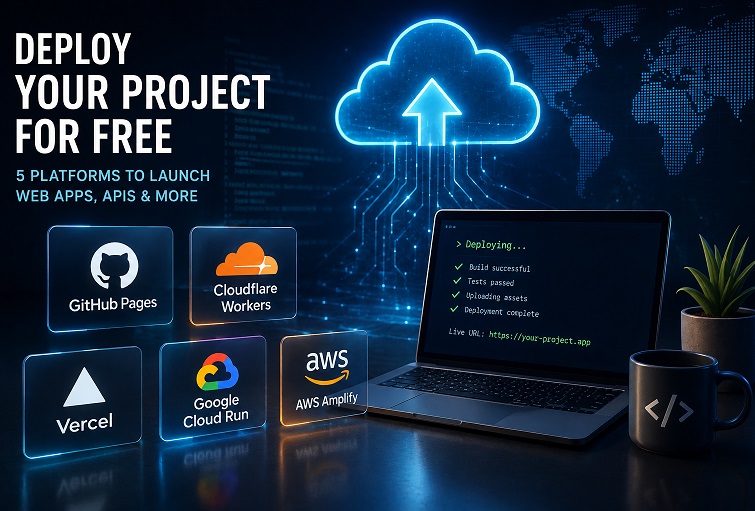
Although free plans come with usage limits, they provide an excellent opportunity to validate ideas before investing in paid infrastructure. Below are five of the most popular services that let developers deploy applications at little or no cost.
1. GitHub Pages: The Easiest Way to Host Static Websites
If your project consists of static files such as HTML, CSS, JavaScript, or a static site generated by frameworks like Jekyll, Hugo, Astro, or Eleventy, GitHub Pages remains one of the simplest deployment options available.
Publishing a website requires little more than pushing your project to a GitHub repository and enabling GitHub Pages in the repository settings. The platform automatically serves your site through GitHub’s global infrastructure and provides a public URL. Custom domains and HTTPS certificates are supported at no additional cost.
GitHub Pages is particularly well suited for:
- Developer portfolios
- Product landing pages
- Technical documentation
- Personal blogs
- Open-source project websites
Because there is no server-side runtime, maintenance is minimal and deployment is almost instantaneous after each update.
2. Cloudflare Workers: Serverless Applications at the Network Edge
Cloudflare Workers offers a different approach to deployment by allowing developers to execute JavaScript or TypeScript directly on Cloudflare’s worldwide edge network.
Instead of running code on a traditional server, Workers execute close to the end user, reducing latency and improving response times. The platform is designed for lightweight APIs, authentication services, request routing, webhooks, and edge computing workloads.
Typical use cases include:
- REST APIs
- Authentication gateways
- Reverse proxies
- URL shorteners
- Server-side rendering
- Edge middleware
The free tier includes a generous daily request allowance, making it suitable for many hobby projects and low-traffic production services.
Cloudflare also provides additional services such as Workers KV, Durable Objects, R2 object storage, D1 SQL databases, and AI inference APIs, allowing developers to build surprisingly capable serverless applications without maintaining infrastructure.
3. Vercel: Optimized for Modern Front-End Development
Vercel has become one of the most popular deployment platforms for modern web applications, especially those built with React, Next.js, Vue, SvelteKit, Nuxt, and similar frameworks.
Its biggest advantage is automation. Once a GitHub, GitLab, or Bitbucket repository is connected, every code push automatically triggers a new deployment. Feature branches receive their own preview URLs, allowing developers and designers to review changes before merging them into production.
Key features include:
- Automatic CI/CD
- Global CDN
- Preview deployments
- Serverless functions
- Edge functions
- Custom domains
- HTTPS by default
The free Hobby plan is intended for personal, educational, and non-commercial projects, making it an excellent option for building portfolios and showcasing side projects.
4. Google Cloud Run: Deploy Containers Without Managing Servers
For developers who package applications as Docker containers, Google Cloud Run offers one of the easiest paths to production.
Instead of managing virtual machines or Kubernetes clusters, developers simply upload a container image. Cloud Run automatically provisions compute resources, handles scaling, distributes traffic, and can even scale down to zero instances when the application is idle. This significantly reduces operating costs for applications with intermittent traffic.
Cloud Run supports virtually any language or framework, including:
- Python
- Node.js
- Go
- Java
- .NET
- Rust
- PHP
Because the service runs standard OCI-compatible containers, migrating existing applications is usually straightforward.
Google provides an ongoing free usage quota, although enabling billing is generally required before deployment.
5. AWS Amplify: Full-Stack Hosting with AWS Integration
AWS Amplify is designed for developers who want to combine front-end deployment with cloud services from Amazon Web Services.
After connecting a source code repository, Amplify automatically builds and deploys the application while integrating with other AWS offerings such as authentication, APIs, databases, storage, and serverless computing.
The platform supports popular frameworks including:
- React
- Next.js
- Vue
- Angular
- Flutter Web
For developers already using the AWS ecosystem, Amplify provides a convenient way to build full-stack applications without manually configuring CI/CD pipelines or hosting infrastructure.
Availability of free resources depends on the AWS Free Tier program and, in some cases, promotional credits provided to new accounts.
How to Choose the Right Platform
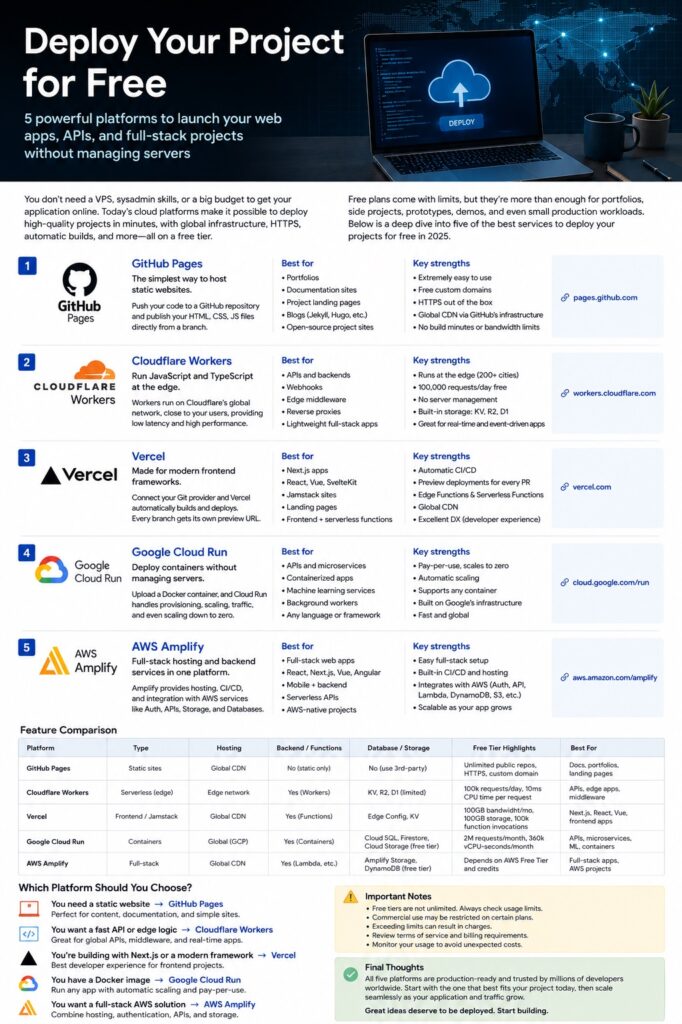
Each service targets a different type of application.
GitHub Pages is ideal for static websites that require no backend logic.
Cloudflare Workers excels at lightweight APIs, edge computing, and globally distributed services.
Vercel is arguably the best choice for modern front-end frameworks and Jamstack applications.
Google Cloud Run is well suited for containerized applications that need automatic scaling and language flexibility.
AWS Amplify is attractive for developers building cloud-native applications within the AWS ecosystem.
Free Doesn’t Mean Unlimited
Before deploying a production workload, carefully review each provider’s pricing model and usage policies. Free plans typically include limits on requests, bandwidth, build minutes, execution time, storage, or compute resources. Exceeding those limits may result in throttling or additional charges.
It is also worth checking whether commercial projects are permitted under the free tier and whether payment information must be added before deployment.
Final Thoughts
Today’s cloud ecosystem makes it possible to launch real applications without purchasing servers or maintaining complex infrastructure. Whether you are building a personal portfolio, validating a startup idea, creating an API, or experimenting with a new framework, these free deployment platforms offer an excellent starting point.
As your application grows, migrating to paid plans is usually straightforward, allowing you to scale resources without changing the overall deployment workflow. For many developers, these services provide everything needed from the first prototype to the first production users.