Agent Harnesses: The Infrastructure Behind Reliable AI Agents
AI AgentThe rapid development of AI agents has changed the way developers think about software built around large language models. A model that generates text is relatively easy to integrate into an application. An agent that can inspect files, execute commands, call APIs, maintain state, recover from errors, and operate for hours is a very different engineering problem.
This difference has given rise to a concept that is becoming increasingly important in agent development: the agent harness.
An agent harness is the software layer surrounding an AI model that gives it tools, memory, execution capabilities, policies, and feedback. The model provides reasoning and generation, while the harness determines what the agent can actually do and how its actions are controlled.
The term is not completely new. Developers have long built wrappers, scaffolding, execution environments, and orchestration layers around language models. However, the term “harness engineering” gained significant attention in 2026 as developers began treating the surrounding software environment as a fundamental part of an agent’s capabilities rather than merely integration code.
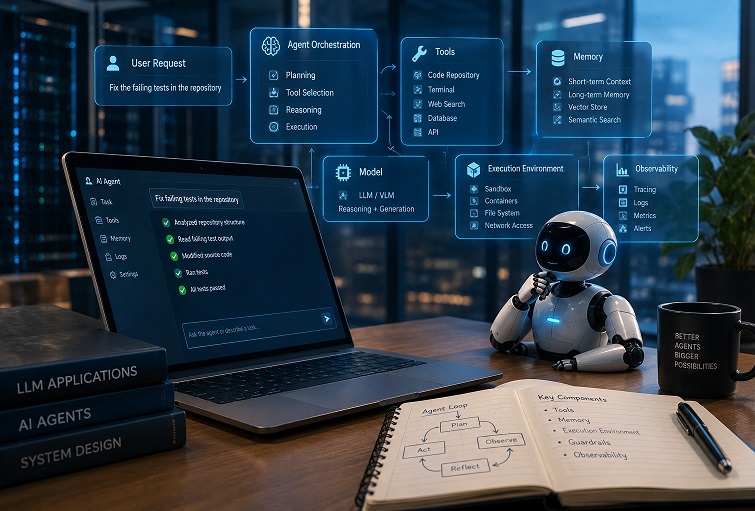
The distinction matters because an agent’s performance is determined not only by the underlying model. Tools, prompts, context management, execution environments, permissions, and recovery mechanisms can have a substantial impact on what the system can accomplish.
What Is an Agent Harness?
There is no universally accepted technical specification for an agent harness. Different vendors and developers use the term somewhat differently. In practical terms, however, an agent harness can be understood as the operational layer between an AI model and the environment in which it works.
A useful abstraction is:
Agent = Model + Harness + Environment
The model is responsible for reasoning, interpreting information, generating plans, and selecting actions. The harness provides the mechanisms required to turn those decisions into controlled operations. The environment contains the actual resources with which the agent interacts, such as files, databases, APIs, websites, terminals, or business applications.
A simple chatbot may require little more than a model API and a conversation history. An autonomous coding agent requires considerably more infrastructure. It must be able to inspect a repository, modify files, execute commands, install dependencies, run tests, interpret failures, make additional changes, and verify the final result.
The language model does not inherently provide these capabilities. The harness does.
This makes the harness an important part of the agent’s effective architecture. Two systems using the same underlying model can behave very differently if they provide different tools, instructions, execution environments, context strategies, or recovery mechanisms.
Why Agents Need More Than a Model
A language model is fundamentally a prediction system. Given a sequence of inputs, it produces a sequence of outputs. Even models with strong reasoning capabilities do not automatically possess persistent memory, unrestricted access to external systems, or reliable mechanisms for executing and verifying their own decisions.
Consider an agent responsible for fixing a failing software test.
A model can examine an error message supplied in the prompt and propose a modification. A properly equipped agent can go much further. It can inspect the repository, locate the relevant implementation, examine configuration files, run the test suite, reproduce the failure, modify the source code, execute the test again, inspect the result, and continue iterating until the problem is resolved.
That iterative process is where the harness becomes essential.
A typical agent loop looks roughly like this:
- Receive a goal.
- Inspect the available context.
- Determine the next action.
- Invoke a tool.
- Receive the tool result.
- Update the working state.
- Decide whether another action is necessary.
- Verify the outcome.
- Stop when the objective has been achieved or escalation is required.
The model may make the decisions, but the harness implements the loop.
This also explains why agent engineering is often less about generating a perfect prompt and more about designing a reliable environment in which imperfect model decisions can be detected and corrected.
The Core Components of an Agent Harness
There is no mandatory checklist, but production-grade harnesses usually combine several recurring components.
System Instructions and Behavioral Policies
The harness normally establishes the rules under which the model operates.
These rules can include system prompts, project-specific instructions, coding conventions, role definitions, security policies, tool usage requirements, and restrictions on particular operations.
For software development agents, a repository may contain an instruction file describing how the project is structured, which commands should be used, what testing requirements apply, and which files should not be modified.
An important trend is progressive disclosure of instructions. Loading the complete documentation for every available tool into the context window is expensive and can make reasoning less effective. A harness can instead expose a compact description of available capabilities and retrieve detailed instructions only when a particular tool becomes relevant.
This turns context management into an active part of the runtime rather than a static prompt construction problem.
Tools and External Actions
Tools are what allow an agent to interact with systems outside the model’s context.
Depending on the application, these may include:
- file and filesystem operations;
- shell and terminal commands;
- web search and browsing;
- database queries;
- REST and GraphQL APIs;
- source control systems;
- cloud infrastructure;
- code execution;
- browser automation;
- document processing;
- communication systems;
- internal enterprise applications.
The harness determines which tools are available and how they can be used.
This distinction is important for security. Giving a model access to a tool does not mean that the model should have unrestricted permission to use it. A production harness may impose restrictions based on the user, task, resource, or type of operation.
For example, an agent might be allowed to read a production database but prohibited from modifying it. It might be able to create files in a sandbox but require explicit human approval before executing a command that affects external infrastructure.
Model Context Protocol
The growing number of external tools has created a need for standardized interfaces between models and applications. Model Context Protocol, or MCP, is one of the most prominent approaches.
Rather than implementing a custom integration for every application, a developer can expose capabilities through an MCP server and allow compatible agent systems to discover and invoke those capabilities.
This is particularly useful for enterprise environments, where an agent may need access to multiple independent systems. A single agent can potentially work with development tools, databases, documentation systems, ticketing platforms, and other services through standardized interfaces.
MCP does not eliminate the need for a harness. It effectively becomes one of the mechanisms through which a harness discovers and manages external capabilities.
Memory and State
Long-running agents need more than conversation history.
There is an important distinction between context and state. Context is the information currently supplied to the model. State is the broader record of what has happened during the task and what should persist afterward.
A harness can maintain state in several forms:
- conversation history;
- temporary working files;
- structured task state;
- summaries of previous interactions;
- databases;
- vector stores;
- logs;
- checkpoints;
- user-specific persistent information.
Context windows also create a practical limitation. A sufficiently long task can generate far more information than the model can efficiently process in a single context.
Modern harnesses therefore use techniques such as summarization, context compaction, selective retrieval, and externalized state. Instead of retaining every intermediate detail, the system can preserve the information that is still relevant to future decisions.
This is one of the most important differences between a simple chatbot and a genuinely long-running agent.
Execution Environments
An agent that needs to perform real work requires an environment in which that work can take place.
For a coding agent, this may be a container containing a source repository, compiler, runtime, package manager, and test suite. For a research agent, it may be a browser and document-processing environment. For a data-analysis system, it may be a Python runtime with access to approved datasets.
Isolation is particularly important when the agent can execute arbitrary code.
Sandboxed environments limit the consequences of incorrect or malicious actions. A disposable container, for example, can be created for a task, populated with the necessary files and dependencies, and destroyed when the task is complete.
The exact isolation mechanism depends on the threat model. Containers, virtual machines, operating system sandboxes, restricted runtimes, and remote execution services all provide different security and performance characteristics.
The harness is responsible for connecting the model to this environment while controlling what the environment can access.
Planning and Orchestration
Some tasks can be completed through a short sequence of tool calls. Others require dozens or hundreds of actions.
A harness can provide explicit planning capabilities to make longer tasks manageable. The agent can divide a high-level objective into smaller steps, record their status, and revisit unfinished work after an interruption.
More sophisticated systems can also delegate subtasks to specialized agents.
For example, a primary agent might divide a software project into research, implementation, testing, and documentation tasks. Separate agents can handle individual areas while the main agent coordinates their results.
Multi-agent systems are not automatically better than single-agent systems. Each additional agent introduces communication overhead, additional failure modes, and more complicated state management. Orchestration should therefore be driven by the structure of the task rather than by the assumption that more agents necessarily produce better results.
Guardrails and Permissions
An autonomous system needs boundaries.
The harness is the natural enforcement point for those boundaries because it controls the interface between the model and external resources.
Typical controls include:
- authentication;
- authorization;
- role-based access control;
- tool-specific permissions;
- human approval;
- input validation;
- output validation;
- rate limits;
- resource quotas;
- network restrictions;
- filesystem restrictions;
- prohibited operations.
It is useful to separate model-level instructions from technical enforcement.
Telling a model not to delete a production database is not equivalent to preventing the database account from having permission to delete data. A robust architecture uses both behavioral instructions and enforceable system-level restrictions.
Human-in-the-loop approval is another important mechanism. High-impact operations can pause the agent and require a human to approve the proposed action before execution.
Observability and Tracing
Long-running agents are difficult to debug without detailed traces.
A conventional application might log a request, response, and error. An agent can generate a much more complex execution history involving dozens of model calls, tool invocations, retries, state transitions, and subagent handoffs.
An agent trace can record:
- model requests and responses;
- tool calls;
- tool outputs;
- execution duration;
- token usage;
- errors;
- retries;
- state transitions;
- agent handoffs;
- approval events;
- resource consumption.
This information is valuable for both debugging and evaluation.
If an agent fails after thirty-seven actions, the important question is not simply that it failed. Developers need to determine where the execution went wrong. Did the model misunderstand the objective? Did a tool return unexpected data? Did the agent lose important context? Was a permission denied? Did an earlier action corrupt the working state?
Without tracing, answering these questions can be extremely difficult.
OpenTelemetry is increasingly relevant here because it provides a vendor-neutral framework for collecting and exporting telemetry. Agent-specific platforms can then build debugging, evaluation, and performance analysis on top of those traces.
Agent Harness vs. Framework vs. Runtime
The terminology surrounding agent infrastructure remains inconsistent. The boundaries between frameworks, runtimes, and harnesses are not fixed, and some products occupy more than one category.
An agent framework generally provides reusable components for building agent applications. It may include model integrations, tool abstractions, prompt handling, memory mechanisms, routing, and agent loops.
An agent runtime is concerned with executing those systems reliably. It can provide state persistence, retries, streaming, scheduling, checkpointing, and recovery from interruptions.
An agent harness usually describes a broader operational environment around the model. It combines some or all of the framework and runtime functionality with tools, instructions, execution environments, permissions, context management, and observability.
The distinction can be understood conceptually rather than as a strict taxonomy.
A framework answers the question: “How do I build this agent?”
A runtime answers: “How do I keep this agent running reliably?”
A harness answers: “What environment does this agent have, what can it do, and how do I make the entire process controllable and repeatable?”
In real products, these layers frequently overlap.
Coding Agents: The Clearest Example
Software development is one of the clearest demonstrations of why an agent harness matters.
A coding model without tools can generate source code. A coding agent can operate on an actual project.
To be useful, it typically needs access to:
- the repository;
- source files;
- Git history;
- a terminal;
- compilers and interpreters;
- package managers;
- test frameworks;
- linters;
- build systems;
- project documentation.
The harness also needs to define how these capabilities are used.
Suppose an agent changes a function and the tests fail. A good harness allows it to inspect the failure, understand the new information, revise the implementation, and run the tests again.
The quality of this loop often matters as much as the raw coding capability of the underlying model.
Features such as clean working directories, version-control integration, automatic checkpoints, isolated execution, context compaction, and structured test feedback can substantially change the practical performance of the same model.
This is why evaluating coding models independently of their execution environment can be misleading.
Research Agents
Research systems have a different set of requirements.
A useful research agent needs more than a language model and a search API. It must keep track of which sources were consulted, distinguish primary sources from secondary material, retain relevant passages, and connect individual findings to the final answer.
The harness can manage:
- web search;
- document retrieval;
- source metadata;
- citation tracking;
- note storage;
- document parsing;
- summarization;
- deduplication;
- evidence verification.
Long documents present another context-management problem. Rather than placing entire reports into the model’s context, the harness can retrieve relevant sections, store intermediate findings, and maintain a compact research state.
The result is closer to a research workflow than to a single prompt.
Data Analysis Agents
Data analysis introduces a different class of risk because the agent may have access to sensitive or operational information.
A typical data agent may require a database connection, SQL execution, Python or another programming environment, schema information, and visualization capabilities.
Before generating a query, the agent needs to know what tables and columns actually exist. Before executing it, the harness may need to determine whether the requested operation is permitted.
Production environments require additional controls. Read-only database credentials, row-level security, query limits, network restrictions, and approval workflows can prevent an otherwise capable model from causing unintended changes.
Here, the harness is as much a security boundary as an AI orchestration layer.
Enterprise Agents
Enterprise deployments combine nearly all of these requirements.
An internal business agent may need to access customer records, documents, calendars, ticketing systems, financial information, and internal applications. At the same time, access must be tied to the identity and permissions of the person using the agent.
A production enterprise harness therefore commonly includes:
- identity and authentication;
- authorization;
- role-based access control;
- audit logging;
- approval workflows;
- data-loss prevention;
- secret management;
- network controls;
- monitoring;
- cost controls;
- persistent state.
The challenge is not simply connecting an LLM to corporate systems. It is making that connection predictable and auditable.
Durable Execution and Failure Recovery
Long-running agents introduce another problem that is easy to underestimate: failures are normal.
Networks fail. APIs time out. Tools return malformed data. Containers terminate. Models produce incorrect actions. External systems become unavailable.
A robust harness should therefore treat failure recovery as a first-class capability.
Checkpointing allows the system to preserve the state of an ongoing task. If execution stops after a successful operation, the agent can resume from that checkpoint rather than repeating everything from the beginning.
Durable execution systems such as Temporal and similar technologies can provide this foundation. They are not necessarily agent harnesses themselves, but they can form an important part of the infrastructure underneath one.
Retries must also be designed carefully. Repeating a read operation may be harmless. Repeating a payment, database mutation, or infrastructure deployment may not be.
Idempotency, transactional boundaries, operation classification, and explicit confirmation become increasingly important as agents gain the ability to affect real systems.
The Security Problem
The same capabilities that make an agent useful also make it dangerous.
An agent with access to a terminal, browser, filesystem, network, and credentials effectively becomes a software operator. A model error can therefore become an operational error.
Several attack classes are particularly relevant.
Prompt injection can cause an agent to treat untrusted content as instructions. For example, a webpage or document could contain text designed to manipulate the agent into revealing information or executing an unintended operation.
Excessive permissions create another problem. If an agent only needs to read customer records, there is little reason to give it unrestricted write access to the customer database.
Credential exposure is equally important. API keys and service credentials should generally remain outside model-controlled text wherever possible. The harness should provide controlled access to secrets without unnecessarily exposing their values to the model.
A secure agent architecture therefore assumes that the model can make mistakes and that external content can be hostile.
Security should not depend entirely on the model following instructions correctly.
The Cost of Context and Tool Use
Agent systems also introduce economic and performance constraints.
A long task may involve dozens of model calls and hundreds of tool operations. Every additional observation increases the amount of information that needs to be processed.
A poorly designed agent can therefore become expensive without becoming more capable.
Harness engineering increasingly involves deciding what the model actually needs to see. Intermediate results can be summarized, irrelevant tool output can be discarded, large files can remain outside the context window, and only the relevant portions can be retrieved when required.
This is not merely an optimization for cost. Excessive context can reduce reasoning quality by burying important information under irrelevant material.
Efficient context management is consequently becoming one of the central design problems in autonomous systems.
Evaluating an Agent Means Evaluating the Whole System
Traditional model benchmarks usually attempt to isolate the model. Agent evaluation is more complicated.
A model can perform well on a benchmark while producing a mediocre agent if its tools are poorly designed, its context is badly managed, or its execution environment is unreliable.
Conversely, a strong harness can significantly improve the practical usefulness of a model by giving it better feedback and recovery mechanisms.
For this reason, agent evaluations increasingly need to measure complete task execution rather than individual responses.
Relevant metrics include:
- task completion rate;
- number of successful tool calls;
- recovery rate after errors;
- execution time;
- token consumption;
- infrastructure cost;
- number of human interventions;
- reliability across repeated runs;
- security policy violations.
A system that solves 95 percent of tasks but requires expensive human intervention on the remaining 5 percent may have very different economics from one that solves 90 percent autonomously.
When Do You Actually Need an Agent Harness?
Not every AI application needs one.
If an application sends a question to an LLM and displays the answer, a full agent harness may be unnecessary. A simple API integration is often the better engineering choice.
The same applies to deterministic workflows. If every operation is known in advance and the system only needs to execute a fixed sequence of steps, conventional application logic may be more reliable than autonomous planning.
A harness becomes useful when the system needs to make decisions during execution.
Typical indicators include:
- the system must use external tools;
- actions depend on previous results;
- the task can take a long time;
- the agent must maintain state;
- code must be executed;
- the agent must interact with multiple systems;
- failures must be recovered automatically;
- several agents need to coordinate;
- sensitive operations require approval;
- execution needs to be audited.
The key question is not whether an application contains an AI model. It is whether the model needs to operate as an actor rather than simply generate an answer.
Common Mistakes in Harness Design
One common mistake is building too much infrastructure too early.
A simple text-generation workflow does not necessarily need containers, multi-agent orchestration, durable execution, complex tracing, and multiple layers of memory. Every additional component increases operational complexity.
The opposite mistake is more dangerous: deploying an agent directly against production systems without considering failure recovery, permissions, or observability.
Another common problem is treating prompts as the primary security mechanism. System instructions are useful, but they cannot replace technical access controls.
Poorly designed tools are also a frequent source of failure. An agent is only as effective as the interfaces through which it interacts with the environment. Tools should provide clear inputs, predictable outputs, meaningful errors, and appropriate permission boundaries.
Finally, developers often optimize for successful demonstrations rather than repeated reliability. A system that completes one carefully selected task is not necessarily ready to operate autonomously in production.
The Direction of Agent Infrastructure
The agent harness is likely to become less visible as agent platforms mature.
Today, developers often have to assemble model APIs, tool interfaces, sandboxes, context management, memory, tracing, and execution infrastructure themselves. Over time, more of these capabilities are likely to become integrated into development platforms and model ecosystems.
At the same time, the underlying principles are unlikely to disappear.
Models will still need access to tools. Long-running tasks will still require state. External actions will still require permissions. Failures will still occur. Developers will still need to understand what an autonomous system did and why it did it.
The abstraction may eventually change. What is currently called a harness could become part of a broader agent runtime or operating environment. The terminology is less important than the architectural role.
The central idea is straightforward: an AI agent is not just a model.
A model supplies reasoning and generation. The surrounding system determines how that reasoning interacts with reality.
As AI agents move from conversational interfaces toward software development, research, data analysis, business operations, and physical systems, that surrounding infrastructure becomes increasingly important. The quality of the harness can determine whether an agent remains an impressive demonstration or becomes a reliable piece of software.