Securing Industrial Robots Against Modern Cyber Threats
Misc, Robotics RobotIndustrial robots have transformed manufacturing by taking over repetitive, hazardous, and highly precise operations. Robotic systems now weld vehicle bodies, assemble electronic components, move materials, inspect finished products, and operate in environments that would be dangerous or impractical for human workers.
For much of the history of industrial automation, these systems were relatively isolated. A robot controller was connected to local equipment, a programmable logic controller, and perhaps a plant-wide control network. Cybersecurity was therefore often treated as an IT concern rather than an engineering requirement for the production floor.
That model is changing. Modern robots are increasingly connected to industrial Ethernet networks, manufacturing execution systems, remote maintenance platforms, cloud services, supplier portals, and enterprise infrastructure. Robot manufacturers also increasingly use connected sensors and controllers to collect operational data, predict component failures, optimize maintenance, and provide remote technical support.
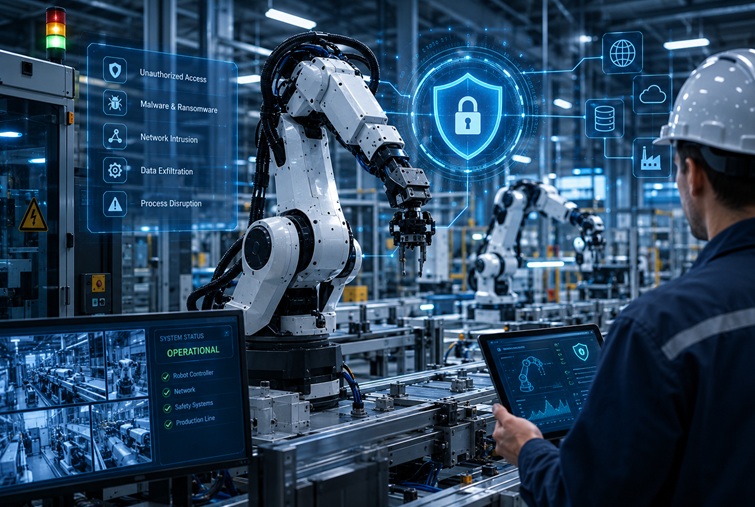
Connectivity creates substantial operational benefits, but it also expands the attack surface. A compromised robot is no longer simply a machine that stops working. Depending on its role and architecture, it can become an entry point into an operational technology environment, a source of sensitive production data, or even a direct safety risk.
Cybersecurity for industrial robots therefore has to address two objectives simultaneously: protecting information and maintaining the physical safety and continuity of the manufacturing process.
Why Connected Robots Create a New Security Challenge
The security model of traditional industrial automation was largely based on isolation. Equipment on the factory floor was separated from corporate networks and the public internet, and access to controllers was physically restricted.
Modern industrial environments are considerably more interconnected.
A robot may exchange information with:
- PLCs and other controllers
- Human-machine interfaces
- Manufacturing execution systems
- Industrial databases
- Quality-control systems
- Engineering workstations
- Maintenance platforms
- Cloud-based analytics services
- Remote support systems
- Enterprise identity infrastructure
- Supplier and equipment-management platforms
A robotic arm may also contain considerably more computing and networking functionality than its predecessors. Modern controllers can run operating systems, expose web interfaces, communicate through standard network protocols, store configuration files, and provide APIs for integration with other systems.
This connectivity means that an attacker does not necessarily need direct physical access to a robot. A vulnerable workstation, poorly protected remote-access service, compromised supplier account, or incorrectly configured network connection may provide an indirect route into the production environment.
The Purdue Enterprise Reference Architecture remains useful for understanding industrial network segmentation, although modern environments do not always follow the model rigidly. The important security principle is that communication between enterprise IT, industrial control systems, and field-level equipment should be deliberately controlled rather than assumed to be trustworthy.
The Industrial Robot as a Cyber-Physical System
Industrial robots are fundamentally different from ordinary IT endpoints because software commands have physical consequences.
A compromised office computer may result in stolen files or unavailable applications. A compromised robot controller can potentially cause a motor to move, change a process parameter, stop a production cell, or interfere with the coordination between machines.
This makes industrial robot security a cyber-physical problem.
A typical robotic cell contains several layers:
- Mechanical components, including joints, tooling, conveyors, fixtures, and safety equipment.
- Sensors, which provide information about position, force, temperature, vision, or other physical conditions.
- Actuators and drives, which convert control commands into physical movement.
- Robot controllers, which execute motion programs and coordinate the robot.
- Industrial networks, which connect the robot to PLCs, HMIs, sensors, and other equipment.
- Supervisory and manufacturing systems, which manage production information and processes.
- Remote and enterprise services, which may provide monitoring, maintenance, analytics, or centralized management.
An attack does not have to compromise every layer. Penetrating one sufficiently privileged component can sometimes provide access to other parts of the system.
Major Cybersecurity Threats to Industrial Robots
Unauthorized Control
The most obvious threat is unauthorized manipulation of robot behavior.
If an attacker obtains sufficient privileges on a robot controller, engineering workstation, or associated control system, they may be able to modify programs or operating parameters. Even relatively small changes can produce defective products.
For example, modifying a welding trajectory by a few millimeters may not immediately cause the robot to stop. Instead, it could result in a gradual deterioration of product quality that is difficult to detect.
More severe attacks could change movement parameters, disable selected functions, alter work sequences, or interfere with coordination between multiple machines.
The consequences depend heavily on the application. A compromised packaging robot and a robot operating near human workers present very different safety profiles.
Ransomware and Production Lockout
Ransomware is another major concern for connected manufacturing environments.
An attacker does not necessarily need to encrypt the robot’s internal software directly. Encrypting or disabling systems that the robot depends on may be enough to stop production.
Potential targets include:
- Engineering workstations
- HMI computers
- Production databases
- MES infrastructure
- Robot configuration repositories
- Authentication servers
- File servers
- Backup systems
This distinction is important. Industrial ransomware attacks frequently cause disruption by compromising the surrounding ecosystem rather than directly attacking the industrial controller.
A production line can remain technically intact while becoming unusable because operators cannot access the systems required to configure, monitor, or restart it.
Manipulation of Production Processes
Attackers may attempt to modify the behavior of an industrial process without immediately stopping it.
This type of attack can be particularly difficult to identify. A robot may continue operating normally while performing subtly incorrect actions.
Possible examples include:
- Changing tool coordinates
- Modifying movement speeds
- Altering process timing
- Changing inspection thresholds
- Manipulating sensor values
- Modifying recipes or production parameters
- Changing communication settings
The objective may be sabotage, financial fraud, product-quality manipulation, or preparation for a later attack.
Physical Damage and Safety Incidents
The defining characteristic of industrial robot cybersecurity is the possibility of physical consequences.
Industrial robots can move heavy payloads at high speed and with considerable force. They are normally protected by safety-rated systems, including emergency stops, interlocks, safety scanners, light curtains, and safety controllers.
Cybersecurity controls should complement these mechanisms rather than replace them.
An attacker who compromises a non-safety-rated control layer should not automatically be able to defeat independent safety functions. This is one reason why safety architecture and cybersecurity architecture need to be considered together.
A successful cyberattack could potentially damage tooling, fixtures, conveyors, products, or the robot itself. In poorly designed environments, interference with control systems could also create conditions that endanger personnel.
Theft of Industrial Data
Robots can provide access to information that is commercially valuable even when the robot itself is not the primary target.
Production systems may contain:
- Robot programs
- CAD-derived manufacturing information
- Production recipes
- Calibration data
- Maintenance records
- Process parameters
- Quality-control results
- Manufacturing schedules
- Equipment configurations
- Proprietary process information
An attacker could use this information for industrial espionage, competitive intelligence, or preparation for a subsequent attack.
Compromise Through Remote Maintenance
Remote maintenance has become increasingly common because it reduces downtime and allows equipment manufacturers to diagnose problems without sending engineers to a plant.
However, remote access is also a significant attack surface.
Risks include:
- Permanently enabled remote-access accounts
- Shared credentials
- Weak authentication
- Excessive privileges
- Unrestricted vendor VPN access
- Outdated remote-access software
- Poorly monitored sessions
A remote connection should therefore be treated as a privileged pathway into the industrial environment rather than as a convenience feature.
Supply Chain Attacks
Industrial robots rarely operate in isolation. A modern robotic cell may depend on software, firmware, libraries, engineering tools, gateways, cloud services, and components supplied by numerous organizations.
An attacker may therefore target a supplier instead of the factory itself.
This is particularly important for smaller equipment manufacturers and system integrators that may have fewer cybersecurity resources than large industrial enterprises. A compromised supplier account or software update mechanism can potentially provide access to multiple customer environments.
Supply chain security must consequently extend beyond the robot manufacturer’s own infrastructure.
Why Traditional IT Security Is Not Enough
Industrial environments have requirements that differ significantly from conventional enterprise IT.
In an office network, installing a security update immediately may be considered good practice. On a production line, restarting a controller or changing its firmware can require extensive testing and scheduled downtime.
Similarly, aggressively scanning industrial equipment can create operational risks if a device is sensitive to unexpected network traffic.
Industrial cybersecurity therefore tends to prioritize several objectives simultaneously:
Safety: The system must remain within defined physical operating limits.
Availability: Production equipment may need to operate continuously for long periods.
Integrity: Commands, programs, configurations, and process data must not be modified without authorization.
Confidentiality: Sensitive production and engineering information must be protected.
In traditional IT security, confidentiality is often emphasized first. In operational technology, availability and safety can be equally or more important.
Network Segmentation and Zero Trust Principles
One of the most effective ways to reduce the impact of a compromised robot is to limit what it can communicate with.
Robots should not automatically have unrestricted access to corporate networks simply because they require network connectivity.
Segmentation can divide the environment into security zones based on function and risk. For example, a production cell may communicate with a local industrial control network, while a controlled industrial DMZ provides limited communication with enterprise services.
Firewalls and industrial security gateways can then restrict traffic between zones.
The objective is not simply to prevent internet access. It is to ensure that every connection has a defined purpose.
Zero trust principles can strengthen this architecture by eliminating implicit trust based solely on network location. A device being inside the factory network should not, by itself, grant it access to every other system.
Authentication and Access Control
Industrial robot controllers should have individual user accounts whenever technically possible.
Shared administrator credentials create a fundamental accountability problem. If ten engineers use the same account, it becomes difficult to determine who changed a program or configuration.
A more robust access model separates privileges according to operational responsibilities.
For example:
- Operators can execute approved programs.
- Maintenance personnel can perform defined maintenance functions.
- Engineers can modify robot programs.
- Administrators can change system-level configuration.
- External vendors receive temporary access only when required.
Multi-factor authentication should be used for remote and administrative access wherever the environment supports it.
The principle of least privilege is particularly important. An account that only needs to inspect robot status should not have permission to upload a new motion program.
Protecting Robot Controllers and Engineering Workstations
The robot controller is an obvious security target, but engineering workstations can be equally important.
Programming and configuration software frequently runs on PCs connected directly to industrial equipment. If such a workstation is compromised, an attacker may gain the same privileges as a legitimate engineer.
Security measures should therefore include:
- Endpoint protection appropriate for OT environments
- Application allowlisting where practical
- Restricted administrator privileges
- Controlled use of USB devices
- Network segmentation
- Secure configuration baselines
- Regular vulnerability assessment
- Removal of unnecessary services
- Secure backup of robot programs and configurations
Legacy equipment requires special attention because it may use unsupported operating systems or protocols that cannot easily be upgraded.
Patch Management in Industrial Environments
Software vulnerabilities are inevitable, but patching industrial equipment is not as straightforward as updating a laptop.
Before applying a firmware or software update, organizations should establish:
- Which assets are affected.
- Which vulnerabilities apply to those assets.
- Whether the vendor has issued a validated patch.
- Whether the patch has been tested with the specific robot and controller configuration.
- Whether production downtime is required.
- How the system can be restored if the update fails.
A formal asset inventory is therefore essential.
Organizations should know the manufacturer, model, firmware version, operating system, network location, software dependencies, and responsible owner for each critical robotic asset.
Where immediate patching is impossible, compensating controls such as network isolation, access restrictions, application controls, and additional monitoring can reduce exposure.
Secure Communication
Industrial robots often exchange information using protocols designed primarily for reliability and interoperability rather than modern security.
Where possible, sensitive communications should use authentication and encryption mechanisms appropriate to the protocol and environment.
However, simply encrypting everything is not necessarily the answer. Industrial systems often depend on deterministic communication and legacy equipment. Introducing new security mechanisms without testing can create compatibility or availability problems.
The correct approach is risk-based. Critical communication paths should be identified, their trust relationships documented, and appropriate protections applied without compromising real-time operational requirements.
Monitoring and Anomaly Detection
Prevention alone is insufficient.
Industrial environments need the ability to detect unusual behavior, including:
- Unexpected connections to robot controllers
- Changes to robot programs
- Configuration modifications
- Unusual login activity
- Unexpected firmware changes
- Abnormal network traffic
- Communication with previously unknown external systems
- Changes in robot operating patterns
Monitoring is particularly valuable because sophisticated attacks may not cause an immediate outage.
A robot that suddenly begins communicating with an external server at unusual times, or whose program changes outside the normal maintenance window, may provide an important indication of compromise.
OT monitoring systems can therefore complement conventional endpoint and network security tools by establishing a baseline of normal industrial behavior.
Backups and Recovery
A secure backup strategy is one of the most important defenses against destructive attacks.
Organizations should maintain recoverable copies of:
- Robot programs
- Controller configurations
- Calibration parameters
- PLC programs
- HMI configurations
- Safety-system configurations
- Network configurations
- Engineering documentation
Backups should not simply exist. They should be tested.
An organization that discovers during a ransomware incident that its backups are incomplete, corrupted, or reachable by the same compromised accounts has little practical protection.
For critical systems, offline or otherwise isolated backup copies can significantly improve resilience.
Incident Response for Robotic Systems
An incident involving an industrial robot cannot always be handled in the same way as a compromised office PC.
The first priority may be physical safety rather than forensic preservation.
An effective incident-response plan should define:
- Who has authority to stop production
- How affected robotic cells are placed into a safe state
- How compromised network connections are isolated
- How robot programs are verified
- How backups are restored
- How safety systems are checked
- How vendors and system integrators are contacted
- How evidence is preserved after the equipment is made safe
The organization should also understand what happens when connectivity is removed. Some robots may continue operating normally, while others depend on network services for authentication, production scheduling, or data exchange.
These dependencies should be documented before an incident occurs.
Security by Design
The most effective time to address robotic cybersecurity is before deployment.
When purchasing or designing a robotic cell, organizations should evaluate security requirements alongside performance, cost, and mechanical specifications.
Questions worth asking include:
- Does the controller support individual user accounts?
- Is multi-factor authentication available for remote access?
- How are firmware updates authenticated?
- Can unnecessary network services be disabled?
- Does the system provide audit logs?
- Can robot-program changes be tracked?
- What remote-access mechanisms are supported?
- How is vendor access controlled?
- What operating systems and third-party components are used?
- How long will security updates be provided?
- Can the equipment operate safely if network connectivity is lost?
Security should also be included in acceptance testing. A robotic system should not be considered complete simply because it performs its mechanical task correctly.
The Role of Safety and Cybersecurity Engineering
Cybersecurity and functional safety have historically been treated as separate engineering disciplines. Connected robotics increasingly makes that separation problematic.
A safety system is designed to prevent hazardous physical conditions. A cybersecurity system is designed to prevent unauthorized manipulation. An attack can potentially cross the boundary between the two.
For example, an attacker might not need to disable an emergency stop directly. Manipulating another part of the system could create a condition in which the safety mechanism becomes relevant.
The appropriate architecture therefore uses independent safety functions, strict access control, segmentation, monitoring, and defense in depth.
No single security mechanism should be expected to protect the entire robotic cell.
A Practical Security Architecture
A mature industrial robot security strategy can be organized into several layers.
Asset layer: Maintain an accurate inventory of robots, controllers, drives, sensors, workstations, software, and network connections.
Network layer: Segment production equipment and restrict communication between security zones.
Identity layer: Use individual accounts, least-privilege access, strong authentication, and controlled vendor access.
Endpoint layer: Harden controllers and engineering workstations while minimizing unnecessary software and services.
Application layer: Protect robot programs, configurations, firmware, and engineering tools against unauthorized modification.
Monitoring layer: Collect logs and detect anomalous network and operational behavior.
Recovery layer: Maintain tested backups and documented procedures for restoring critical systems.
Safety layer: Ensure that cybersecurity failures cannot easily bypass independent safety functions.
This layered approach is more resilient than relying on a single firewall, antivirus product, or authentication mechanism.
The Security Challenge Will Grow With Industrial Connectivity
The cybersecurity challenge facing industrial robotics is unlikely to disappear as automation advances. On the contrary, it will become more complex as robots acquire more sensors, computing power, artificial intelligence, cloud connectivity, and autonomous decision-making capabilities.
Future robotic systems will increasingly exchange information with digital twins, manufacturing platforms, predictive-maintenance systems, AI services, and other autonomous machines. Every additional connection creates another dependency that must be secured.
At the same time, greater autonomy may increase the consequences of compromised software. A robot capable of adapting its behavior dynamically could potentially be more difficult to secure than a machine executing a fixed sequence of commands.
The answer is not to disconnect industrial robots from modern networks. Connectivity is one of the reasons robotic automation has become so valuable. The objective is to design that connectivity deliberately.
Industrial robots should be treated as critical cyber-physical assets rather than ordinary network devices. Security needs to begin with the architecture of the production cell and continue through authentication, segmentation, software maintenance, monitoring, incident response, and recovery.
As factories become increasingly connected, the boundary between operational technology and information technology will continue to disappear. Industrial robot security will consequently become an integral part of manufacturing engineering, not an additional security feature added after deployment.