Choosing the Right LLM API Provider for Modern AI Applications
AI API, LLMIntroduction
The rapid adoption of large language models has fundamentally changed how software is built. Tasks that once required specialized machine learning teams can now be implemented through a simple API call. From intelligent search and customer support automation to coding assistants and autonomous agents, language models have become a core building block of modern applications.
For most organizations, running frontier-scale models internally is impractical. Training and serving advanced language models requires massive computational resources, specialized hardware, and significant operational expertise. As a result, most companies access AI capabilities through external API providers that handle infrastructure, model deployment, scaling, updates, and optimization.
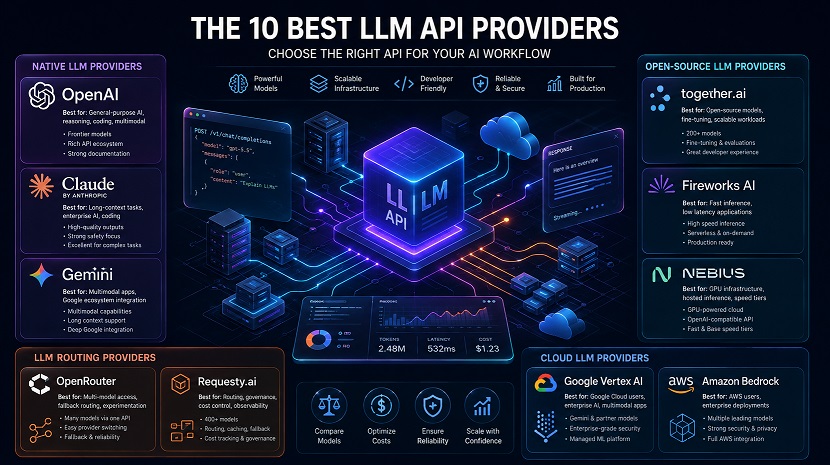
The growing number of providers has created a diverse ecosystem. Some companies develop and host their own proprietary models, while others specialize in open-source inference, cloud deployment, model routing, or enterprise AI platforms.
Selecting the right provider has become a strategic decision that affects cost, performance, scalability, compliance, and long-term flexibility.
Understanding the LLM API Landscape
Not all language model providers serve the same purpose.
The market can generally be divided into four categories:
- Proprietary model providers
- Open-model inference platforms
- Model routing services
- Enterprise cloud AI platforms
Each category addresses different requirements and deployment scenarios.
Organizations focused on raw model quality often prioritize proprietary providers. Teams seeking flexibility and lower costs may prefer open-model platforms. Enterprises frequently choose cloud-native solutions that integrate with existing infrastructure and governance frameworks.
Understanding these differences is the first step toward making an informed decision.
Proprietary Model Providers
Proprietary providers develop and operate their own foundation models.
These platforms typically offer the highest-performing models in areas such as reasoning, coding, multimodal processing, instruction following, and natural language generation.
Because the entire stack is controlled by a single organization, users generally benefit from:
- Consistent model behavior
- Extensive documentation
- Frequent model updates
- Managed scalability
- Advanced safety mechanisms
- Enterprise support options
For production systems where quality is the primary concern, proprietary models often remain the benchmark.
Advantages
The biggest strength of proprietary providers is model capability.
Many offer advanced reasoning systems, multimodal processing, large context windows, structured outputs, real-time streaming, function calling, and agent-oriented workflows.
Development teams can usually integrate these features without worrying about infrastructure management.
Limitations
The primary drawback is cost.
Applications processing large volumes of requests can generate substantial API expenses, particularly when using advanced reasoning models or large context windows.
Organizations also sacrifice a degree of control. Model architecture, training methodology, update schedules, and deployment locations are generally determined by the provider.
This can create challenges for highly regulated industries or organizations with strict data sovereignty requirements.
Open-Model Inference Platforms
The growth of open-weight language models has created a second major category of providers.
Rather than building their own foundation models, these platforms host popular open models and expose them through managed APIs.
This approach allows developers to access powerful language models without purchasing GPUs or maintaining inference infrastructure.
Open-model platforms have become increasingly attractive due to rapid improvements in model quality and the growing availability of specialized models optimized for coding, reasoning, multilingual applications, retrieval-augmented generation, and domain-specific workloads.
Advantages
Flexibility is the primary benefit.
Developers can evaluate multiple models, compare performance, and switch architectures without major engineering effort.
Open-model ecosystems also tend to evolve quickly, making it easier to experiment with emerging technologies.
Cost efficiency is another important factor. In many scenarios, open-model inference can be significantly less expensive than premium proprietary models.
Limitations
Model quality varies considerably.
Unlike proprietary providers that focus on a small number of carefully optimized models, open-model platforms may host hundreds of alternatives with different strengths and weaknesses.
Organizations must often invest additional effort in benchmarking, evaluation, and performance testing before selecting a model for production deployment.
Reliability can also differ between providers depending on infrastructure quality and resource allocation policies.
Model Routing Platforms
As the number of available models continues to grow, many organizations no longer rely on a single provider.
Model routing platforms address this challenge by offering a unified API that connects to multiple model vendors.
Instead of integrating separately with several providers, developers can access numerous models through a single interface.
This architecture introduces an additional abstraction layer between applications and model vendors.
Advantages
Routing platforms simplify experimentation.
Development teams can compare models, evaluate performance differences, implement fallback mechanisms, and optimize costs without modifying application logic.
They also reduce vendor lock-in.
Organizations can switch between providers as pricing, performance, or business requirements change.
For teams operating large AI systems, routing platforms can improve resilience by automatically redirecting traffic during outages or service degradation.
Limitations
The additional layer introduces complexity.
Latency may increase slightly, debugging can become more challenging, and organizations must trust another intermediary with their data and traffic.
Careful governance is required to ensure routing policies align with security, compliance, and performance objectives.
Enterprise Cloud AI Platforms
Major cloud providers have increasingly positioned themselves as AI platforms rather than simple infrastructure vendors.
These environments combine model access, deployment tools, security controls, monitoring, governance frameworks, and enterprise integrations within a unified ecosystem.
Rather than functioning as standalone model providers, cloud AI platforms serve as complete operational environments for building, deploying, and managing AI systems.
Advantages
The strongest benefit is integration.
Organizations already using a particular cloud platform can leverage existing identity management, networking, monitoring, logging, compliance, and security services.
This simplifies governance and reduces operational complexity.
Cloud AI platforms are particularly attractive for enterprises that require strict access controls, audit trails, regional deployment options, and centralized infrastructure management.
Limitations
These environments are often more complex than direct API providers.
Teams may need expertise in cloud architecture, permissions management, networking, billing structures, and deployment workflows.
For smaller organizations or early-stage projects, this additional complexity may outweigh the benefits.
Key Factors When Evaluating Providers
The best provider depends heavily on the specific application being built.
Several criteria deserve careful consideration.
Model Quality
Not all models perform equally.
Some excel at software development and technical reasoning, while others are optimized for conversational interactions, content generation, multilingual communication, or multimodal processing.
Benchmark results can provide useful insights, but real-world testing remains essential.
Latency and Performance
Response speed directly affects user experience.
Interactive applications such as chat systems, virtual assistants, and coding tools often require low-latency inference.
Background automation systems may prioritize throughput and cost efficiency instead.
Understanding workload requirements helps determine the appropriate balance.
Context Window Size
Many modern applications process large documents, knowledge bases, legal contracts, research papers, or software repositories.
Large context windows can significantly improve performance in these scenarios.
However, larger contexts often increase computational costs.
Cost Structure
Pricing models vary widely.
Organizations should evaluate:
- Input token costs
- Output token costs
- Reasoning model pricing
- Fine-tuning expenses
- Embedding costs
- Image and multimodal processing fees
A provider that appears inexpensive during development may become costly at production scale.
Reliability and Availability
Mission-critical applications require consistent service availability.
Key considerations include:
- Service-level agreements
- Regional redundancy
- Rate limits
- Failover capabilities
- Historical uptime
Reliability often becomes more important than marginal differences in benchmark performance.
Security and Compliance
For enterprise deployments, governance requirements frequently influence provider selection.
Organizations should evaluate:
- Data retention policies
- Encryption standards
- Regulatory certifications
- Geographic deployment options
- Audit capabilities
- Access controls
Security requirements may eliminate otherwise attractive options.
Which Type of Provider Is Right for You?
There is no universally correct choice.
Different organizations have different priorities.
Startups and independent developers often prioritize flexibility, speed, and cost efficiency. Open-model platforms can provide excellent value in these environments.
Product teams building customer-facing applications may benefit from proprietary providers whose models deliver the highest quality outputs with minimal operational overhead.
Organizations managing large-scale AI deployments frequently adopt routing platforms to improve resilience, reduce vendor dependence, and optimize costs.
Large enterprises typically prefer cloud-native solutions that integrate with existing governance and infrastructure frameworks.
In practice, many mature AI deployments combine multiple approaches. A single organization may use proprietary models for premium customer experiences, open models for internal automation, and cloud platforms for regulated workloads.
The Future of LLM Infrastructure
The language model market continues to evolve rapidly.
Model quality is improving across both proprietary and open ecosystems, while infrastructure providers compete on performance, cost, and developer experience.
At the same time, organizations are increasingly adopting multi-model strategies rather than committing to a single vendor.
As AI systems become more integrated into business operations, flexibility and interoperability will likely become as important as raw model capability.
The most successful AI architectures will not necessarily rely on one provider. Instead, they will combine models, platforms, and infrastructure according to the requirements of each workload.
Conclusion
Selecting an LLM API provider is no longer a purely technical decision. It influences development velocity, operational costs, scalability, security, and long-term strategic flexibility.
Proprietary providers continue to lead in model capability and ease of adoption. Open-model platforms offer greater flexibility and cost control. Routing services simplify multi-provider strategies, while enterprise cloud platforms provide governance and operational consistency.
The optimal choice depends on the balance between performance, cost, control, and organizational requirements. Teams that evaluate providers through the lens of their specific workloads, rather than benchmark rankings alone, are far more likely to build sustainable and effective AI systems.