
SafeTensors Explained: Secure and Efficient Model Storage for Modern Machine Learning
AI SafeTensorsAs machine learning models grow larger and AI development becomes increasingly collaborative, the way models are stored and distributed has become a security concern. Modern AI projects routinely exchange checkpoints through public repositories, cloud storage, and internal artifact registries. In many cases, developers download and execute pretrained models created by people they have never met.
For years, this workflow relied heavily on Python serialization formats such as Pickle, which were originally designed for flexibility rather than security. While these formats made it easy to save and restore complex Python objects, they also introduced an often-overlooked risk: loading a model could execute arbitrary code.
SafeTensors was created to eliminate this problem. Instead of treating a machine learning checkpoint as a collection of executable Python objects, it treats it as structured numerical data. The result is a serialization format that is safer, faster, and better suited for modern AI infrastructure.
Why Model Serialization Matters
Machine learning models are essentially collections of parameters. Neural networks may contain millions or even trillions of numerical values representing learned relationships between inputs and outputs.
During training, these parameters must be saved periodically as checkpoints. Checkpoints serve several purposes:
- Resuming interrupted training
- Sharing pretrained models
- Fine-tuning existing architectures
- Deploying models into production
- Creating backups for disaster recovery
An effective serialization format should preserve model weights accurately while allowing efficient loading and compatibility across different environments.
Historically, flexibility was prioritized over security. As AI ecosystems expanded, this trade-off became increasingly problematic.
The Security Challenge with Traditional Checkpoints
Python’s Pickle system was never designed specifically for machine learning. Its purpose is to serialize almost any Python object, including custom classes and complex application states.
When a Pickle file is loaded, Python reconstructs objects by executing instructions embedded in the file itself. This behavior is convenient for application developers but potentially dangerous for machine learning workflows.
A malicious checkpoint could:
- Execute arbitrary system commands
- Download additional malware
- Steal environment variables
- Access API credentials
- Modify local files
- Install persistence mechanisms
The issue is particularly relevant today because AI developers frequently download models from public repositories.
Unlike conventional software packages, pretrained models often receive less security scrutiny despite being integrated directly into development environments.
Security researchers have repeatedly demonstrated that malicious checkpoints can compromise systems simply through the loading process.
The underlying problem is straightforward: a file intended to contain numerical weights should not require executable instructions.
What Is SafeTensors?
SafeTensors is a serialization format designed specifically for machine learning tensor storage.
Instead of attempting to serialize arbitrary objects, it stores only:
- Tensor names
- Data types
- Tensor dimensions
- Byte locations
- Raw numerical values
There is no embedded Python code, reconstruction logic, or executable payload.
This design dramatically reduces the attack surface associated with model sharing while maintaining compatibility with common machine learning frameworks.
Originally developed for the Hugging Face ecosystem, SafeTensors has evolved into a broader industry standard supported by numerous frameworks and tooling ecosystems.
Internal File Structure
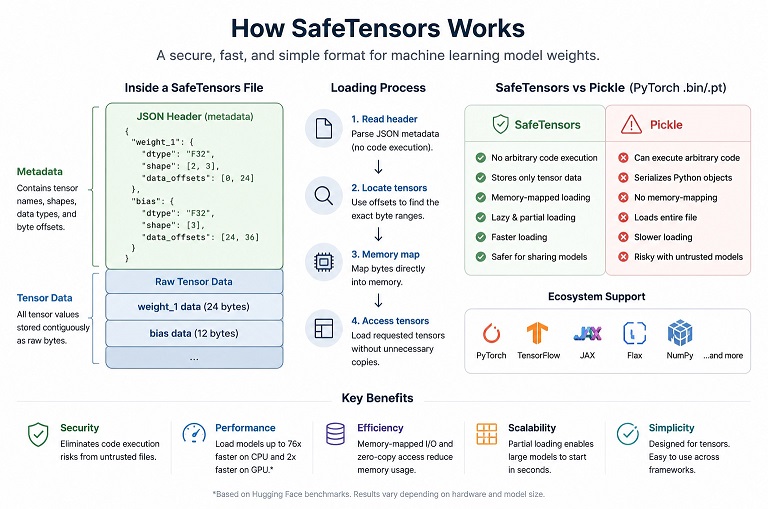
A SafeTensors file consists of two primary sections.
Metadata Header
The file begins with a JSON header containing metadata for every tensor.
Typical information includes:
- Tensor identifier
- Shape
- Data type
- Byte offset
- Data length
This header functions as an index that tells the loader exactly where each tensor resides within the file.
Raw Tensor Data
Following the header is a contiguous block of binary tensor data.
Since tensors are stored sequentially without embedded execution logic, loaders can access them directly without reconstructing Python objects.
This simple layout contributes both to security and performance.
Why SafeTensors Is Faster
Security was the original motivation behind SafeTensors, but performance improvements quickly became another major advantage.
Traditional checkpoint loading often involves several expensive operations:
- Parsing Python objects
- Reconstructing class hierarchies
- Allocating intermediate memory
- Copying data multiple times
SafeTensors avoids much of this overhead.
Memory Mapping
Operating systems can map tensor data directly into memory without fully copying the file.
This approach reduces:
- Startup latency
- Memory consumption
- CPU utilization
Large models benefit particularly from this optimization.
Zero-Copy Access
Because tensor locations are explicitly defined in the metadata, frameworks can access required data directly instead of rebuilding complex object structures.
Partial Loading
Developers can retrieve individual tensors without loading an entire checkpoint.
For large language models distributed across multiple accelerators, this capability significantly reduces initialization time.
Lazy Loading in Large AI Systems
Modern foundation models rarely run on a single GPU.
A distributed deployment may partition layers across multiple devices using:
- Tensor parallelism
- Pipeline parallelism
- Data parallelism
Traditional checkpoint formats often require loading the complete model before redistributing parameters across hardware.
SafeTensors allows systems to load only the required tensor shards.
This capability becomes increasingly valuable as model sizes continue to grow and distributed inference becomes standard practice.
Framework Compatibility
One of SafeTensors’ strengths is its framework-agnostic design.
The format supports ecosystems including:
- PyTorch
- TensorFlow
- JAX
- Flax
- NumPy
Many higher-level libraries have integrated native support, making adoption straightforward for existing projects.
Developers generally continue working with familiar state dictionaries and tensors while changing only the underlying serialization method.
SafeTensors Versus Pickle
The most important distinction between the two formats is scope.
Pickle attempts to serialize arbitrary Python objects.
SafeTensors focuses exclusively on numerical tensors.
| Feature | SafeTensors | Pickle |
|---|---|---|
| Arbitrary code execution | No | Yes |
| Tensor storage | Yes | Yes |
| General Python objects | No | Yes |
| Memory mapping | Yes | Limited |
| Partial loading | Yes | No |
| Security for public sharing | High | Low |
For model weight storage, SafeTensors offers a cleaner and safer solution.
SafeTensors and GGUF
SafeTensors and GGUF serve different parts of the machine learning lifecycle.
SafeTensors is optimized for:
- Training
- Fine-tuning
- Checkpoint sharing
- Research workflows
GGUF targets deployment scenarios involving:
- Quantized models
- CPU inference
- Edge devices
- Lightweight runtimes
A common workflow might involve:
- Training a model with SafeTensors.
- Fine-tuning the checkpoint.
- Applying quantization.
- Exporting to GGUF for deployment.
The formats complement rather than replace one another.
SafeTensors and ONNX
ONNX addresses a different problem entirely.
SafeTensors stores model parameters.
ONNX stores:
- Model weights
- Computational graphs
- Operations
- Execution relationships
If the goal is checkpoint storage during training, SafeTensors is usually the better choice.
If the objective is cross-platform deployment across different inference engines, ONNX provides broader portability.
Using SafeTensors in Practice
Adopting SafeTensors typically requires minimal code changes.
The standard workflow consists of:
- Training the model.
- Extracting the state dictionary.
- Saving weights using SafeTensors.
- Loading tensors directly when needed.
Many modern machine learning libraries automatically detect and load SafeTensors checkpoints when available.
Large repositories increasingly distribute models in this format by default.
Benefits for MLOps
SafeTensors aligns well with modern MLOps practices.
Improved Supply Chain Security
Artifact registries become less vulnerable to malicious checkpoint injection.
Faster Deployment
Reduced loading overhead decreases startup times for production services.
Better Resource Utilization
Memory mapping minimizes unnecessary copies and lowers infrastructure costs.
Easier Distributed Serving
Partial tensor loading simplifies multi-GPU and multi-node deployments.
Predictable Behavior
The absence of executable code makes checkpoint handling easier to audit and validate.
Remaining Limitations
SafeTensors is not intended to replace every serialization format.
Some limitations include:
Tensor-Only Storage
The format cannot serialize arbitrary Python classes or application states.
Separate Metadata Management
Training configurations, optimizer states, and preprocessing pipelines may require additional storage mechanisms.
Ecosystem Transition
Some legacy projects still depend on older checkpoint formats and conversion utilities.
These limitations are largely intentional and reflect the format’s focus on secure tensor storage.
The Future of SafeTensors
As AI infrastructure evolves, SafeTensors continues to expand its capabilities.
Several areas are receiving active development attention.
Direct Accelerator Loading
Reducing intermediate CPU staging can further decrease startup latency.
Better Distributed Checkpoint Support
Native handling of sharded tensor layouts will improve large-scale deployments.
Quantized Tensor Formats
Support for modern low-precision representations can simplify efficient inference workflows.
Deeper Framework Integration
Closer integration with major machine learning frameworks could make secure serialization the default rather than an optional feature.
Best Practices for Model Distribution
Organizations sharing machine learning models should adopt several practical guidelines:
- Prefer tensor-only checkpoint formats.
- Verify model integrity through checksums and signatures.
- Separate executable code from model weights.
- Maintain versioned artifact registries.
- Scan third-party dependencies before deployment.
- Restrict loading of untrusted serialized objects.
Combining these practices with SafeTensors reduces both operational and security risks.
Conclusion
Machine learning has entered an era where model checkpoints are exchanged as frequently as source code. As public model repositories continue to expand, serialization formats must balance flexibility with security.
SafeTensors addresses a long-standing weakness in traditional machine learning workflows by eliminating executable deserialization logic and focusing exclusively on tensor storage. The simplified design improves security while also delivering faster loading, efficient memory usage, and better support for distributed AI systems.
For training pipelines, fine-tuning workflows, and model distribution, SafeTensors has become a practical standard for secure checkpoint management. While formats such as GGUF and ONNX continue to serve specialized deployment needs, SafeTensors fills an increasingly important role as the foundation for reliable and secure model storage in modern machine learning ecosystems.