Human-in-the-Loop AI: Engineering Reliable Human Oversight into Intelligent Systems
AIIntroduction
Artificial intelligence systems are becoming increasingly autonomous. Modern foundation models can generate software, analyze medical images, perform financial assessments, execute multi-step workflows, and interact with external services with minimal human intervention. As this level of autonomy grows, so does the importance of determining where automated decision-making should stop and human judgment should begin.
Human-in-the-Loop (HITL) has emerged as one of the primary architectural approaches for maintaining control over AI systems. While the term is often reduced to the idea that “a person reviews the output,” effective HITL is considerably more sophisticated. It is not a manual approval step appended to an automated workflow. Instead, it is a system design methodology that deliberately integrates human expertise throughout the lifecycle of an AI application.
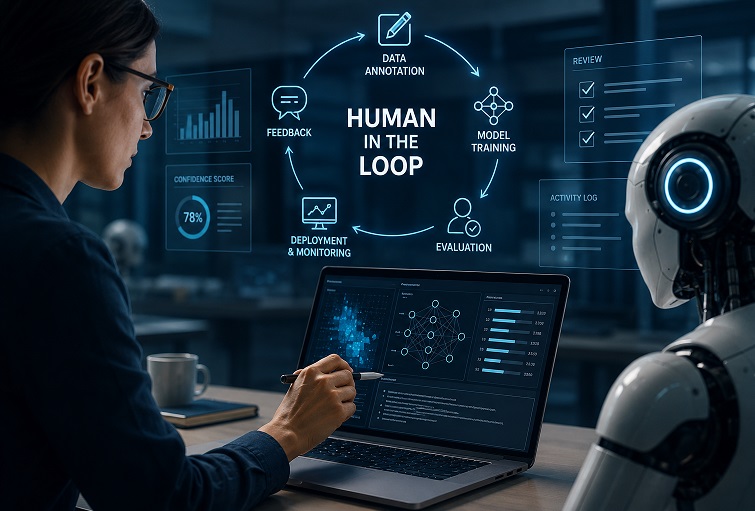
Well-designed HITL architectures improve model quality, reduce operational risk, simplify regulatory compliance, and enable AI systems to adapt as environments evolve. Poorly designed implementations, however, introduce unnecessary latency, excessive operational costs, and little measurable benefit.
Understanding where and how humans should participate has therefore become one of the defining engineering challenges in modern AI.
Defining Human-in-the-Loop
Human-in-the-Loop refers to an AI architecture in which human decisions directly influence how a machine learning system learns, operates, or produces outcomes. Human input is treated as a required component of the system rather than an optional safeguard.
Unlike conventional software, machine learning models operate under uncertainty. They infer patterns from historical data and generalize those patterns to previously unseen situations. While this enables remarkable flexibility, it also creates situations where confidence, correctness, and ethical acceptability diverge.
Human oversight compensates for these limitations by introducing capabilities that statistical models cannot reliably reproduce, including contextual reasoning, domain expertise, ethical judgment, and common sense.
Rather than replacing automation, HITL combines computational efficiency with selective human intervention where it delivers the greatest value.
Human Participation Across the AI Lifecycle
Effective oversight begins long before a model reaches production. Human involvement influences every major phase of system development.
Dataset Creation
The quality of any AI model is fundamentally constrained by the quality of its training data.
Human annotators classify images, label text, review conversations, identify anomalies, and construct ground truth datasets that supervised learning algorithms rely upon. Errors introduced during annotation often become deeply embedded in the model and remain undetected until deployment.
High-quality annotation requires more than detailed labeling guidelines. Modern annotation pipelines rely on multiple reviewers, consensus mechanisms, disagreement analysis, and continuous refinement of labeling policies.
Many organizations now treat dataset engineering as an iterative process rather than a one-time preparation stage.
Model Training and Alignment
Human feedback is increasingly used to optimize model behavior after initial training.
Large language models illustrate this particularly well. Instead of learning only from static datasets, they are refined using human preference data that teaches the model which responses are more accurate, helpful, and appropriate.
Techniques such as Reinforcement Learning from Human Feedback (RLHF) and newer preference optimization algorithms allow models to align statistical predictions with human expectations.
This alignment stage has become one of the defining characteristics of modern generative AI systems.
Evaluation Beyond Traditional Metrics
Benchmark accuracy alone rarely predicts production performance.
Human reviewers evaluate outputs according to dimensions that automated metrics struggle to measure, including:
- factual correctness
- reasoning quality
- contextual relevance
- consistency
- safety
- readability
- policy compliance
For enterprise AI, qualitative evaluation frequently uncovers weaknesses that remain invisible during standard benchmarking.
Real users interacting with production systems often become one of the most valuable sources of evaluation data.
Operational Oversight
Once deployed, AI systems continue to require human supervision.
Instead of reviewing every prediction, humans typically intervene only under predefined conditions, including:
- low confidence scores
- policy violations
- safety-critical situations
- regulatory requirements
- unexpected model behavior
- out-of-distribution inputs
This selective escalation allows organizations to maintain efficiency while preserving accountability.
Fraud detection provides a typical example. Machine learning models identify suspicious transactions in real time, while experienced analysts investigate only the highest-risk cases before financial actions are taken.
Human-in-the-Loop, Human-on-the-Loop, and Fully Autonomous Systems
These concepts are frequently confused despite representing different operational models.
Human-in-the-Loop requires human participation before critical decisions are finalized. The workflow cannot complete without human input.
Human-on-the-Loop describes supervisory oversight. The AI system operates independently while humans monitor performance and intervene only when necessary.
Human-out-of-the-Loop represents fully autonomous operation where decisions are executed without human involvement during runtime.
Most production environments combine all three approaches.
For example, an autonomous medical imaging platform may automatically classify routine examinations while forwarding uncertain diagnoses to radiologists. Infrastructure monitoring systems may resolve known incidents automatically while escalating novel failures to engineers.
Choosing where each operational mode applies is one of the most important architectural decisions in AI engineering.
Designing Effective HITL Systems
Successful HITL implementations are built around structured interaction rather than ad hoc human intervention.
Intelligent Data Annotation
Modern annotation platforms increasingly use active learning.
Instead of randomly selecting data samples, the model identifies examples where prediction uncertainty is highest. Human experts annotate only those difficult cases, allowing models to learn more efficiently while dramatically reducing labeling costs.
This strategy has become standard practice for many industrial machine learning systems.
Human Feedback Loops
Feedback mechanisms should extend beyond simple approval or rejection.
Reviewers should be able to identify failure categories, explain incorrect reasoning, suggest preferred outputs, and document contextual information.
This richer supervision produces significantly better training signals than binary feedback alone.
Workflow Orchestration
As AI agents become capable of executing multiple sequential actions, workflow management becomes increasingly important.
Modern orchestration frameworks can interrupt execution whenever predefined conditions are met, allowing humans to inspect intermediate reasoning before additional actions occur.
Rather than reviewing final outputs alone, engineers can supervise entire decision chains.
This approach is becoming particularly valuable for AI systems capable of interacting with databases, APIs, enterprise software, and cloud infrastructure.
Why Human Oversight Remains Essential
Several characteristics of machine learning make human participation indispensable.
Managing Uncertainty
No model possesses complete knowledge of the environments in which it operates.
Unexpected inputs, changing business rules, ambiguous language, and novel edge cases continually emerge after deployment.
Human expertise enables systems to respond appropriately when statistical confidence no longer guarantees correctness.
Detecting Distribution Shift
Real-world data evolves continuously.
Customer behavior changes.
Fraud techniques adapt.
Medical practices improve.
Language evolves.
Without human observation, model quality gradually deteriorates as production data diverges from training data.
Human reviewers often identify distribution shift before automated monitoring systems detect statistically significant changes.
Ethical Judgment
Many AI applications involve decisions that cannot be reduced to numerical optimization.
Healthcare, finance, hiring, education, and public safety all require ethical reasoning that extends beyond probability estimates.
Humans remain responsible for balancing competing priorities, interpreting regulations, and making decisions with societal consequences.
Advantages of Human-in-the-Loop Architectures
Organizations implementing mature HITL systems typically observe improvements across several dimensions.
Higher prediction accuracy through expert validation of uncertain cases.
Reduced model bias by identifying systematic errors during annotation and evaluation.
Greater transparency through detailed audit trails documenting review decisions and model corrections.
Improved user confidence because critical decisions remain accountable to human experts.
Continuous performance improvement as operational feedback becomes additional training data for future model versions.
Rather than treating oversight as a cost, many organizations increasingly recognize human expertise as an integral component of model optimization.
Practical Applications
Human-in-the-Loop has become standard practice across numerous industries.
Medical AI relies on physicians to validate diagnostic recommendations before clinical decisions are made.
Financial institutions use analysts to investigate high-risk fraud alerts generated by machine learning systems.
Content moderation platforms automatically process millions of posts while escalating ambiguous or sensitive cases to trained reviewers.
Legal document analysis combines large language models with attorney review to accelerate contract analysis without sacrificing accuracy.
Cybersecurity platforms prioritize incidents automatically but allow security analysts to investigate sophisticated attack patterns that require contextual reasoning.
In each case, automation handles scale while humans resolve uncertainty.
Engineering Principles for HITL
Several design principles consistently distinguish successful implementations.
Human intervention should occur only where it materially improves outcomes rather than becoming a default requirement.
Review interfaces should minimize cognitive effort by presenting relevant evidence, model confidence, historical context, and supporting information.
Automation should handle routine decisions while humans focus on ambiguity and high-impact situations.
Feedback collected during operation should flow directly into future model training and evaluation pipelines.
Finally, review capacity should be treated as a limited engineering resource. Every unnecessary escalation reduces the effectiveness of the entire oversight process.
Challenges and Limitations
Despite its advantages, HITL introduces several operational challenges.
Human review does not eliminate mistakes. Reviewers become fatigued, develop inconsistent standards, and introduce their own cognitive biases.
Scaling expert oversight remains expensive, particularly in domains requiring specialized knowledge such as medicine, law, or semiconductor engineering.
Complex review workflows increase system latency and operational costs.
Integration itself can be difficult. Effective HITL requires routing infrastructure, monitoring systems, reviewer management, audit logging, and governance processes that extend far beyond machine learning models.
Organizations frequently underestimate the engineering effort required to operationalize human oversight.
Where HITL Is Not the Right Solution
Not every AI system benefits from continuous human intervention.
Applications requiring millisecond response times, including autonomous flight control, industrial robotics, or high-frequency trading, cannot pause for human review without compromising functionality.
Similarly, excessive oversight creates diminishing returns.
If reviewers approve nearly every prediction without meaningful analysis, the organization incurs operational costs while gaining little additional safety.
Effective oversight requires careful calibration rather than maximum human involvement.
Emerging Trends
The role of HITL continues to evolve alongside advances in generative AI.
AI-assisted review systems increasingly help reviewers prioritize cases requiring attention.
Agentic AI platforms now support dynamic approval checkpoints based on confidence, policy constraints, or business rules.
Regulatory frameworks, including the European Union AI Act, are making meaningful human oversight a legal requirement for many high-risk applications.
At the same time, improvements in uncertainty estimation, explainability, and adaptive orchestration are making oversight significantly more efficient than traditional manual review models.
The future is unlikely to involve either complete autonomy or constant human supervision. Instead, intelligent systems will continuously determine when human expertise is necessary and when automation can safely proceed independently.
Conclusion
Human-in-the-Loop should not be viewed as a mechanism for compensating for weak AI models. It is an architectural principle for building intelligent systems that remain reliable, accountable, and adaptable in complex environments.
The most effective AI platforms do not maximize either automation or human involvement. They optimize the interaction between the two.
As AI systems become more autonomous, designing efficient collaboration between humans and machines will become one of the central disciplines of AI engineering. Organizations capable of building that balance will develop systems that are not only more accurate but also more trustworthy, maintainable, and resilient over time.