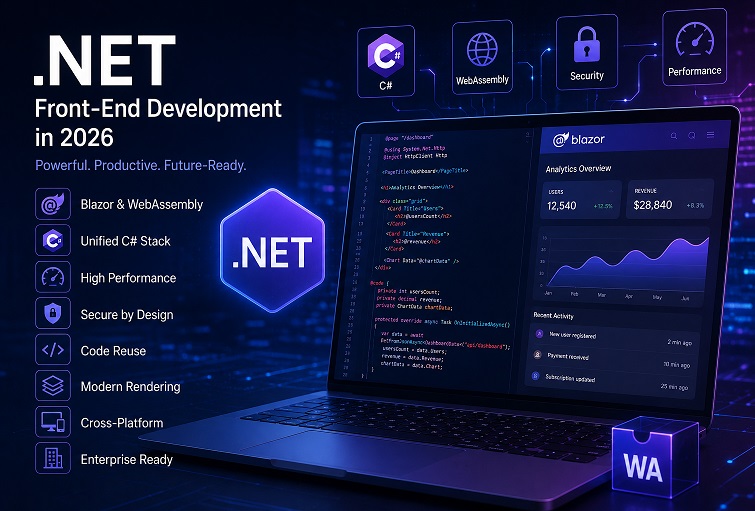
Is .NET Ready for Front-End Development? A Technical Perspective for 2026
Programming .NETIntroduction
For more than a decade, JavaScript has been the unquestioned foundation of front-end web development. Frameworks such as React, Angular, Vue, and more recently Svelte have shaped how modern web applications are built, creating one of the largest software ecosystems in the industry.
Yet the landscape is gradually changing.
The emergence of WebAssembly, improvements in server-side rendering, and the rapid evolution of Microsoft’s Blazor framework have transformed .NET into a serious option for building modern web interfaces. While JavaScript remains indispensable across the browser ecosystem, .NET is no longer confined to backend services and enterprise APIs.
Organizations that already rely on the Microsoft technology stack are increasingly evaluating whether a unified C# development model can simplify application architecture, reduce operational complexity, and improve developer productivity.
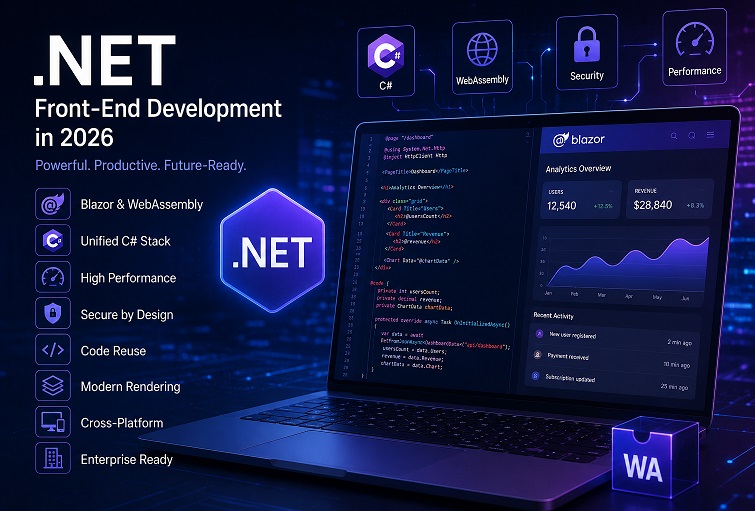
Although .NET is unlikely to replace JavaScript as the dominant browser technology, it has matured into a practical alternative for many classes of applications.
The Evolution of .NET on the Front End
Historically, browser applications depended almost entirely on JavaScript because browsers could execute no other language natively.
That limitation changed with the introduction of WebAssembly (Wasm), a binary instruction format supported by all major browsers. WebAssembly allows languages such as C#, C++, Rust, and Go to execute inside the browser with near-native performance.
Microsoft leveraged this capability to build Blazor WebAssembly, enabling developers to write interactive client-side applications entirely in C# while sharing business logic with backend services.
Alongside Blazor Server and the newer Blazor Web App hosting model introduced in recent versions of .NET, developers can now choose between multiple rendering strategies depending on application requirements.
This flexibility has significantly expanded the role of .NET within modern web development.
A Unified Development Stack
One of the strongest advantages of adopting .NET across the entire application stack is technological consistency.
Instead of maintaining separate frontend and backend codebases written in different languages, development teams can build both layers using C#.
Business logic, validation rules, data models, authentication components, utility libraries, and API contracts can be shared across projects without duplication.
This reduces synchronization problems between frontend and backend implementations while simplifying long-term maintenance.
For organizations with large existing .NET teams, the ability to leverage existing developer expertise can significantly reduce onboarding time and staffing complexity.
Component-Based Architecture
Blazor follows a component-oriented development model similar to React and other modern UI frameworks.
Applications are composed of reusable components that encapsulate rendering, state management, lifecycle events, and business logic.
This modular architecture improves maintainability while encouraging consistent design systems across large applications.
Reusable components can be packaged into shared libraries and deployed across multiple projects, reducing duplicated development effort.
As enterprise applications continue to grow in complexity, component reuse becomes increasingly valuable.
Multiple Rendering Models
Modern web applications rarely rely on a single rendering strategy.
.NET supports several approaches depending on performance, scalability, and interactivity requirements.
Server-side rendering generates HTML on the server before delivering content to the browser, improving initial load performance and search engine optimization.
Client-side rendering executes application logic directly in the browser through WebAssembly, enabling rich interactive experiences.
Interactive server rendering combines both approaches, allowing applications to balance responsiveness with reduced client resource consumption.
Recent versions of .NET have further enhanced rendering performance through streaming rendering and progressive page delivery, allowing users to interact with applications before all resources have finished loading.
This flexibility enables architects to select rendering models that best match specific workloads rather than relying on a single architectural pattern.
Code Reuse Across Client and Server
Sharing code between frontend and backend has long been one of the promises of full-stack development.
Within the .NET ecosystem, this capability extends beyond simply using the same programming language.
Validation logic, domain models, DTOs, authentication policies, serialization routines, and business rules can all exist within shared libraries consumed by multiple projects.
Maintaining a single implementation reduces inconsistencies while improving software quality through centralized testing.
For large enterprise systems with multiple user interfaces, shared code significantly lowers maintenance costs over the application’s lifecycle.
Performance Improvements
Performance has historically been one of the major concerns surrounding browser-based .NET applications.
Recent releases have substantially narrowed that gap.
Runtime optimizations, improved WebAssembly execution, incremental loading, ahead-of-time compilation, and enhanced rendering pipelines have reduced startup latency and improved runtime responsiveness.
Server-side rendering also allows applications to deliver meaningful content immediately while interactive functionality loads progressively in the background.
Although JavaScript frameworks remain highly optimized for browser execution, modern .NET applications now provide competitive performance across many enterprise scenarios.
The most appropriate technology continues to depend on application requirements rather than benchmark comparisons alone.
Security Advantages
Security considerations increasingly influence frontend architecture.
Applications built on the .NET platform benefit from the security capabilities already present throughout the broader ecosystem.
Authentication and authorization integrate naturally with ASP.NET Core Identity, OAuth 2.0, OpenID Connect, and enterprise identity providers.
Role-based and policy-based authorization models are supported throughout the application stack.
Strong typing, mature dependency management, integrated validation frameworks, and consistent serialization mechanisms reduce several classes of implementation errors that commonly occur in loosely typed environments.
While no framework eliminates security risks, centralized architecture simplifies secure application development and auditing.
Enterprise Development Experience
Development productivity extends beyond programming languages.
The .NET ecosystem provides mature tooling through Visual Studio, Visual Studio Code, comprehensive debugging capabilities, integrated profiling tools, advanced diagnostics, automated testing frameworks, and first-party cloud integration.
Modern development workflows also benefit from strong support for containerization, GitHub Actions, Azure DevOps, and infrastructure automation.
These capabilities are particularly valuable for organizations maintaining large software portfolios across multiple development teams.
Interoperability with JavaScript
Choosing .NET for frontend development does not require abandoning JavaScript entirely.
Blazor provides JavaScript interoperability mechanisms that allow applications to call existing JavaScript libraries whenever native browser APIs or third-party components are required.
This compatibility enables gradual migration rather than complete rewrites.
Organizations can continue using established JavaScript ecosystems while incrementally introducing .NET into appropriate areas of their applications.
Hybrid architectures have therefore become increasingly common.
Where .NET Performs Best
Although .NET is capable of powering many types of web applications, certain workloads benefit particularly from its architecture.
Enterprise business platforms.
Internal corporate portals.
Healthcare information systems.
Financial applications.
Government services.
Industrial monitoring dashboards.
Administrative interfaces.
Business intelligence solutions.
These applications typically prioritize maintainability, long-term support, security, and integration over minimal download size or cutting-edge browser animation.
For such systems, the advantages of a unified technology stack frequently outweigh the remaining limitations of browser-based .NET execution.
Current Challenges
Despite significant progress, .NET frontend development is not without trade-offs.
Blazor WebAssembly applications generally produce larger initial downloads than equivalent JavaScript applications.
The surrounding ecosystem remains considerably smaller than React or Angular, particularly regarding third-party UI libraries and community packages.
Experienced Blazor developers are also less common than JavaScript specialists, which may affect hiring in some markets.
Additionally, browser APIs continue to evolve primarily around JavaScript, meaning certain new capabilities become available there before receiving mature .NET abstractions.
These considerations should be evaluated alongside the advantages of architectural consistency.
Industry Trends
Several technology trends continue to strengthen the position of .NET in frontend development.
WebAssembly adoption is expanding across browsers.
Server-side rendering has become a standard optimization strategy.
Hybrid rendering models are increasingly replacing purely client-side applications.
Organizations are consolidating technology stacks to reduce operational complexity.
Artificial intelligence integration is driving demand for strongly typed backend-centric architectures capable of exposing intelligent services through rich user interfaces.
Microsoft continues investing heavily in Blazor, ASP.NET Core, and the broader .NET platform, making frontend development an increasingly important part of its long-term roadmap.
Conclusion
The question is no longer whether .NET can be used for frontend development. It clearly can.
The more relevant question is where it provides the greatest architectural value.
For organizations already invested in the Microsoft ecosystem, adopting a unified C# development model can simplify maintenance, improve code reuse, strengthen security, and reduce long-term development costs.
JavaScript will remain the dominant browser language for the foreseeable future, particularly for public-facing consumer applications. However, the evolution of WebAssembly, Blazor, and modern rendering technologies has established .NET as a mature platform capable of supporting sophisticated frontend applications.
Rather than competing directly with JavaScript in every scenario, .NET has carved out a strong position where integration, maintainability, scalability, and enterprise architecture matter most. As the platform continues to evolve, its role in frontend development is likely to expand well beyond its traditional backend roots.