Exposed VPNs and Ransomware: Understanding the Modern Attack Chain and How to Stop It
Cybersecurity VPNVirtual Private Networks remain an essential component of enterprise infrastructure. They provide secure remote access, connect branch offices, and enable employees to work from virtually anywhere. However, the same technology that simplifies remote connectivity continues to be one of the most attractive targets for cybercriminals.
Despite growing adoption of Zero Trust architectures and cloud-native identity services, VPN gateways are still widely deployed across organizations of every size. Many of them remain directly accessible from the Internet, making them valuable entry points for attackers seeking an initial foothold inside corporate environments.
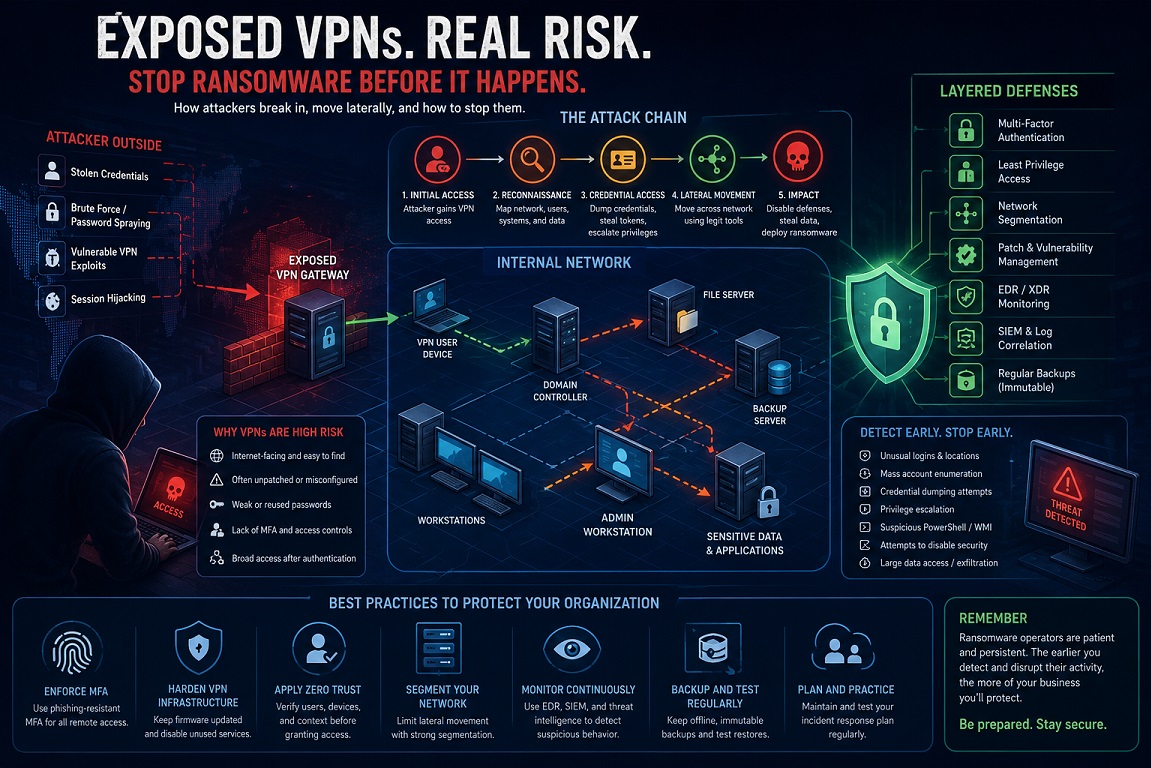
Modern ransomware campaigns rarely begin with sophisticated exploits or advanced malware. In many cases, the attack starts with something much simpler: a compromised VPN account, an unpatched gateway, or weak authentication controls. Once access has been established, attackers move methodically through the environment, escalating privileges, identifying critical assets, disabling security controls, and preparing for large-scale encryption or data theft.
This article examines how VPN-based ransomware attacks unfold, why exposed remote access infrastructure remains a favorite target, and what organizations can do to reduce their exposure.
Why VPN Infrastructure Remains a High-Value Target
Remote access systems sit at the boundary between trusted internal networks and the public Internet. Any vulnerability, misconfiguration, or compromised credential affecting these systems can provide attackers with direct access to corporate resources.
Unlike phishing attacks that depend on user interaction, compromising a VPN gateway often grants immediate authenticated access to internal systems. From an attacker’s perspective, this significantly reduces the effort required to bypass perimeter defenses.
Several factors contribute to the continued popularity of VPNs as an attack vector:
- Internet-facing services are easy to discover through automated scanning.
- Legacy VPN appliances frequently remain unpatched.
- Password reuse continues to expose valid credentials.
- Multi-factor authentication is still inconsistently deployed.
- VPN connections often provide broad network visibility after authentication.
Attackers continuously scan the Internet for vulnerable appliances from major vendors. Publicly disclosed vulnerabilities are frequently weaponized within days, sometimes hours, after patches become available. Organizations that delay updates become attractive targets for both ransomware operators and initial access brokers.
Initial Access: How Attackers Get Inside
There are several common methods used to compromise VPN infrastructure.
Stolen Credentials
Credential theft remains the most common approach. Usernames and passwords leaked through unrelated data breaches are routinely tested against corporate VPN portals using automated credential stuffing attacks.
Employees who reuse passwords across multiple services unintentionally increase this risk.
Brute Force and Password Spraying
Weak password policies make automated guessing attacks surprisingly effective. Password spraying, where attackers attempt a few common passwords across many accounts, often avoids account lockout thresholds while successfully identifying valid credentials.
Exploiting Vulnerabilities
VPN appliances occasionally contain critical remote code execution or authentication bypass vulnerabilities. Organizations that postpone firmware updates expose themselves to attacks requiring little or no user interaction.
Session Hijacking
Compromised browsers, malware infections, or stolen authentication cookies can allow attackers to bypass login procedures entirely if session management is not properly secured.
What Happens After VPN Compromise
Successful authentication is only the beginning.
Professional ransomware groups rarely deploy encryption immediately. Instead, they spend time understanding the victim’s environment while attempting to remain unnoticed.
Typical post-compromise activities include:
- mapping network topology;
- identifying Active Directory infrastructure;
- locating domain controllers;
- enumerating servers and workstations;
- identifying backup systems;
- discovering file shares;
- collecting information about endpoint security products.
Many attackers deliberately mimic legitimate administrator behavior, making detection considerably more difficult.
Internal Reconnaissance
Once inside the network, attackers begin gathering intelligence.
Native operating system utilities are often sufficient for this purpose. Commands that list users, groups, computers, network shares, scheduled tasks, and running services generate relatively little suspicion because administrators use them regularly.
Common reconnaissance objectives include:
- discovering privileged accounts;
- identifying virtualization platforms;
- locating database servers;
- finding backup repositories;
- identifying cloud synchronization services;
- determining which systems contain sensitive business data.
The goal is to understand which assets provide the greatest operational leverage before launching the final attack.
Credential Theft and Privilege Escalation
Administrative credentials significantly increase the likelihood of a successful ransomware deployment.
Attackers frequently attempt to extract credentials stored in memory, harvest cached authentication tokens, or exploit privilege escalation vulnerabilities to obtain administrative rights.
Once domain-level privileges are acquired, the attack becomes substantially more dangerous.
Administrative access allows threat actors to:
- deploy malicious software across multiple systems;
- modify Group Policy;
- disable endpoint protection;
- create additional administrator accounts;
- erase security logs;
- access backup infrastructure;
- encrypt servers simultaneously.
Preventing privilege escalation is therefore one of the most effective ways to interrupt the attack chain.
Lateral Movement Across the Network
Rarely does the initial VPN endpoint contain the organization’s most valuable information.
Instead, attackers move laterally toward increasingly sensitive systems.
Depending on the environment, they may leverage legitimate administrative protocols, remote management tools, scheduled tasks, Windows Management Instrumentation (WMI), PowerShell remoting, or Remote Desktop Protocol (RDP).
The objective is simple: maximize operational impact before detection occurs.
Flat networks with limited segmentation make this phase considerably easier. Conversely, properly segmented environments force attackers to overcome additional authentication and authorization barriers, increasing the likelihood of detection.
Preparing for Ransomware Deployment
Encryption is typically the final stage rather than the first.
Before launching ransomware, attackers often attempt to weaken the organization’s ability to recover.
Preparation commonly includes:
- deleting shadow copies;
- disabling backup agents;
- terminating database services;
- uninstalling endpoint security software;
- stopping monitoring tools;
- identifying offline backup locations;
- exfiltrating sensitive files.
Many modern ransomware operations now combine encryption with data theft. Rather than relying solely on operational disruption, attackers threaten to publish confidential information unless ransom demands are met.
This “double extortion” model has become a defining characteristic of contemporary ransomware campaigns.
Detecting an Attack Before Encryption
The most successful defensive strategies focus on identifying attacker behavior long before ransomware binaries execute.
Organizations should monitor for unusual authentication activity, including:
- VPN logins outside normal business hours;
- impossible travel events;
- authentication from unfamiliar countries;
- repeated failed login attempts;
- sudden use of dormant accounts;
- concurrent logins from geographically distant locations.
Within the internal network, suspicious indicators include:
- extensive account enumeration;
- abnormal PowerShell execution;
- unexpected credential dumping activity;
- creation of new administrative users;
- large-scale remote execution;
- mass file access;
- attempts to disable security software.
Behavior-based detection is often more effective than relying solely on malware signatures because attackers increasingly use legitimate administrative tools throughout the intrusion.
Building a Resilient VPN Security Strategy
Reducing VPN-related risk requires multiple layers of protection rather than a single security control.
Strong authentication should be the first priority.
Multi-factor authentication dramatically reduces the usefulness of stolen passwords. Hardware security keys or phishing-resistant authentication methods provide even stronger protection than SMS-based verification.
Patch management is equally important. VPN appliances should receive firmware updates promptly, particularly when vendors disclose critical security vulnerabilities.
Organizations should also enforce:
- strong password policies;
- account lockout mechanisms;
- conditional access policies;
- device compliance checks;
- certificate-based authentication where appropriate.
Access should follow the principle of least privilege. Remote users should receive only the permissions required for their specific roles instead of unrestricted access to internal networks.
The Role of Network Segmentation
Segmentation significantly limits an attacker’s ability to move laterally.
Critical systems such as domain controllers, backup infrastructure, financial databases, and industrial control systems should reside on isolated network segments protected by strict access controls.
Administrative workstations should remain separate from ordinary user devices.
Segmentation also improves visibility by making unusual cross-segment communication easier to detect.
Even if attackers successfully compromise a VPN account, proper segmentation can prevent a localized intrusion from becoming an organization-wide incident.
Endpoint Detection and Continuous Monitoring
Modern Endpoint Detection and Response (EDR) platforms have become indispensable for identifying ransomware activity before encryption begins.
Unlike traditional antivirus software, EDR solutions analyze behavioral patterns including:
- suspicious process creation;
- credential dumping attempts;
- privilege escalation;
- persistence mechanisms;
- abnormal PowerShell activity;
- unauthorized remote administration.
Centralized logging through Security Information and Event Management (SIEM) platforms further improves detection by correlating VPN authentication events, endpoint telemetry, identity logs, firewall alerts, and cloud activity into a unified investigation timeline.
Organizations that combine EDR, SIEM, identity monitoring, and threat intelligence are significantly better positioned to detect attackers during reconnaissance rather than during encryption.
Preparing for the Worst
Even mature security programs must assume that some attacks will eventually succeed.
Incident response planning should therefore include:
- tested offline backups;
- documented recovery procedures;
- predefined communication plans;
- forensic evidence preservation;
- clearly assigned response roles;
- regular tabletop exercises.
Backup systems deserve particular attention. They should be isolated from production environments and protected with immutable storage whenever possible. A backup that attackers can modify or delete offers little value during recovery.
Organizations should also periodically verify that backups can actually be restored within acceptable recovery time objectives.
Conclusion
VPN technology remains a critical component of enterprise connectivity, but it also continues to represent one of the most attractive entry points for ransomware operators. A compromised VPN account or vulnerable gateway can provide everything an attacker needs to begin a carefully planned intrusion.
Modern ransomware campaigns are rarely opportunistic. They involve patient reconnaissance, credential theft, privilege escalation, lateral movement, and deliberate efforts to undermine recovery capabilities before encryption is ever deployed.
Preventing these attacks requires more than patching VPN appliances. Organizations must combine strong authentication, continuous monitoring, network segmentation, endpoint detection, rapid vulnerability management, and well-tested incident response procedures into a cohesive defense strategy.
As ransomware operations become increasingly sophisticated, the ability to detect and interrupt the attack chain during its earliest stages has become one of the most valuable capabilities any security team can develop.