Quantum Machine Learning Explained: Principles, Algorithms, Current Limitations, and Real-World Applications
Science Quantum ComputingArtificial intelligence has transformed fields ranging from healthcare and finance to manufacturing and scientific research. At the same time, quantum computing has emerged as one of the most ambitious areas of computer science, promising fundamentally different ways of solving computational problems. The intersection of these two disciplines has given rise to Quantum Machine Learning (QML), an area of research that investigates whether quantum computers can improve certain machine learning tasks.
Although QML frequently appears in headlines alongside claims of revolutionary performance gains, the reality is considerably more nuanced. Current quantum hardware remains experimental, and most practical machine learning workloads continue to run on classical computers. Nevertheless, quantum algorithms have demonstrated theoretical advantages for specific computational problems, making QML an active research field with long-term potential.
This article explains the foundations of quantum machine learning, introduces the quantum computing concepts necessary to understand it, examines the major algorithm families, discusses practical applications, and evaluates where the technology stands today.
What Is Quantum Machine Learning?
Quantum Machine Learning refers to machine learning techniques that incorporate quantum computation into part or all of the learning process. Instead of relying exclusively on CPUs or GPUs, these algorithms utilize quantum processors to execute specific operations that may be computationally expensive on classical hardware.
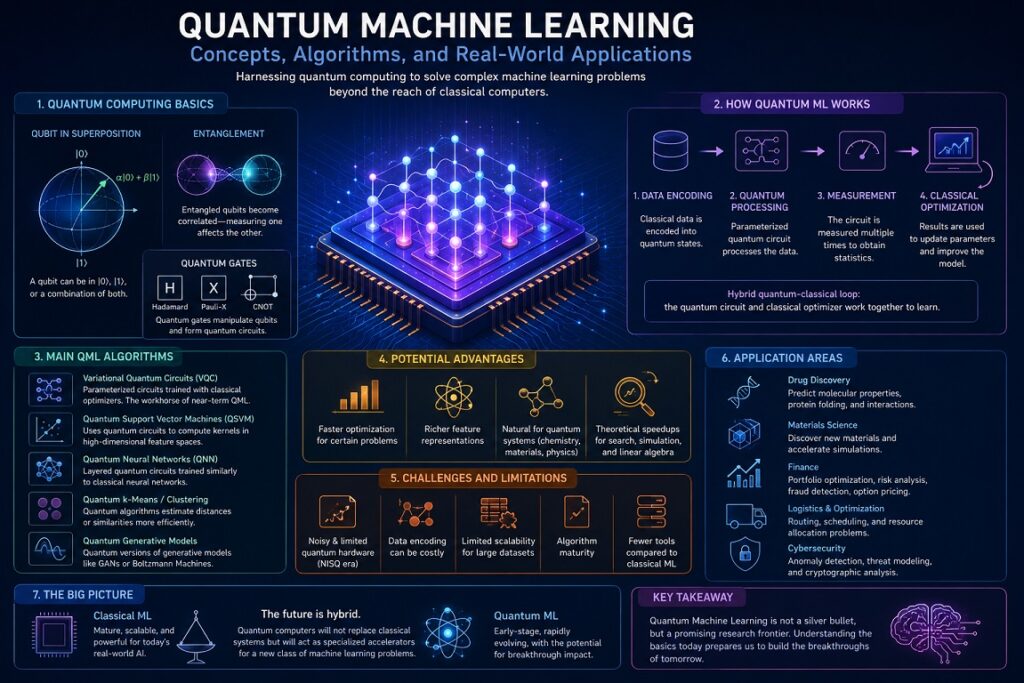
Unlike traditional machine learning, QML is not a completely separate discipline. Most modern approaches combine classical optimization algorithms with quantum circuits, creating hybrid systems that leverage the strengths of both computing paradigms.
Depending on the application, a quantum computer may be responsible for:
- generating feature representations
- evaluating complex mathematical kernels
- estimating probability distributions
- optimizing parameterized quantum circuits
- accelerating specialized linear algebra operations
The remainder of the workflow, including preprocessing, optimization, and evaluation, generally remains classical.
Rather than replacing conventional machine learning, QML currently complements it.
Why Researchers Are Interested in QML
Many machine learning algorithms eventually encounter computational bottlenecks. As datasets become larger and models more complex, operations such as optimization, matrix multiplication, graph traversal, and combinatorial search become increasingly expensive.
Quantum computers process information using fundamentally different physical principles, allowing certain algorithms to explore computational spaces more efficiently than classical machines under specific assumptions.
Researchers hope this could eventually benefit problems such as:
- molecular simulation
- materials discovery
- optimization
- quantum chemistry
- financial portfolio optimization
- cryptographic analysis
- high-dimensional feature mapping
Whether these theoretical advantages will translate into practical machine learning improvements remains one of the major open questions in quantum computing research.
Quantum Computing Fundamentals
Understanding QML requires familiarity with several quantum computing concepts. Fortunately, only a handful of ideas are necessary before exploring machine learning applications.
Classical Bits vs. Qubits
Traditional computers store information using binary bits, where each bit is either 0 or 1.
Quantum computers instead operate on qubits.
Unlike classical bits, qubits exist as quantum states described by probability amplitudes. Prior to measurement, a qubit may represent both logical states simultaneously through a phenomenon known as superposition.
As additional qubits are introduced, the size of the quantum state grows exponentially. A register containing n qubits mathematically represents a state space containing 2ⁿ possible basis states.
This exponential representation is one of the reasons quantum computing has attracted significant attention.
Superposition
Superposition allows quantum states to represent multiple computational possibilities simultaneously.
This does not mean a quantum computer evaluates every possible solution independently. Instead, quantum algorithms manipulate probability amplitudes so that correct answers become increasingly likely when the quantum state is measured.
Designing algorithms that successfully exploit superposition is one of the central challenges of quantum computing.
Entanglement
Entanglement describes strong quantum correlations between qubits.
Once qubits become entangled, the state of one qubit cannot be described independently of the others. Operations performed on one portion of the system affect the combined quantum state, enabling computational patterns that have no direct classical equivalent.
Many proposed quantum speedups rely heavily on entanglement.
Quantum Gates
Classical programs manipulate bits using logical operations such as AND, OR, and XOR.
Quantum circuits instead use reversible quantum gates that transform qubit states.
Common examples include:
- Hadamard gates
- Pauli-X, Y, and Z gates
- Controlled-NOT (CNOT)
- Rotation gates
- Controlled phase gates
Sequences of these gates form quantum circuits, which serve as the computational backbone of quantum algorithms.
How Quantum Machine Learning Works
Although implementations differ, many QML workflows follow a similar sequence.
Step 1: Data Encoding
Machine learning datasets originate as classical numerical values.
Before quantum processing begins, these values must be encoded into quantum states.
Several encoding strategies exist:
- Angle encoding
- Amplitude encoding
- Basis encoding
- Feature map encoding
Data encoding remains one of the most expensive and technically challenging aspects of QML because transferring classical information into quantum states is itself a computational task.
Step 2: Quantum Processing
After encoding, a parameterized quantum circuit transforms the quantum state.
The circuit may contain dozens or hundreds of adjustable parameters that influence the computation.
These parameters play a role similar to weights in a neural network.
Step 3: Measurement
Quantum information cannot be read directly.
Instead, measurements collapse the quantum state into classical outcomes.
Since each measurement produces only one probabilistic result, quantum circuits must be executed repeatedly to estimate useful statistics.
Step 4: Classical Optimization
Most current QML systems employ classical optimizers such as gradient descent, Adam, or SPSA to update quantum circuit parameters.
Training therefore alternates between classical computation and quantum execution.
This iterative loop is known as hybrid quantum-classical optimization.
Hybrid Quantum-Classical Models
Fully quantum machine learning remains impractical with today’s hardware.
Instead, researchers overwhelmingly favor hybrid architectures.
A typical hybrid workflow resembles the following:
- Classical preprocessing
- Quantum feature transformation
- Measurement
- Classical loss calculation
- Parameter update
- Repeat
This approach minimizes the amount of work performed on fragile quantum hardware while still allowing researchers to investigate possible computational advantages.
Hybrid models dominate research because current quantum processors contain relatively few qubits and suffer from significant noise.
Major Categories of Quantum Machine Learning
Different QML methods use quantum computation in different ways.
Quantum-Enhanced Classical Algorithms
These methods modify existing machine learning algorithms by replacing one expensive computational component with a quantum alternative.
Examples include:
- kernel estimation
- matrix inversion
- sampling
- optimization routines
The majority of the machine learning pipeline remains unchanged.
Variational Quantum Algorithms
Variational methods are currently the most active area of QML research.
A parameterized quantum circuit acts as a trainable model whose parameters are optimized using classical optimization techniques.
Examples include:
- Variational Quantum Classifiers
- Variational Quantum Eigensolvers
- Quantum Approximate Optimization Algorithm (QAOA)
These algorithms are specifically designed for noisy intermediate-scale quantum (NISQ) hardware.
Fully Quantum Models
The most ambitious approaches assume that both data and model exist entirely within quantum states.
While elegant in theory, these methods require hardware capabilities that do not yet exist at meaningful scales.
For this reason, fully quantum machine learning remains almost entirely theoretical.
Important Quantum Machine Learning Algorithms
Several algorithm families appear frequently throughout QML literature.
Variational Quantum Classifiers
Variational classifiers replace the decision function of a conventional classifier with a parameterized quantum circuit.
Training adjusts circuit parameters until the measured outputs separate different classes effectively.
These models are among the most widely studied practical QML techniques.
Quantum Support Vector Machines
Support Vector Machines rely heavily on kernel functions that measure similarity between data points.
Quantum SVMs use quantum circuits to evaluate kernels within high-dimensional quantum feature spaces.
Researchers hope these feature spaces may reveal complex structures that are difficult to model classically.
Quantum Neural Networks
Quantum Neural Networks (QNNs) extend ideas from deep learning into quantum circuits.
Although they share conceptual similarities with artificial neural networks, QNNs use quantum gates instead of neurons and rely on repeated quantum measurements during training.
Current implementations remain relatively small compared to modern deep learning architectures.
Quantum Clustering
Clustering algorithms frequently depend on repeated distance calculations.
Quantum clustering methods investigate whether quantum algorithms can estimate distances or similarities more efficiently for certain datasets.
Research remains ongoing, and practical advantages have yet to be conclusively demonstrated.
Quantum Generative Models
Several researchers are exploring quantum analogues of generative models.
Examples include:
- Quantum Boltzmann Machines
- Quantum GANs
- Quantum circuit generative models
These approaches attempt to generate probability distributions using quantum states rather than classical neural networks.
Potential Advantages of Quantum Machine Learning
Although practical evidence remains limited, several theoretical benefits motivate ongoing research.
Faster Optimization
Certain optimization problems may benefit from quantum search techniques or variational optimization methods.
This could become valuable for large combinatorial optimization tasks.
Richer Feature Spaces
Quantum circuits naturally represent complex mathematical transformations.
These transformations may produce feature spaces that are difficult or computationally expensive to reproduce classically.
Scientific Simulation
Perhaps the strongest application for quantum computing involves simulating quantum systems themselves.
Machine learning models used in chemistry, materials science, and pharmaceutical research may eventually benefit from quantum hardware because the underlying physical systems are already quantum mechanical.
Specialized Computational Speedups
Several quantum algorithms offer provable asymptotic improvements over classical alternatives under ideal assumptions.
Examples include:
- Grover’s search algorithm
- Quantum phase estimation
- Harrow-Hassidim-Lloyd (HHL) algorithm
Whether these theoretical improvements survive real-world implementation challenges remains an active area of investigation.
Current Limitations
Despite growing interest, QML faces substantial obstacles.
Hardware Constraints
Today’s quantum computers remain small and noisy.
Most available processors contain relatively few high-quality qubits and suffer from limited coherence times.
Noise introduces computational errors that restrict algorithm depth and model complexity.
Expensive Data Encoding
Loading classical datasets into quantum states can itself require significant computational effort.
In some cases, this preprocessing cost offsets much of the theoretical speedup offered by the quantum algorithm.
Limited Scalability
Most published QML demonstrations involve relatively small datasets.
There is currently little evidence that existing hardware can outperform large-scale classical machine learning systems operating on industrial datasets.
Immature Software Ecosystem
Although frameworks such as Qiskit, PennyLane, Cirq, and TensorFlow Quantum have matured considerably, the ecosystem remains far less developed than established machine learning libraries such as PyTorch, TensorFlow, or scikit-learn.
Real-World Applications Under Investigation
Although commercial deployment remains limited, researchers are actively exploring QML across multiple industries.
Drug Discovery
Quantum-enhanced machine learning may improve molecular property prediction and protein interaction modeling.
Since molecular behavior is inherently quantum mechanical, this area is considered particularly promising.
Materials Science
Researchers are investigating whether quantum algorithms can accelerate the discovery of new battery materials, superconductors, and advanced alloys.
Financial Modeling
Banks and investment firms are studying quantum optimization for:
- portfolio allocation
- derivative pricing
- fraud detection
- risk analysis
Most work remains experimental.
Logistics and Supply Chain Optimization
Large optimization problems involving routing, scheduling, and resource allocation may eventually benefit from quantum optimization techniques.
Cybersecurity
Machine learning already plays a major role in anomaly detection and threat analysis.
Quantum-enhanced optimization and pattern recognition may eventually improve certain cybersecurity workflows, although practical implementations remain speculative.
Quantum Machine Learning vs. Classical Machine Learning
Quantum machine learning should not be viewed as a replacement for classical AI.
Classical machine learning currently offers:
- mature software ecosystems
- scalable cloud infrastructure
- optimized GPU hardware
- decades of algorithm development
- proven industrial deployments
Quantum machine learning currently offers:
- promising theoretical models
- experimental algorithms
- hybrid research workflows
- specialized optimization techniques
- potential long-term computational advantages
For the foreseeable future, classical AI will remain the dominant platform for production systems, while quantum computing serves as a specialized accelerator for carefully selected problems.
Common Misconceptions
Several misconceptions continue to shape public perception of QML.
“Quantum computers will make every machine learning algorithm faster.”
This is incorrect. Only specific computational tasks exhibit theoretical quantum advantages.
“Quantum AI will replace GPUs.”
Modern GPUs remain vastly more practical for training deep neural networks.
Quantum processors target entirely different computational workloads.
“Quantum machine learning is ready for enterprise deployment.”
Most QML research still relies on simulators or small experimental quantum devices.
Large-scale commercial adoption remains years away.
Learning Quantum Machine Learning
Developers interested in QML can begin experimenting without owning quantum hardware.
Several open-source frameworks provide simulators that execute quantum circuits on conventional computers.
Popular libraries include:
- Qiskit
- PennyLane
- Cirq
- TensorFlow Quantum
Learning the mathematical foundations is equally important. Useful background topics include:
- linear algebra
- probability theory
- optimization
- quantum mechanics fundamentals
- classical machine learning
A strong understanding of conventional machine learning provides an excellent foundation before exploring quantum algorithms.
The Future of Quantum Machine Learning
Quantum machine learning represents one of the most intriguing intersections of artificial intelligence and quantum computing. While the field has not yet delivered the broad performance gains sometimes suggested in popular media, it has produced a growing body of theoretical research and experimental algorithms that continue to expand our understanding of both disciplines.
Progress in QML ultimately depends on advances in quantum hardware. As processors become more stable, larger, and less error-prone, researchers will be able to evaluate increasingly sophisticated machine learning models under realistic conditions. Until then, hybrid quantum-classical systems are likely to remain the dominant research direction.
Organizations should view QML as an emerging technology rather than a production-ready replacement for existing AI infrastructure. For researchers, however, it offers a rare opportunity to contribute to a field that is still defining its foundations. Whether quantum machine learning eventually transforms artificial intelligence or occupies a more specialized niche, it is already reshaping how scientists think about computation, optimization, and learning itself.