Forward Deployed Engineers: The Technical Role Driving Enterprise AI Deployments
AIArtificial intelligence platforms have become remarkably capable. Large language models can generate code, summarize documents, automate workflows, and analyze massive datasets. Yet even the most advanced platform delivers little value until it is integrated into a company’s infrastructure, connected to business systems, and adapted to real operational processes.
This gap between a product’s capabilities and a customer’s production environment has created a relatively new engineering discipline: the Forward Deployed Engineer (FDE).
Unlike traditional software engineers who primarily build features for a general audience, Forward Deployed Engineers work directly with customers, deploying production-grade solutions that solve organization-specific problems. They combine software engineering, systems integration, product thinking, and customer collaboration into a single role.
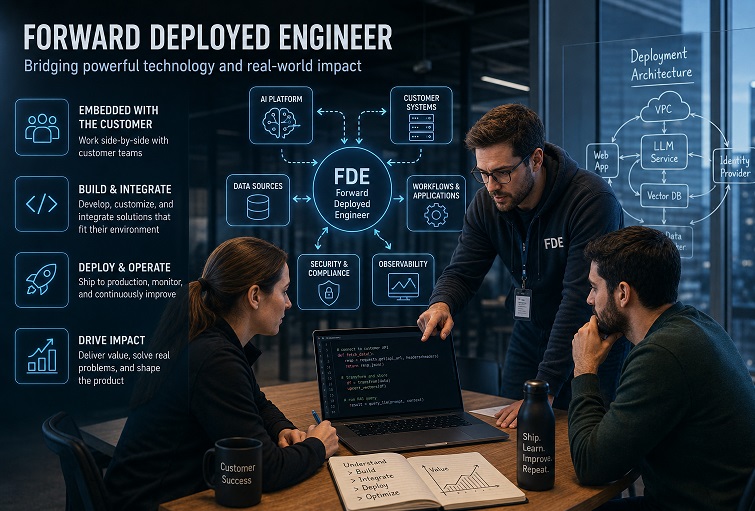
As enterprise AI adoption accelerates across industries, demand for engineers capable of bridging technical implementation with business outcomes continues to grow.
What Is a Forward Deployed Engineer?
A Forward Deployed Engineer is a software engineer who works closely with enterprise customers to deploy, customize, integrate, and optimize complex software within the customer’s own environment.
Rather than developing generic product features, FDEs focus on ensuring that a platform successfully operates inside a specific organization’s infrastructure, workflows, and security requirements.
The role exists because enterprise software rarely works perfectly out of the box. Every organization has unique authentication systems, APIs, databases, compliance requirements, internal tooling, and operational processes. Even highly configurable platforms typically require engineering work before they become useful in production.
Forward Deployed Engineers own that engineering effort.
Although titles vary between companies, similar positions may appear as:
- Forward Deployed Software Engineer
- Forward Deployed AI Engineer
- Customer Engineer
- Embedded Software Engineer
- Deployment Engineer
While responsibilities differ between organizations, the central objective remains consistent: transform a general-purpose platform into a working production solution for an individual customer.
Why the Role Has Become So Important
Enterprise technology has become increasingly interconnected.
A modern AI deployment may need to communicate with:
- internal APIs
- CRM systems
- ERP platforms
- cloud infrastructure
- data warehouses
- authentication providers
- monitoring systems
- document repositories
- custom business applications
Connecting these components often represents a larger engineering challenge than deploying the AI model itself.
Generative AI has amplified this complexity. Organizations purchasing language models, retrieval systems, or autonomous agents expect those systems to operate using their own data while respecting strict security, compliance, and governance requirements.
Without engineers capable of integrating these technologies into existing infrastructure, even sophisticated AI products struggle to deliver measurable business value.
Forward Deployed Engineers make those deployments successful.
How an FDE Differs from Other Engineering Roles
The position overlaps with several established engineering disciplines, but its responsibilities extend beyond any single one.
Product engineers focus on building reusable capabilities that benefit every customer. Their work emphasizes scalability, maintainability, and long-term product evolution.
Solutions engineers generally participate before a sale is completed. They conduct demonstrations, answer technical questions, and build proof-of-concept implementations that help prospective customers evaluate the product.
Implementation engineers concentrate on onboarding customers and configuring existing functionality, typically with limited custom development.
Professional services consultants often build custom solutions but may not maintain a close relationship with the core engineering organization.
Forward Deployed Engineers combine elements of all these positions.
They write production software, build integrations, troubleshoot infrastructure, collaborate directly with customer teams, and frequently provide feedback that influences future product development.
Typical Responsibilities
Although responsibilities vary by company, most FDEs perform work across several technical domains.
Customer Discovery
Projects usually begin by understanding how a customer operates rather than immediately writing code.
Forward Deployed Engineers meet with stakeholders to understand:
- business objectives
- operational workflows
- technical constraints
- existing infrastructure
- compliance requirements
- integration priorities
Unlike traditional engineering teams that often receive detailed specifications, FDEs frequently work with incomplete or evolving requirements.
Systems Integration
Integration is typically the largest part of the role.
A deployment might involve connecting an AI platform to:
- REST APIs
- GraphQL services
- relational databases
- cloud storage
- identity providers
- message queues
- internal microservices
- third-party SaaS platforms
Real-world environments rarely match documentation perfectly, making debugging and adaptation essential skills.
Custom Development
Many customer requirements cannot be satisfied through configuration alone.
Forward Deployed Engineers often build:
- middleware services
- API adapters
- authentication layers
- workflow automation
- orchestration logic
- data transformation pipelines
- monitoring tools
- deployment scripts
The objective is not simply writing code but creating maintainable solutions that integrate naturally with the customer’s environment.
Deployment and Operations
Unlike prototype work, FDE projects usually end in production.
Typical responsibilities include:
- deployment automation
- infrastructure configuration
- performance optimization
- production debugging
- monitoring
- logging
- incident response
- reliability improvements
Success is measured by stable production systems rather than completed feature requests.
Working with Enterprise AI Systems
Many modern FDE positions revolve around AI deployments.
Deploying an enterprise language model involves considerably more than exposing an API endpoint.
A production implementation may require:
- document ingestion pipelines
- vector databases
- retrieval systems
- prompt engineering
- access control
- audit logging
- data anonymization
- usage monitoring
- latency optimization
- cost management
Healthcare organizations may require integration with electronic medical records.
Financial institutions often demand strict auditability and regulatory compliance.
Manufacturing companies may connect AI assistants to operational databases and industrial monitoring systems.
Every deployment introduces unique technical challenges that cannot be solved by generic documentation alone.
Technical Skills
The role requires broad engineering expertise rather than specialization in a single technology.
Strong software engineering fundamentals remain essential.
Forward Deployed Engineers are expected to design maintainable systems, write production-quality code, debug complex failures, and understand software architecture.
Programming languages vary depending on the organization, although Python, Go, Java, TypeScript, and Java are frequently encountered.
Cloud computing experience has become increasingly valuable since most enterprise deployments operate on AWS, Azure, or Google Cloud Platform.
Understanding networking, containers, Kubernetes, infrastructure automation, CI/CD pipelines, and distributed systems significantly improves an engineer’s effectiveness.
Database knowledge is equally important because deployments often require working with relational databases, NoSQL systems, analytical warehouses, and caching layers.
Integration Expertise
Perhaps more than any other engineering discipline, FDEs spend their time connecting systems.
This requires familiarity with:
- REST APIs
- GraphQL
- OAuth
- OpenID Connect
- SAML
- webhooks
- messaging systems
- ETL pipelines
- event-driven architectures
- service orchestration
Many deployment challenges involve diagnosing why two otherwise functional systems fail to communicate correctly under production conditions.
Communication and Product Thinking
Technical ability alone is rarely sufficient.
Forward Deployed Engineers spend substantial time working with people outside engineering.
They must translate business requirements into technical solutions while also explaining engineering trade-offs in language stakeholders can understand.
This communication extends in both directions.
Customer feedback often identifies recurring implementation challenges that product teams can address in future releases.
Experienced FDEs recognize which customer requests should become reusable platform capabilities and which should remain deployment-specific customizations.
That judgment directly influences product evolution.
Operating with High Autonomy
Many deployments occur far from company headquarters.
Forward Deployed Engineers frequently work independently or in small teams, making technical and architectural decisions without extensive oversight.
Successful engineers are comfortable with ambiguity, incomplete information, and rapidly changing priorities.
Projects rarely follow perfectly defined specifications.
Instead, requirements evolve through ongoing collaboration with customer teams.
Career Path
Most professionals enter the role after building experience in backend, platform, cloud, infrastructure, or full-stack engineering.
Strong experience in production systems provides the technical foundation needed for customer-facing deployments.
As engineers gain experience, several career paths become available.
Some transition into product engineering, bringing practical customer knowledge back into platform development.
Others move toward solutions architecture, technical leadership, engineering management, or enterprise consulting.
Because the role provides exposure to customers, infrastructure, architecture, and product strategy simultaneously, it develops a uniquely broad perspective that can support multiple long-term career directions.
Challenges of the Role
Although rewarding, the position presents unique difficulties.
Every customer environment differs.
Infrastructure may be undocumented, APIs inconsistent, authentication systems outdated, and business processes highly customized.
Engineers must adapt quickly while maintaining production reliability.
Balancing customer-specific customization against long-term maintainability is another constant challenge.
Building excessive one-off functionality increases technical debt, while excessive standardization may fail to meet customer needs.
The most effective Forward Deployed Engineers consistently identify solutions that solve immediate problems without compromising the broader product.
Travel can also be part of the position, particularly for organizations supporting strategic enterprise customers, although many companies now perform deployments remotely using cloud infrastructure and secure collaboration tools.
The Future of Forward Deployed Engineering
The growth of enterprise AI suggests that Forward Deployed Engineering will become increasingly important.
Organizations adopting AI rarely purchase isolated models. They invest in complete operational solutions that integrate securely with existing infrastructure and deliver measurable business outcomes.
This trend favors engineers who understand software development, distributed systems, cloud platforms, enterprise architecture, and customer collaboration equally well.
Future deployments are also expected to become more sophisticated as AI agents gain greater autonomy and organizations automate increasingly complex workflows.
Rather than replacing Forward Deployed Engineers, these advances are likely to increase demand for professionals capable of integrating intelligent systems into production environments safely and efficiently.
Final Thoughts
Forward Deployed Engineers occupy one of the most technically diverse positions in modern software engineering. They build production software, integrate complex enterprise systems, solve infrastructure challenges, collaborate directly with customers, and help shape the evolution of the products they deploy.
As enterprise AI adoption continues to accelerate, the ability to bridge advanced technology with practical business implementation has become a significant competitive advantage. Organizations increasingly need engineers who can move beyond writing code and ensure sophisticated platforms deliver real value inside production environments.
For software engineers who enjoy systems integration, cloud architecture, customer interaction, and solving complex real-world problems, Forward Deployed Engineering offers a challenging career path with growing strategic importance across the enterprise technology landscape.