Hybrid Microcontrollers: Why Heterogeneous Architectures Are Redefining Embedded Systems
Electronics MicrocontrollerFor decades, embedded system designers worked within a relatively clear division of labor. Microcontrollers handled deterministic control, peripheral management, and low-power operation. Microprocessors provided the computational resources required by complex operating systems, graphical interfaces, networking stacks, and demanding applications.
That distinction is becoming increasingly difficult to maintain.
Modern embedded devices are expected to perform real-time control, process data from large numbers of sensors, run machine learning models, communicate over high-speed networks, enforce sophisticated security policies, and sometimes support a full operating system. In many applications, all of these tasks must run simultaneously while the system remains power-efficient, compact, reliable, and predictable.
The result is the emergence of a new class of heterogeneous or hybrid microcontrollers. These devices combine multiple processing domains and dedicated hardware accelerators within a single system-on-chip. Instead of asking one CPU to handle every workload, a hybrid MCU assigns each task to the hardware best suited to perform it.
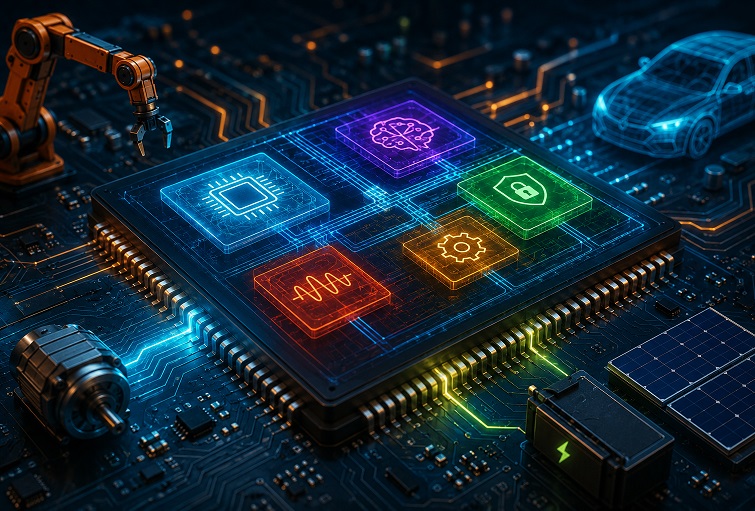
This architectural shift is changing the way embedded systems are designed. The central question is no longer simply how fast the processor is. It is how efficiently different computing resources can cooperate while preserving determinism, security, and energy efficiency.
The traditional MCU model is reaching its limits
A conventional microcontroller typically combines a CPU core, memory, timers, communication interfaces, analog peripherals, and other hardware blocks on a single chip. This architecture remains extremely effective for many control applications.
A traditional MCU can reliably manage sensors, actuators, motor-control loops, communication interfaces, and interrupt-driven workloads while consuming very little power. Its relatively simple architecture also makes system behavior easier to understand and validate.
However, embedded applications have become significantly more demanding.
A single device may now be expected to:
- Collect data from dozens of sensors.
- Process high-speed digital signals.
- Run machine learning inference.
- Operate industrial Ethernet or wireless connectivity.
- Execute complex communication stacks.
- Protect data using hardware cryptography.
- Support secure firmware updates.
- Perform predictive maintenance analysis.
- Control motors or power converters with strict timing requirements.
- Run a Linux-based application environment or another advanced operating system.
These workloads have very different characteristics. A motor-control loop may require deterministic response within a few microseconds. A neural network may require massive parallel multiplication and accumulation operations. A networking stack may require significant memory and operating-system support. Cryptographic operations benefit from dedicated mathematical accelerators.
Trying to execute all of these tasks on one general-purpose CPU creates conflicts. A processor busy handling network traffic may delay a control task. An AI workload can consume substantial computing resources. A complex operating system introduces scheduling behavior that is not always compatible with hard real-time requirements.
Adding a more powerful CPU can solve some performance problems, but it often increases power consumption, software complexity, cost, and system size.
Hybrid architectures take a different approach. Instead of relying on one processor to do everything, they divide the workload across specialized processing domains.
What makes a microcontroller hybrid?
A hybrid MCU is generally characterized by the integration of multiple heterogeneous processing resources within a single chip or tightly integrated system architecture.
The exact implementation varies between manufacturers and product families, but common configurations include:
- A real-time microcontroller core combined with a higher-performance application processor.
- Multiple CPU cores with different performance and power characteristics.
- Digital signal processors for specialized numerical workloads.
- Neural processing units for machine learning inference.
- Hardware accelerators for image and video processing.
- Dedicated cryptographic engines.
- Independent motor-control or power-control subsystems.
- Programmable accelerators for application-specific workloads.
One common architectural model combines a real-time Cortex-M-class processor with a more powerful application-oriented core. The real-time domain can run a lightweight RTOS or bare-metal firmware, while the application processor handles Linux, networking, graphical interfaces, data processing, or other complex software.
The important feature is not simply the number of cores. It is the difference between the processing domains.
A real-time core is optimized for predictable execution and fast interrupt response. An application processor is optimized for computational capacity and operating-system support. A DSP is designed for repetitive mathematical operations. An NPU is optimized for neural network inference. A security subsystem protects keys and cryptographic operations.
Each unit performs the work for which it is most efficient.
Heterogeneous computing is about specialization
The main advantage of a hybrid MCU is workload specialization.
Consider a smart industrial sensor. It may need to acquire data, filter a signal, run an anomaly-detection model, communicate with a central controller, and securely store configuration information.
On a conventional architecture, the main CPU may have to perform all of these tasks. On a heterogeneous device, the workload can be distributed:
- The real-time core handles sensor timing and control loops.
- A DSP performs filtering and signal analysis.
- An NPU runs the machine learning model.
- A communication subsystem manages network traffic.
- A security engine performs encryption and authentication.
- DMA controllers move data between peripherals and memory without continuous CPU intervention.
This division reduces contention between unrelated workloads.
The result is often more important than a simple increase in clock frequency. A system can achieve lower latency, greater throughput, and more predictable behavior because computationally intensive operations are executed in parallel.
In other words, hybrid architecture is not necessarily about making one processor faster. It is about ensuring that the right processor or accelerator is working on the right task.
The importance of real-time determinism
One of the most significant benefits of heterogeneous MCUs is the ability to separate real-time workloads from non-deterministic application workloads.
This distinction is particularly important in industrial automation, robotics, automotive systems, and power electronics.
A Linux-based application may occasionally experience scheduling delays. Network traffic may produce bursts of activity. Memory management and background services can introduce timing variation.
These behaviors are acceptable for many high-level tasks, but they can be problematic for a motor-control loop or a safety-critical function.
A hybrid MCU can isolate the real-time workload on a dedicated processing domain. The real-time core can continue executing a deterministic control loop even while another processor handles networking, user interfaces, data analytics, or cloud communication.
This separation can improve:
- Interrupt response time.
- Timing predictability.
- Control-loop stability.
- System reliability.
- Software partitioning.
- Functional safety analysis.
The two domains can still exchange data through shared memory, message queues, hardware mailboxes, or other interprocessor communication mechanisms.
This architecture allows the system to combine the flexibility of a high-level operating system with the deterministic behavior of a dedicated real-time controller.
Hardware acceleration changes the energy equation
Performance alone is not enough for modern embedded systems. Energy efficiency is often equally important.
A general-purpose processor can perform many different operations, but it is not necessarily efficient at every type of workload. A dedicated accelerator can execute a narrow class of operations using far fewer clock cycles and less energy.
This is particularly visible in AI workloads.
Neural network inference involves large numbers of repetitive mathematical operations. A general-purpose CPU can execute these operations, but an NPU or other neural accelerator can often process them more efficiently by using specialized parallel hardware.
The same principle applies to other workloads:
- DSPs efficiently process signals and sensor data.
- Video accelerators process images and video streams.
- Cryptographic engines accelerate encryption and hashing.
- DMA engines transfer data without requiring the CPU to copy every byte.
- Motor-control peripherals can generate precisely timed waveforms in hardware.
Reducing the amount of work performed by the main CPU can allow it to remain in a lower-power state or dedicate its resources to higher-level tasks.
For battery-powered systems, this can directly improve operating time. For industrial equipment, lower energy consumption can reduce thermal requirements and improve long-term reliability.
Edge AI is accelerating the adoption of hybrid architectures
Artificial intelligence is one of the strongest forces behind the development of more heterogeneous embedded processors.
Many applications cannot afford to send all sensor data to the cloud. The data volume may be too large, network connectivity may be unreliable, and the latency may be unacceptable.
Processing data locally enables a device to make decisions at the edge.
A smart camera, for example, may capture a continuous video stream but transmit only detected events. An industrial sensor may analyze vibration data locally and report only anomalies. A vehicle may process sensor data immediately rather than waiting for a remote server.
Edge AI provides several advantages:
- Lower response latency.
- Reduced network bandwidth requirements.
- Greater privacy.
- Lower cloud processing costs.
- Continued operation during connectivity interruptions.
Hybrid MCUs make this possible by combining traditional embedded control with local AI acceleration.
A typical processing pipeline might look like this:
- Sensors acquire raw data.
- A real-time subsystem manages acquisition timing.
- A DSP or accelerator performs preprocessing.
- An NPU runs neural network inference.
- The CPU evaluates the result and makes a system-level decision.
- A communication subsystem sends only the relevant information to a remote service.
This architecture is considerably more efficient than sending all raw data to a centralized cloud platform.
Security is becoming part of the hardware architecture
Connectivity has transformed embedded devices into networked computing systems. At the same time, it has expanded their attack surface.
A connected controller may communicate with industrial networks, cloud services, mobile applications, or other devices. If its firmware or communication channels are compromised, the consequences can be serious.
As a result, security can no longer be treated as a software feature added at the end of the design process.
Modern hybrid MCUs increasingly include dedicated security functions such as:
- Secure boot.
- Hardware-based key storage.
- Hardware security modules.
- Cryptographic accelerators.
- AES and SHA acceleration.
- Public-key cryptography acceleration.
- Secure firmware update support.
- Memory isolation.
- Trusted execution environments.
- Hardware random-number generators.
A secure boot mechanism can verify the authenticity and integrity of firmware before allowing it to execute. Hardware-protected key storage can prevent sensitive cryptographic material from being exposed to ordinary application software.
Security isolation is also important in heterogeneous systems. A real-time control domain may need to be protected from application software running on a more complex operating system. Conversely, a compromised network-facing application should not automatically gain access to critical control functions.
The architecture therefore becomes part of the security model.
Communication and control no longer need to compete
Modern embedded systems often have to process communications while maintaining strict control timing.
Industrial Ethernet, CAN FD, USB, PCIe, Wi-Fi, Bluetooth Low Energy, and other interfaces can generate substantial traffic and software activity.
On a conventional single-core architecture, this traffic competes directly with control tasks for processor time.
A heterogeneous architecture can separate these responsibilities.
A real-time processor can continue controlling a motor or power converter while another processing domain manages network communication. Dedicated peripherals and DMA engines can further reduce CPU involvement in data movement.
This separation is particularly valuable in systems that combine:
- High-speed networking.
- Deterministic control.
- Local data analytics.
- Functional safety requirements.
- Security processing.
Technologies such as Time-Sensitive Networking can also benefit from architectures in which communication and control workloads are carefully partitioned.
The result is a system that can handle significant communication traffic without compromising the timing behavior of critical control functions.
Hybrid MCUs and functional safety
As embedded processors become more complex, functional safety becomes an increasingly important design consideration.
Automotive systems, industrial machinery, medical devices, and energy infrastructure may require mechanisms for detecting and responding to hardware and software failures.
A hybrid architecture can support safety strategies through hardware redundancy, independent monitoring, isolation between processing domains, and dedicated safety mechanisms.
For example, a safety-oriented subsystem may monitor the behavior of a more complex application processor. If the application domain becomes unresponsive, the independent control domain can place the system into a safe state.
This type of separation can simplify the design of systems that must combine advanced software with safety-critical control.
However, heterogeneous architecture does not automatically make a system safe. It also introduces additional complexity. Communication between processing domains, shared memory, boot sequences, firmware updates, and failure handling must all be carefully designed and validated.
The hardware provides the building blocks. The final safety properties depend on the complete system architecture.
Where hybrid microcontrollers are being used
The applications for heterogeneous MCUs are expanding rapidly.
Automotive electronics
Modern vehicles contain increasingly powerful electronic control systems. A single platform may need to combine real-time control, diagnostics, connectivity, cybersecurity, sensor processing, and AI.
Hybrid processors are particularly useful in:
- Advanced driver assistance systems.
- Battery management systems.
- Electric powertrains.
- Vehicle gateways.
- Body electronics.
- Automotive networking.
An application processor can handle high-level software and connectivity, while dedicated real-time domains maintain precise control over safety-critical functions.
Industrial automation
Industrial systems must often operate continuously for years while maintaining predictable behavior.
Hybrid MCUs can support:
- Servo drives.
- Motor controllers.
- Industrial robots.
- Programmable automation systems.
- Machine vision.
- Predictive maintenance.
- Industrial gateways.
A controller can perform real-time motion control while simultaneously analyzing vibration, monitoring equipment condition, and communicating with a plant-wide network.
Robotics
Robots combine control, perception, communication, and increasingly sophisticated AI.
A heterogeneous architecture can allow one processing domain to handle precise actuator control while other hardware processes images, runs perception models, and manages higher-level planning.
This reduces the need for multiple separate processors and can simplify the overall system design.
Energy systems
Power electronics require extremely fast control loops.
Applications include:
- Solar inverters.
- Battery energy storage systems.
- Electric vehicle chargers.
- Motor drives.
- Grid-connected converters.
A dedicated real-time control subsystem can operate at microsecond-scale intervals while a more powerful application processor manages communications, diagnostics, configuration, and data analytics.
Medical and wearable devices
Medical equipment often requires a difficult combination of low power, local processing, connectivity, and reliability.
Hybrid architectures can be used in portable diagnostic devices, monitoring equipment, wearable systems, and other products that need to process sensor data locally while maintaining long battery life.
Industrial IoT
An industrial IoT node may collect large amounts of sensor data but have limited network bandwidth.
Local processing allows the device to filter and analyze data before transmission. Instead of sending every raw measurement to the cloud, it can send a smaller set of meaningful events, trends, and alerts.
This reduces bandwidth requirements and enables the system to continue operating even when cloud connectivity is temporarily unavailable.
The software challenge: heterogeneous hardware requires heterogeneous software
The hardware benefits of a hybrid MCU are significant, but they also create new software challenges.
Developers must now consider:
- Which processor should execute each task?
- How should data move between processing domains?
- Which operating system belongs on each core?
- How should shared memory be synchronized?
- What happens if one processing domain fails?
- How are firmware updates coordinated?
- How are security boundaries enforced?
A typical system may run bare-metal firmware or an RTOS on a real-time core and Linux or another advanced operating system on an application processor.
These environments have different programming models and different timing characteristics.
Interprocessor communication therefore becomes a central design concern. Common mechanisms include shared-memory buffers, message queues, hardware mailboxes, remote procedure calls, and vendor-specific communication frameworks.
The software architecture must also minimize unnecessary data movement. If a sensor produces a large stream of data, copying that data repeatedly between processors can consume both memory bandwidth and energy.
Efficient designs often rely on zero-copy techniques, DMA, shared buffers, and carefully designed data ownership models.
Profiling becomes more important than raw specifications
A hybrid MCU may have impressive specifications, but theoretical performance does not automatically translate into a better product.
The actual result depends on how effectively the workload is mapped to the available hardware.
A design team may discover that:
- A CPU is spending too much time waiting for data.
- An accelerator is underutilized.
- Interprocessor communication creates excessive latency.
- Memory bandwidth becomes the real bottleneck.
- A neural network model is too large for the available local memory.
- Moving data between domains consumes more energy than the computation itself.
This is why profiling tools are becoming increasingly important.
Developers need visibility into:
- CPU utilization.
- Accelerator utilization.
- Memory bandwidth.
- Cache behavior.
- Interprocessor communication latency.
- Power consumption.
- Real-time deadline violations.
The most efficient architecture is not necessarily the one with the most processing units. It is the one that distributes the workload effectively.
The trade-offs of hybrid MCU architectures
Heterogeneous computing introduces advantages, but it also comes with costs.
The first is software complexity. Developers must understand multiple processing environments and carefully define communication between them.
The second is debugging complexity. A problem may involve interactions between processors, shared memory, hardware accelerators, drivers, and operating systems.
The third is resource management. Memory, bandwidth, power, and security boundaries must be carefully planned.
There is also a risk of overengineering. Not every embedded application needs an NPU, multiple CPU architectures, or a full application processor.
For a simple sensor node or motor controller, a conventional MCU may remain the better choice because it is cheaper, easier to develop, and easier to validate.
Hybrid architecture becomes most valuable when the application genuinely combines workloads with substantially different requirements.
How hybrid MCUs change embedded system design
The transition to heterogeneous microcontrollers changes the role of the embedded system designer.
Instead of designing firmware around a single CPU, developers increasingly design a system of cooperating processing domains.
The design process may begin with workload analysis:
- Identify the real-time functions.
- Separate safety-critical and non-critical workloads.
- Identify computationally intensive operations.
- Determine which tasks can be accelerated in hardware.
- Analyze data movement between processing domains.
- Define security boundaries.
- Measure power and latency requirements.
- Select the appropriate operating environment for each domain.
This approach is closer to system architecture than traditional single-core firmware development.
The software must be designed together with the hardware architecture from the beginning.
The future of embedded processing is increasingly heterogeneous
The distinction between microcontrollers and microprocessors will probably continue to become less clear.
Future embedded devices are likely to combine:
- Real-time CPU cores.
- High-performance application processors.
- AI accelerators.
- DSPs.
- Security subsystems.
- Safety monitoring hardware.
- High-speed communication engines.
- Domain-specific accelerators.
The important trend is not simply that chips are becoming more powerful. They are becoming more specialized.
A future embedded device may contain several different types of computing resources, each optimized for a particular class of workload. The challenge for developers will be to use these resources efficiently without allowing software complexity to overwhelm the benefits of hardware integration.
Hybrid MCUs are therefore more than a response to increasing processor performance requirements. They represent a broader change in embedded computing architecture.
Modern systems must be intelligent, connected, secure, energy-efficient, and deterministic at the same time. A single general-purpose processor is often poorly suited to satisfy all of these requirements simultaneously.
Heterogeneous microcontrollers address the problem by combining specialized processing domains within a single platform. Real-time cores handle deterministic control, application processors manage complex software, accelerators process data efficiently, neural engines run AI models, and dedicated security hardware protects the system.
The result is a new generation of embedded platforms that can combine capabilities that previously required several separate chips.
For designers, the central challenge is no longer choosing between an MCU and an MPU. Increasingly, it is determining how different types of computing should cooperate within the same system.