
TOPS Explained: What Trillions of Operations Per Second Really Mean in AI Hardware
AIArtificial intelligence has changed the way computing performance is measured. For decades, CPUs were evaluated primarily by clock speed and core count. GPUs introduced parallel computing metrics such as FLOPS. Today, AI accelerators, NPUs, edge processors, and modern SoCs are increasingly marketed using another number: TOPS.
Whether you are looking at a smartphone chipset, an autonomous driving computer, an industrial AI camera, or a data center inference accelerator, you will almost certainly encounter claims like “45 TOPS,” “120 TOPS,” or even “1000+ TOPS.” The number is often presented as a shorthand for AI capability, but in practice, TOPS is one of the most misunderstood metrics in the semiconductor industry.
This article explains what TOPS actually measures, how it differs from FLOPS, why precision matters, how vendors calculate these numbers, and why comparing TOPS values across devices is often misleading.
What Is TOPS?
TOPS stands for Trillions of Operations Per Second.
It measures how many mathematical operations a processor can theoretically execute in one second. In AI hardware, those operations are usually integer matrix multiplications and accumulations used during neural network inference.
The metric is especially common in:
- Neural Processing Units (NPUs)
- AI accelerators
- Edge inference chips
- Mobile SoCs
- Automotive AI systems
- Embedded machine vision hardware
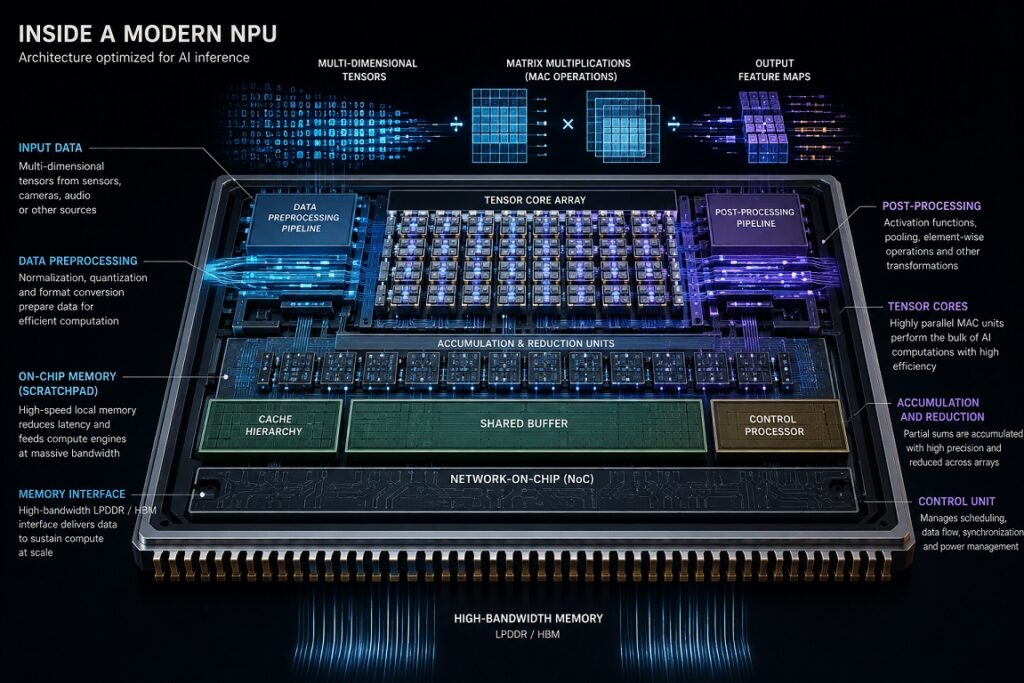
A processor rated at 10 TOPS can theoretically perform:
10×1012 operations per second
In practical terms, TOPS is intended to describe raw AI inference throughput.
The keyword here is theoretical. Real-world performance is usually significantly lower.
Why AI Hardware Uses TOPS Instead of FLOPS
Traditional high-performance computing relied on FLOPS, or Floating Point Operations Per Second. Scientific computing, physics simulations, and graphics rendering all depend heavily on floating-point arithmetic.
Modern AI inference workloads are different.
Most inference systems no longer require 32-bit floating-point precision. Quantized neural networks can often run effectively using:
- FP16
- BF16
- INT8
- INT4
- Binary operations
Lower precision reduces memory bandwidth requirements and dramatically increases throughput. Because many AI accelerators now operate primarily on integer arithmetic, vendors began using OPS and TOPS rather than FLOPS.
The distinction matters because a chip optimized for INT8 inference may deliver enormous TOPS numbers while offering relatively modest floating-point performance.
How TOPS Is Calculated
The simplified formula is straightforward:
Suppose an AI accelerator performs 4096 integer operations per clock cycle and runs at 1.5 GHz:
In reality, modern accelerators include thousands of parallel MAC units operating simultaneously across tensor cores or systolic arrays.
Most vendors calculate TOPS using peak throughput under ideal laboratory conditions:
- Fully utilized compute units
- Optimal tensor shapes
- Data already in cache
- No thermal throttling
- No memory bottlenecks
- Reduced numerical precision
As a result, advertised TOPS values should be treated as peak theoretical ceilings rather than sustained performance expectations.
The Importance of Precision
One of the biggest problems with TOPS marketing is that precision is often omitted.
A chip advertised as “100 TOPS” may only achieve that number using INT4 arithmetic. The same hardware could deliver dramatically lower throughput using FP16 or FP32.
This distinction is critical because different AI workloads require different levels of numerical accuracy.
Common precision formats include:
| Precision | Typical Use Case | Relative Throughput |
|---|---|---|
| FP32 | Training, scientific AI | Lowest |
| FP16 | Training and inference | Medium |
| BF16 | Large-scale training | Medium |
| INT8 | Efficient inference | High |
| INT4 | Aggressive quantization | Very high |
A processor capable of 200 INT4 TOPS is not necessarily faster in practical AI workloads than one delivering 50 FP16 TOPS.
Without precision context, TOPS numbers are nearly meaningless.
TOPS vs Real-World Performance
Consumers often assume that a higher TOPS value automatically means better AI performance. That assumption is frequently incorrect.
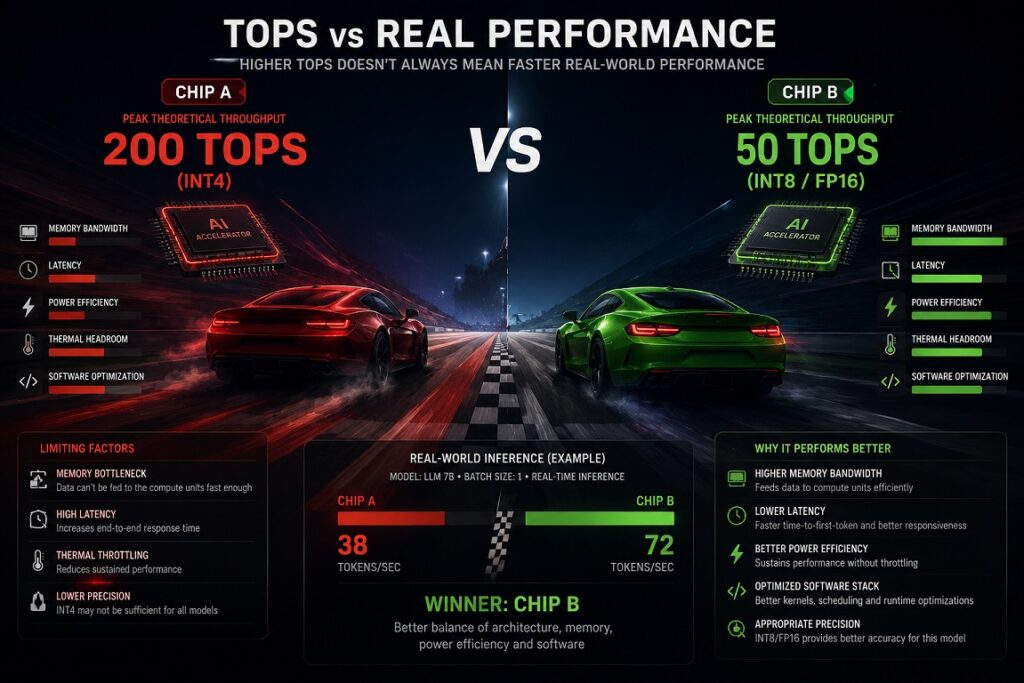
Actual inference speed depends on many factors:
Memory Bandwidth
AI accelerators are often limited by data movement rather than arithmetic throughput. If tensors cannot be delivered to compute units fast enough, utilization collapses.
Model Architecture
Different neural networks stress hardware differently. Transformers, CNNs, diffusion models, and recommendation systems each produce unique workload patterns.
Software Stack
Compiler quality, kernel optimization, graph scheduling, and runtime frameworks significantly affect sustained performance.
Thermal Constraints
Mobile and embedded systems may advertise high TOPS values but cannot sustain them for long periods due to thermal limits.
Sparsity Support
Some vendors count sparse operations toward TOPS calculations. Sparse acceleration can improve throughput dramatically, but only for compatible models.
Batch Size
Large batch inference increases hardware utilization. Edge devices running real-time single-batch inference rarely approach theoretical TOPS limits.
Why Comparing TOPS Across Vendors Is Difficult
TOPS lacks standardization.
Unlike some traditional CPU benchmarks, there is no universally enforced methodology for calculating AI throughput. Vendors may use different assumptions regarding:
- Precision
- Sparsity
- Clock frequency
- Thermal state
- Data locality
- Tensor utilization
- Batch configuration
This creates highly inconsistent marketing claims.
For example:
- Vendor A may report dense INT8 throughput.
- Vendor B may include sparse acceleration.
- Vendor C may quote burst performance only.
- Vendor D may combine CPU, GPU, and NPU throughput into a single number.
As a result, two chips with identical TOPS ratings can deliver dramatically different real-world inference performance.
TOPS in Edge AI
TOPS has become especially important in edge computing.
Devices such as:
- Smart cameras
- Drones
- Industrial robots
- Automotive systems
- AR glasses
- Smartphones
must run AI inference locally with strict power constraints.
In these environments, performance-per-watt often matters more than raw TOPS.
An edge accelerator delivering 20 TOPS at 3 watts may be more valuable than a 100 TOPS accelerator consuming 40 watts.
This is one reason why modern semiconductor companies increasingly emphasize efficiency metrics alongside raw throughput.
TOPS and Autonomous Vehicles
Automotive AI platforms are among the most aggressive users of TOPS marketing.
Self-driving systems process enormous sensor streams from:
- Cameras
- LiDAR
- Radar
- Ultrasonic sensors
- Mapping systems
Automotive vendors often advertise hundreds or thousands of TOPS to demonstrate their ability to handle perception and planning workloads in real time.
However, autonomous driving stacks involve far more than neural network arithmetic. System latency, redundancy, safety certification, memory architecture, and deterministic execution are equally important.
A larger TOPS number alone does not guarantee superior autonomous driving capability.
The Rise of NPUs in Consumer Devices
The recent explosion of generative AI has accelerated adoption of NPUs inside consumer hardware.
Modern laptops and smartphones now include dedicated AI engines for:
- Local LLM inference
- Image generation
- Speech recognition
- Real-time translation
- Video enhancement
- AI-assisted operating system features
This trend has transformed TOPS into a mainstream consumer specification.
Microsoft’s Copilot+ PC initiative, for example, introduced minimum NPU performance requirements measured directly in TOPS.
As AI workloads move increasingly onto local devices, TOPS is likely to become as familiar to consumers as GHz once was.
TOPS vs TFLOPS
TOPS and TFLOPS are related but not interchangeable.
TFLOPS measures floating-point throughput:
TFLOPS=Trillions of floating-point operations per second
TOPS measures general operations, often integer-based.
In modern AI accelerators:
- TFLOPS is more relevant for training.
- TOPS is more common for inference.
Some hardware supports both metrics simultaneously depending on precision mode.
For example, a GPU may deliver:
- 80 TFLOPS FP16
- 320 TOPS INT8
- 640 TOPS INT4
These are not contradictory numbers. They represent different arithmetic formats and execution paths.
Why Marketing Around TOPS Can Be Misleading
TOPS is useful, but it is also highly marketable.
Large numbers are easy to advertise, especially when precision and methodology are hidden in footnotes.
Several common tactics inflate perceived AI performance:
Using Extremely Low Precision
INT4 and binary operations produce massive throughput figures but may not support all models effectively.
Counting Sparse Operations
Sparse acceleration can double theoretical throughput under ideal conditions.
Combining Multiple Compute Engines
Some SoCs aggregate CPU, GPU, DSP, and NPU performance into a single TOPS figure.
Reporting Burst Rather Than Sustained Performance
Short-duration peak throughput may not reflect real deployment conditions.
Ignoring Power Consumption
Two chips with identical TOPS ratings may differ radically in efficiency.
This is why engineers rarely evaluate AI hardware using TOPS alone.
Better Metrics for Evaluating AI Hardware
TOPS remains useful as a rough indicator of theoretical capability, but it should never be treated as a standalone benchmark.
More meaningful evaluation criteria include:
- Inference latency
- Tokens per second
- Frames per second
- Performance per watt
- Memory bandwidth
- Real benchmark results
- Supported model architectures
- Software ecosystem maturity
- Quantization support
- Thermal sustainability
Industry benchmarks such as MLPerf provide significantly more reliable comparisons because they measure actual workloads under standardized conditions.
The Future of TOPS
TOPS will likely remain a dominant marketing metric throughout the AI hardware industry, particularly for edge inference devices.
At the same time, the metric is becoming less representative as modern AI systems evolve toward:
- Larger transformer architectures
- Memory-intensive workloads
- Mixture-of-experts models
- Long-context inference
- Agentic AI systems
In many next-generation workloads, memory movement and interconnect efficiency matter as much as arithmetic throughput.
The industry may eventually shift toward more holistic metrics that better capture end-to-end AI system performance.
For now, however, TOPS remains the simplest shorthand for communicating theoretical AI compute capability.
Conclusion
TOPS is one of the most visible and least understood metrics in modern AI hardware.
At its core, it measures the theoretical number of operations a processor can execute per second. In practice, the value depends heavily on precision, workload characteristics, memory bandwidth, thermal conditions, software optimization, and power efficiency.
A larger TOPS number does not automatically translate into better AI performance.
Understanding how vendors calculate TOPS, what arithmetic precision they use, and how their hardware behaves under real workloads is essential for making meaningful comparisons between AI accelerators.
As AI increasingly moves from data centers into edge devices, TOPS will continue to appear across product specifications, investor presentations, and semiconductor marketing campaigns. Engineers, developers, and technically literate consumers should treat the number as a useful starting point, not a definitive measure of AI capability.