How Intelligent Robots Are Evolving: From Smart Automation to Real-Time Intelligence
RoboticsThe term “smart robot” has become so common that it can describe almost any robotic system equipped with sensors, software, or some form of artificial intelligence. Yet there is a substantial difference between a robot that performs a predefined task efficiently and one that can interpret its environment, adapt to unexpected conditions, and make decisions in real time.
This distinction is becoming increasingly important as robotics moves beyond controlled industrial environments. Robots are entering warehouses, hospitals, roads, homes, construction sites, and other spaces where conditions cannot be completely predicted in advance. In these environments, high precision alone is not enough. A robot must be able to perceive what is happening around it, understand the significance of that information, select an appropriate action, and respond quickly enough for the physical world.
That is the transition from smart automation to intelligent robotics.
Modern advances in machine learning, multimodal sensing, edge computing, reinforcement learning, robotics foundation models, and embodied AI are bringing these capabilities closer to practical deployment. However, a genuinely intelligent robot remains an engineering challenge. Real-time reasoning must operate under strict constraints involving latency, power consumption, safety, reliability, computing resources, and incomplete information.
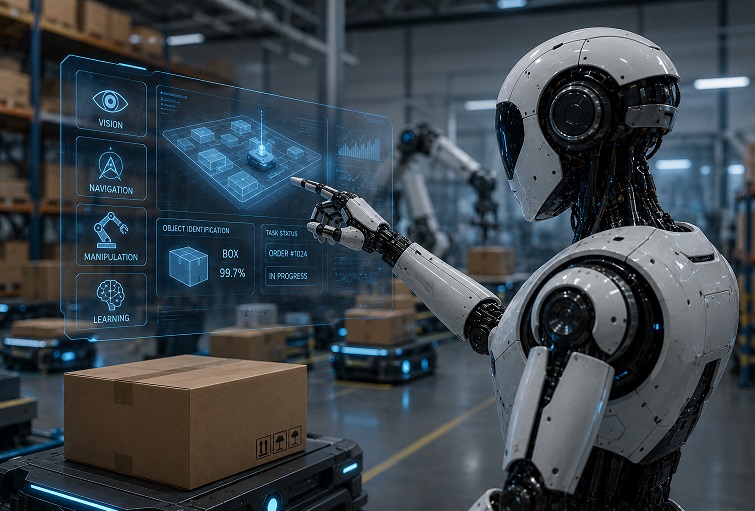
The important question is therefore not whether robots are becoming smarter. They clearly are. The more difficult question is whether current architectures can turn that increased computational capability into robust, real-time intelligence in the physical world.
Smart Robots and Intelligent Robots Are Not the Same Thing
The distinction between smart and intelligent robotics is useful because it highlights two fundamentally different approaches to automation.
A smart robotic system typically performs a predefined task using sensors, control algorithms, machine learning models, and carefully designed decision logic. It may adjust its behavior according to sensor feedback, recognize objects using computer vision, or compensate for small variations in its environment.
Consider an industrial robotic arm used for assembly. A vision system can identify a component, calculate its position, and modify the robot’s trajectory accordingly. The robot is not simply repeating the same movement every time. It is responding to information from the environment.
Nevertheless, its operational intelligence remains constrained by the assumptions built into its software.
If the component is presented in a position outside the expected range, the lighting changes significantly, or an unfamiliar object appears in the workspace, the system may fail. Engineers may need to retrain the vision model, modify the control program, recalibrate the sensors, or introduce additional rules.
This type of automation is extremely valuable. In fact, industrial robotics depends on precisely this combination of predictability, repeatability, and controlled adaptation.
An intelligent robot aims to operate beyond such narrowly defined boundaries.
Instead of simply selecting an action from a known set of possibilities, an intelligent system should be able to interpret unfamiliar situations, infer what is happening, evaluate alternatives, and adapt its behavior without requiring engineers to explicitly program every possible scenario.
The difference can be summarized as follows:
| Capability | Smart automation | Intelligent robotics |
|---|---|---|
| Primary objective | Optimize predefined tasks | Adapt to changing objectives and environments |
| Environment | Structured and predictable | Dynamic and partially unknown |
| Decision-making | Rules, models, constrained policies | Context-aware inference and planning |
| Learning | Usually offline | Increasingly continuous or incremental |
| Generalization | Limited | Broader cross-task generalization |
| Response to novelty | Error, fallback, or reconfiguration | Interpretation and adaptation |
| Computing | Local, cloud, or hybrid | Increasingly edge-centric |
| Human interaction | Structured commands | Intent and context interpretation |
The boundary is not absolute. Many real robotic systems combine both approaches. Deterministic control loops may handle motion and safety while machine learning models deal with perception and higher-level decision-making.
That hybrid architecture is likely to remain important for years to come.
Why Traditional Robotic Architectures Have Reached Their Limits
Conventional industrial robots were designed around a relatively simple assumption: if the environment can be controlled, the robot can be made extremely reliable.
This philosophy works exceptionally well in factories. A robotic arm can repeatedly perform the same operation thousands or millions of times when its workspace, tooling, components, lighting, and operating conditions are carefully controlled.
The problem appears when robots leave those environments.
A warehouse robot cannot assume that every package will be positioned identically. A delivery robot encounters pedestrians, bicycles, vehicles, weather, road construction, and unexpected obstacles. A household robot cannot assume that objects will always be placed in known locations.
The physical world contains ambiguity.
Sensors are noisy. Objects are partially occluded. Lighting changes. People behave unpredictably. Surfaces deform. Mechanical components wear. Communication links become unavailable. A robot may encounter an object that was not included in its training data.
A system optimized for a narrow operating envelope can degrade rapidly when those assumptions are violated.
Cloud computing introduces another limitation. Large AI models can provide substantial reasoning and perception capabilities, but sending sensor data to a remote server and waiting for a response introduces network latency and dependency on connectivity.
For many robotic tasks, that delay is unacceptable.
A robot balancing a payload, avoiding an obstacle, controlling a high-speed manipulator, or maintaining vehicle stability cannot wait hundreds of milliseconds for a remote inference result. Some decisions must happen locally and deterministically.
This is why the development of intelligent robots is closely connected to edge AI.
Embodied AI: Intelligence That Exists in the Physical World
One of the most important concepts in modern robotics is embodied AI.
A conventional AI model can process enormous quantities of text, images, or video without physically interacting with the environment. A robot faces a fundamentally different problem. It must connect perception to physical action.
The robot does not merely need to identify a cup. It needs to understand where the cup is, estimate its orientation, determine whether its gripper can reach it, calculate the required force, account for the possibility that the cup is fragile or slippery, and execute the movement without colliding with surrounding objects.
This relationship between perception and action is central to embodied intelligence.
Robots acquire information through multiple sensory channels. A modern platform may combine:
- RGB and stereo cameras
- Depth sensors
- LiDAR
- Force and torque sensors
- Tactile sensors
- Inertial measurement units
- Joint position and velocity sensors
- Microphones
- Environmental sensors
Sensor fusion allows the robot to build a richer representation of its surroundings than any single sensor can provide.
For example, a camera can identify an object visually, while depth information determines its three-dimensional position and force sensors indicate whether the manipulator has successfully grasped it.
The result is not simply better perception. It creates a feedback loop between sensing, reasoning, movement, and the consequences of movement.
That loop is one of the foundations of embodied intelligence.
Multimodal Perception Is Becoming a Core Robotic Capability
Human beings rarely rely on a single sensory modality when interacting with the physical world. Robotics is moving in the same direction.
A robot operating in a warehouse may simultaneously process visual information, depth measurements, wheel odometry, inertial data, and information from its manipulation system. An autonomous vehicle combines cameras, radar, LiDAR, GPS, inertial measurements, and maps.
The challenge is not merely collecting these signals. The system must synchronize and interpret them.
Multimodal AI provides a potential solution by allowing different forms of information to be represented and processed within a common computational framework.
This is particularly important for understanding context.
Suppose a robot sees a person reaching toward a box. Vision alone may indicate the person’s position, but temporal information and learned models of human behavior can help the robot infer that the person is about to pick up the box. The robot could then adjust its trajectory or wait.
Such behavior requires more than object recognition. It requires interpretation of relationships and events over time.
From Perception to Action: The Role of Reinforcement Learning
Perception tells a robot what is happening. It does not necessarily tell the robot what it should do next.
Reinforcement learning provides one approach to this problem.
In reinforcement learning, an agent learns a policy by interacting with an environment and receiving feedback associated with its actions. Successful behavior is reinforced, while unsuccessful behavior is penalized.
This approach is particularly attractive for robotics because many robotic tasks are inherently sequential. Moving a manipulator from point A to point B is not sufficient. The robot must find a sequence of movements that achieves the objective while respecting constraints involving collisions, energy consumption, joint limits, stability, and timing.
Training robots directly in the physical world, however, is expensive and potentially dangerous.
Simulation therefore plays a major role. A robot can perform millions of virtual trials without damaging hardware or endangering people. Once a useful policy has been learned, it can be transferred to a physical robot.
This process is commonly known as sim-to-real transfer.
The remaining challenge is the reality gap. Simulations are approximations. Physical objects deform, motors behave differently from mathematical models, sensors introduce noise, and friction is difficult to reproduce accurately.
Successful intelligent robotics therefore requires not only powerful learning algorithms but also increasingly realistic simulation environments and robust methods for transferring learned behavior to physical hardware.
Why Edge AI Matters for Real-Time Robotics
The increasing computational demands of AI create a fundamental architectural problem.
Large neural networks can provide better perception, planning, and reasoning, but running them requires substantial processing power. Robots, meanwhile, have strict constraints on size, thermal dissipation, energy consumption, and response time.
The solution is increasingly based on heterogeneous edge computing.
Instead of relying on a single general-purpose processor, modern robotic platforms can combine CPUs, GPUs, NPUs, DSPs, microcontrollers, and dedicated accelerators. Each processing element handles workloads for which it is best suited.
For example, a real-time microcontroller can manage safety-critical control loops, while a GPU or NPU processes camera data and neural network inference. A CPU can coordinate high-level software, and a dedicated accelerator can handle specific signal-processing workloads.
This architecture makes it possible to keep latency-sensitive functions local while reserving more computationally expensive processing for suitable hardware.
The advantage is not limited to speed.
Local inference also reduces network bandwidth requirements, improves resilience when connectivity is unavailable, and can keep sensitive sensor information inside the robot rather than transmitting it to an external cloud service.
For autonomous machines, these characteristics are essential.
Foundation Models Could Change How Robots Are Programmed
One of the most significant developments in AI is the emergence of foundation models.
Instead of developing a separate neural network for every robotic task, researchers are exploring models that can be trained on large and diverse datasets and subsequently adapted to many different applications.
In robotics, the objective is to build models capable of understanding combinations of language, vision, spatial relationships, and actions.
A user could potentially tell a robot to “move the smaller box to the empty shelf,” without specifying coordinates, object IDs, motion trajectories, or gripper commands.
The system would need to translate natural language into an actionable representation, identify the relevant objects, understand their spatial relationships, plan a sequence of actions, execute that sequence, and verify the result.
This represents a major shift from conventional robot programming.
Instead of describing exactly how the robot should perform a task, the operator describes what should be accomplished.
The challenge is reliability.
A foundation model that produces a plausible answer in a chatbot is not necessarily suitable for controlling a machine that can damage equipment or injure a person. Physical actions have consequences, and robotic AI therefore requires substantially stronger guarantees than ordinary software systems.
Real-Time Intelligence Requires More Than a Large Model
It is tempting to assume that increasing the size of a neural network will eventually solve robotic intelligence.
That is unlikely to be sufficient.
Robotic intelligence is a systems problem. The model is only one component of the overall architecture.
A capable robot needs at least several tightly integrated layers:
- Perception, which converts raw sensor signals into meaningful representations.
- State estimation, which determines the robot’s position and the state of the surrounding environment.
- World modeling, which maintains information about objects, people, and events.
- Reasoning and planning, which determines possible actions and their consequences.
- Control, which converts plans into precise physical movements.
- Safety supervision, which prevents unacceptable behavior.
- Learning, which allows the system to improve from new experiences.
These layers operate on different timescales.
A motor-control loop may need to execute every few milliseconds. Object detection can operate at tens of frames per second. High-level planning can take considerably longer.
Trying to force every function through a single large model can therefore be inefficient and potentially unsafe.
A more realistic architecture is hierarchical. Fast deterministic control operates underneath slower AI-driven perception, reasoning, and planning.
This separation allows the robot to remain stable and safe even when higher-level AI components are uncertain.
The Problem of Lifelong Learning
A genuinely intelligent robot should not remain frozen after leaving the factory.
Real environments change continuously. New objects appear, workflows evolve, mechanical components degrade, and users behave differently.
This creates the need for lifelong learning.
The concept sounds straightforward: allow a robot to learn from experience throughout its operational lifetime. In practice, it is one of the hardest problems in machine learning.
One major obstacle is catastrophic forgetting. When a model learns new information, it can unintentionally degrade its performance on previously learned tasks.
Robots therefore need mechanisms that allow them to incorporate new knowledge without destroying existing capabilities.
Another problem is data efficiency. Humans can often learn a physical task from a handful of demonstrations. Robots typically require far more data, particularly when the task involves complex contact dynamics.
Researchers are investigating approaches including imitation learning, reinforcement learning, continual learning, self-supervised learning, and increasingly sophisticated simulation environments.
The ultimate goal is a robot that can improve from experience without requiring engineers to periodically rebuild its entire intelligence stack.
Safety Is a Fundamental Constraint
The transition from smart automation to intelligent robotics also changes the way safety must be designed.
Traditional industrial robots can be made relatively predictable because their behavior is tightly constrained. AI-driven systems introduce probabilistic components that may produce unexpected outputs.
That creates a difficult engineering problem.
A robot cannot simply be allowed to explore arbitrary behavior in the real world. In a manufacturing environment, an incorrect movement could damage equipment. In healthcare, the consequences could be considerably more serious.
Future intelligent robots will therefore require layered safety architectures.
These may include deterministic safety controllers, physical limits, collision detection, redundant sensors, runtime monitors, restricted action spaces, confidence estimation, and emergency shutdown mechanisms.
The AI system can propose an action, but a separate safety layer may determine whether that action is physically permissible.
This principle is particularly important as robots become more autonomous.
Energy Efficiency Is Just as Important as Compute Performance
Another barrier is energy consumption.
A stationary industrial robot can draw substantial power from the electrical grid. A mobile robot, drone, wearable device, or autonomous vehicle cannot rely on unlimited energy.
Running large multimodal models continuously can consume significant computational resources.
This makes hardware acceleration and model optimization critical.
Quantization, pruning, knowledge distillation, sparse computation, efficient attention mechanisms, and specialized AI accelerators can reduce the computational cost of inference.
Heterogeneous computing also allows the system to power up expensive processing only when required.
For example, a low-power processor can continuously monitor basic sensors while activating a more powerful neural accelerator when a relevant event is detected.
The future of intelligent robotics will therefore depend not only on increasingly capable AI models but also on increasingly efficient hardware.
Where Real-Time Intelligent Robots Are Most Likely to Appear First
Some applications are better suited to intelligent robotics than others.
Warehousing and logistics
Warehouses are structured enough to provide useful constraints while still containing substantial variability. Robots can identify packages, navigate dynamic environments, collaborate with workers, and adapt to changing inventory.
Autonomous vehicles
Road environments are highly dynamic and cannot be completely predetermined. Autonomous vehicles must interpret traffic participants, road conditions, signs, and unexpected events in real time.
Healthcare
Robotic systems can assist with rehabilitation, patient monitoring, surgery, and logistics. However, safety and regulatory requirements make this one of the most demanding areas for adaptive AI.
Manufacturing
Factories remain one of the strongest applications for smart automation, but intelligent robotics can expand automation into tasks that are currently too variable for conventional systems.
Agriculture
Outdoor environments introduce weather, terrain, biological variability, and constantly changing objects. Intelligent perception and adaptive control can make robotic harvesting, inspection, and field maintenance more practical.
Construction
Construction sites are far less structured than factories. Robots must deal with changing layouts, uneven surfaces, human workers, and materials that vary in position and condition.
Service and domestic robotics
Homes represent one of the hardest environments because they contain almost unlimited variability. A household robot must cope with unfamiliar objects, clutter, people, pets, changing lighting, and natural-language instructions.
This is precisely the type of environment where the limitations of traditional automation become obvious.
What Would a Truly Intelligent Robot Look Like?
The defining characteristic of an intelligent robot will not simply be its ability to execute more tasks.
It will be the ability to determine how to approach a task when the exact solution has not been specified.
Such a robot could receive an objective, inspect its surroundings, determine what information is missing, plan an appropriate sequence of actions, execute that plan, observe the results, and change strategy when something goes wrong.
For example, imagine a warehouse robot instructed to prepare an order.
A conventional system might follow a fixed sequence of coordinates. A more advanced robot could identify the required items, locate them in an unfamiliar arrangement, select an appropriate manipulation strategy, recognize that one item is damaged, report the problem, substitute another item if permitted, and continue the task.
That is a qualitatively different form of automation.
The robot is no longer simply executing a program. It is interpreting an objective and adapting its behavior to achieve it.
The Remaining Technical Barriers
Several major problems must be solved before this vision becomes widespread.
Generalization
A model trained on millions of examples can still fail when confronted with a situation that differs substantially from its training distribution.
Real-time constraints
Reasoning models can require significant computational resources. Robots cannot always tolerate the latency associated with complex inference.
Data collection
Robotic data is expensive because it must be generated through physical interaction or highly realistic simulation.
Sim-to-real transfer
A policy that works perfectly in simulation can fail when transferred to physical hardware.
Multimodal integration
Combining vision, tactile sensing, audio, language, spatial information, and proprioception into one coherent representation remains difficult.
Hardware constraints
Robots require compact, thermally manageable, and energy-efficient computing platforms.
Safety and verification
Probabilistic AI behavior must coexist with deterministic safety requirements.
Cybersecurity
Connected robots create new attack surfaces. Compromising perception, control software, communication interfaces, or model-update mechanisms could have direct physical consequences.
These challenges are interconnected. Solving one does not automatically solve the others.
The Future: From Programmed Machines to Adaptive Systems
The evolution of robotics is unlikely to produce a sudden moment when machines become “intelligent.” Instead, the transition will occur through gradual integration of increasingly capable technologies.
Smart automation will remain dominant wherever environments can be controlled and tasks are repetitive. There is little reason to replace a deterministic system with a complex AI architecture when a conventional controller already performs the job reliably.
Intelligent robotics will become increasingly important in environments where variability is unavoidable.
The most capable systems will probably combine both approaches. Deterministic controllers will handle timing-critical and safety-critical operations, while AI models will provide perception, reasoning, prediction, and adaptation.
Foundation models will provide broader knowledge and generalization. Multimodal perception will give robots a richer understanding of their surroundings. Reinforcement and imitation learning will improve physical skills. Edge AI will reduce latency and dependence on cloud infrastructure. Continual learning will allow systems to adapt to changing conditions.
The result will not necessarily be a machine that thinks like a human. Human intelligence is not the only useful reference point for robotics.
A successful intelligent robot may instead have a form of machine intelligence optimized for physical interaction: fast perception, reliable spatial reasoning, precise control, strong situational awareness, and the ability to adapt without losing previously acquired capabilities.
Conclusion
The robotics industry is moving beyond the idea that a robot is intelligent simply because it contains sensors, machine learning, or sophisticated control software.
Smart robots already perform remarkably complex tasks, but their capabilities are usually bounded by carefully defined operating conditions. The next stage is to build machines that can cope with uncertainty, interpret context, learn from experience, and adapt their behavior while operating in the physical world.
That transition requires much more than larger neural networks. It depends on the convergence of embodied AI, multimodal perception, reinforcement learning, foundation models, edge computing, heterogeneous processors, simulation, continual learning, and robust safety architectures.
The most important change may therefore be architectural rather than purely algorithmic. Future robots will increasingly combine fast deterministic control with slower but more capable reasoning systems, allowing each layer to operate at the timescale and level of reliability appropriate to its task.
The ultimate measure of robotic intelligence will not be how efficiently a machine repeats a known procedure. It will be how reliably it handles situations that its designers did not fully anticipate.
That is the point at which smart automation begins to become real-time machine intelligence.