Why Traditional AI Training Fails to Build Real AI Skills in 2026
AI AI TrainingArtificial intelligence has moved from an experimental technology to a standard part of enterprise software. Companies are deploying generative AI assistants, machine learning systems, automated analytics, and AI-powered development tools across departments. At the same time, many organizations are investing heavily in employee training.
Yet a persistent contradiction remains. Employees have more opportunities to learn about AI than ever before, while organizations continue to report a shortage of practical AI skills.
A 2026 survey of more than 500 enterprise leaders in the United States and United Kingdom illustrates the problem. Some form of AI training is offered by 82% of organizations, and 68% provide employees with access to AI learning resources. Nevertheless, only 35% describe their AI upskilling efforts as mature and organization-wide. At the same time, 59% report an AI skills gap.
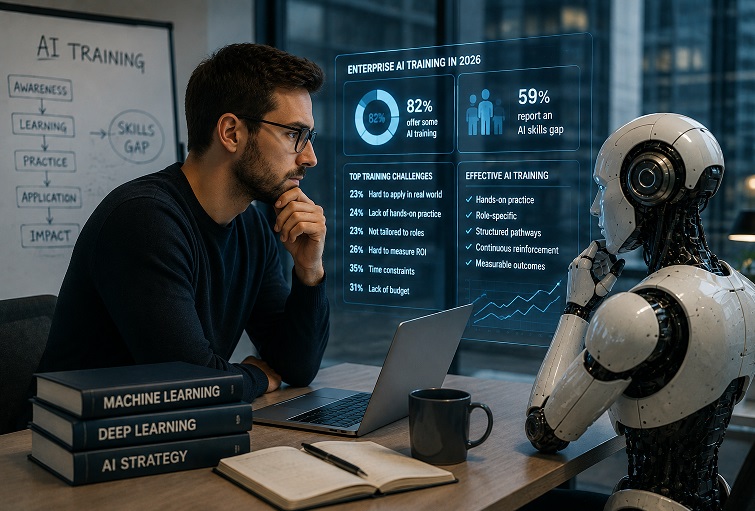
The numbers suggest that the central problem is no longer access to AI education. It is the ability to turn education into measurable workplace capability.
Traditional corporate training was designed around relatively stable technologies and clearly defined competencies. AI does not behave that way. Models, tools, interfaces, workflows, and best practices change continuously. Employees therefore need more than an introduction to AI concepts. They need a system that allows them to practice, evaluate, adapt, and repeatedly apply AI within the context of their actual work.
The Difference Between AI Awareness and AI Competence
There is an important distinction between knowing what AI can do and being able to use it effectively.
An employee may understand the basic principles of generative AI, know what a large language model is, and recognize common AI risks. None of this necessarily means that the employee can incorporate AI into a production workflow.
Practical AI competence involves several additional capabilities:
- identifying tasks that are suitable for AI assistance;
- selecting an appropriate model or tool;
- providing sufficiently precise instructions and context;
- evaluating generated output;
- detecting hallucinations and factual errors;
- protecting confidential information;
- integrating AI into existing software and processes;
- measuring whether the resulting workflow is actually better.
This difference explains why many organizations can have high participation rates in AI training while still struggling to achieve meaningful productivity gains.
The issue is not whether employees have encountered AI. It is whether they can use it reliably and responsibly when solving real business problems.
1. Passive Learning Does Not Create Practical AI Skills
One of the most persistent weaknesses in corporate AI education is the dominance of passive learning.
Online courses, recorded lectures, presentations, and occasional instructor-led sessions remain common. According to the survey, 40% of organizations primarily combine online learning with periodic instructor-led training. These formats are convenient and scalable, but convenience does not guarantee competence.
Among surveyed leaders, 23% said video-based courses make it difficult for employees to apply what they have learned in real-world situations. Another 24% identified the lack of hands-on projects or practical laboratories as a significant problem.
This is especially important with generative AI.
Learning how prompt engineering works is fundamentally different from developing a reliable workflow that uses an LLM to summarize technical documents, classify incoming requests, generate software test cases, or assist with financial analysis.
AI skills are procedural. They develop through repeated interaction with tools, exposure to failures, comparison of alternative approaches, and feedback.
A useful training sequence therefore looks less like a traditional lecture and more like an engineering workflow:
Concept → demonstration → practical task → failure analysis → iteration → evaluation → deployment
Without this feedback cycle, employees often finish training with conceptual familiarity but little operational confidence.
2. Generic AI Training Rarely Matches the Employee’s Job
A second problem is the assumption that AI literacy is essentially the same for everyone.
An HR specialist, software engineer, financial controller, industrial designer, sales manager, and data scientist may all need to understand AI, but their practical requirements are radically different.
A software developer may need training in:
- code generation and review;
- automated testing;
- repository-level AI assistants;
- debugging;
- API integration;
- secure use of proprietary source code.
A finance professional may instead need to learn how to automate spreadsheet analysis, extract information from financial documents, construct forecasting workflows, and validate AI-generated calculations.
A manufacturing engineer may benefit from AI-assisted predictive maintenance, machine-vision systems, anomaly detection, sensor-data analysis, and edge inference.
Generic AI training rarely provides this connection between technology and work.
The survey reinforces the problem. Approximately 23% of leaders identified insufficient role-specific tailoring as a weakness of online learning, while 21% reported that employees have difficulty understanding where to begin.
A successful program should therefore start with workflows rather than technologies.
Instead of asking, “How do we teach employees generative AI?”, organizations should ask, “Which parts of this employee’s work can be improved with AI, and what skills are required to do that safely?”
That change in perspective has significant consequences for curriculum design.
3. AI Training Often Has No Clear Definition of Success
Traditional training programs frequently measure participation rather than capability.
The organization knows how many employees completed a course, how many hours they spent learning, or how many certificates were issued. These metrics are easy to collect, but they do not necessarily demonstrate business value.
Among the surveyed leaders, 26% reported difficulties measuring the ROI of training programs, while 15% identified the lack of certification or objective proof of skills as a problem.
For AI training, the measurement challenge is particularly important because organizations are simultaneously under pressure to justify AI investments.
A meaningful measurement framework should go beyond course completion. It can include several layers:
Knowledge
Can the employee explain fundamental AI concepts and limitations?
Practical skill
Can the employee complete a realistic task using an AI system?
Reliability
Can the employee identify incorrect, incomplete, or misleading model output?
Workflow impact
Does AI reduce processing time, improve quality, or increase throughput?
Business impact
Does the resulting workflow produce measurable value for the organization?
For example, an AI training program for customer support could measure not only whether employees completed a course but also whether trained employees resolve tickets faster, maintain quality scores, and use AI-generated responses appropriately.
This creates a direct connection between training expenditure and operational outcomes.
4. One-Time AI Workshops Become Obsolete Quickly
Another fundamental problem is the speed at which AI technology changes.
A traditional enterprise course may remain relevant for several years. AI training has a much shorter shelf life.
Model capabilities change. New interfaces appear. Vendors introduce new features. Context windows increase. Multimodal models become more capable. Agentic systems acquire access to tools and enterprise data. Security and regulatory requirements evolve alongside them.
As a result, AI competence cannot realistically be treated as a one-time certification.
A workshop held in January may teach employees how to use a particular interface, while the same interface may have changed significantly by the end of the year.
Effective AI education therefore needs continuous reinforcement. Organizations should provide employees with opportunities to revisit concepts, experiment with new tools, receive feedback, and learn from changes in their own workflows.
The training model needs to resemble software development more closely than conventional classroom education: iterative, continuously updated, and connected to changing requirements.
5. AI Training Must Address Risk, Not Just Productivity
Another weakness in many AI education programs is excessive focus on productivity.
Employees are shown how to generate text, summarize documents, analyze information, or create code. Less attention may be given to the consequences of using AI incorrectly.
That creates a significant operational risk.
A competent AI user should understand at least the fundamentals of:
- hallucinations and fabricated information;
- data leakage;
- confidential and regulated information;
- intellectual-property considerations;
- prompt injection;
- model bias;
- insufficient source verification;
- excessive dependence on automated recommendations;
- security implications of AI agents with tool access.
This is particularly important as organizations move from simple chatbots toward systems that can interact with databases, software repositories, business applications, and external services.
An employee who knows how to use an AI assistant but does not understand its security boundaries can create more risk than value.
AI literacy therefore has to combine productivity skills with operational judgment.
6. AI Training Should Reflect the Actual Technology Stack
There is another practical consideration that generic training often overlooks: companies rarely use AI in isolation.
Enterprise AI workflows are normally built around a technology stack that can include cloud platforms, internal databases, SaaS applications, APIs, data warehouses, identity systems, collaboration tools, and security controls.
Consequently, the useful question is not simply whether an employee knows how to use an LLM.
The more relevant question is whether that employee understands how AI fits into the organization’s technical environment.
For technical teams, this may involve learning how to work with model APIs, retrieval-augmented generation, vector databases, structured outputs, function calling, evaluation frameworks, and observability systems.
For nontechnical teams, the same principle applies at a different level. Employees need to understand which approved AI tools are available, what information they can safely provide, when human verification is required, and how AI output should enter existing business processes.
The closer training is to the actual technology stack, the more likely it is to produce measurable adoption.
From Courses to AI Capability Systems
The most effective organizations are beginning to treat AI training as an ongoing capability system rather than a collection of courses.
Such a system typically combines several components.
Structured learning
Employees still need foundational material. Concepts such as machine learning, generative AI, model limitations, prompting, and AI security provide the necessary baseline.
Practical exercises
Theoretical knowledge should immediately be followed by realistic tasks. These exercises should resemble the employee’s actual work rather than generic demonstrations.
Role-specific pathways
Different employees should receive different training based on their responsibilities, technical background, and expected AI use cases.
Real business projects
Capstone projects are particularly valuable because they force learners to move beyond experimentation. An employee might use AI to automate a reporting process, build a document-analysis workflow, improve data preparation, or prototype an internal assistant.
Continuous reinforcement
Skills should be revisited as employees encounter new tools and new problems.
Evaluation
Organizations need objective ways to determine whether employees have developed practical competence.
Governance
Training should also explain how AI may be used safely within the organization’s security, privacy, compliance, and data-management framework.
This combination creates a much stronger feedback loop between learning and business operations.
Why Real Projects Matter
The transition from theoretical knowledge to practical competence is perhaps the most important part of the entire model.
Consider an employee who completes a course explaining neural networks, generative AI, or data analytics. The course may provide a strong conceptual foundation, but the employee has not necessarily demonstrated the ability to solve a real problem.
A project changes the situation.
The learner must identify a problem, select an appropriate technique, work with imperfect data, evaluate results, deal with errors, and explain the outcome to other stakeholders.
This is where the real value of training emerges.
Programs such as Bayer’s Data Academy illustrate this approach. The company has combined broad learning resources covering areas such as data analytics, statistics, machine learning, SQL, and generative AI with practical capstone projects. Employees can apply their knowledge to real organizational use cases rather than stopping after course completion.
The underlying principle is more important than the specific training provider: practical capability is built when learning becomes part of actual work.
The Role of Managers in AI Upskilling
AI training is also unlikely to succeed if it is treated solely as an HR responsibility.
Managers play an important role because they understand where AI can generate value within a particular team.
A manager can identify repetitive workflows, bottlenecks, manual data processing, documentation requirements, and other tasks that may be suitable for automation or augmentation.
Managers also determine whether employees have enough time to experiment.
This is significant because 35% of surveyed leaders identified time constraints as the leading obstacle to improving AI skills. Another 31% pointed to budget limitations.
If employees are expected to develop AI capabilities entirely outside their normal workload, participation may be high initially but sustained adoption will be difficult.
AI learning needs to be incorporated into the work itself.
AI Training Should Be Embedded Into Workflows
The strongest model is not necessarily to remove employees from their jobs for several days of training.
Instead, organizations can introduce learning directly into the workflows where AI is being adopted.
For example, a company implementing an AI-assisted customer service system could train employees while they are using the system. Training can cover how to evaluate suggested responses, when to override the model, how to provide useful feedback, and how to identify problematic outputs.
Similarly, developers adopting AI coding assistants can learn through real repositories and controlled development tasks rather than artificial exercises.
This approach has two benefits. Employees develop skills in the environment where those skills will actually be used, and the organization obtains direct evidence of whether the technology is delivering value.
The Emerging Role of AI Skill Benchmarks
As AI becomes a standard component of knowledge work, companies will increasingly need standardized ways to describe AI competence.
A useful benchmark could evaluate employees across several dimensions:
| Capability | Example assessment |
|---|---|
| AI fundamentals | Explain model capabilities and limitations |
| Prompting and context | Construct reliable instructions for a defined task |
| Output evaluation | Identify hallucinations and unsupported claims |
| Workflow integration | Incorporate AI into an existing business process |
| Tool selection | Select an appropriate model or application |
| Data handling | Apply organizational data-security requirements |
| Automation | Build or configure a repeatable AI-assisted workflow |
| Governance | Recognize situations requiring human review |
Such benchmarks can provide organizations with a much clearer picture of where skills are strong and where additional investment is required.
They also create a common language between employees, managers, IT departments, and executives.
What Happens When Training Fails
Poorly designed AI education tends to produce a predictable set of outcomes.
Employees experiment with AI but do not develop confidence in its reliability. They use models for simple tasks but fail to identify higher-value applications. Some employees may avoid AI entirely because they do not understand how it fits into their work.
There is also a more dangerous outcome: employees may use AI extensively without understanding its limitations.
This can result in fabricated information being accepted as fact, confidential data being entered into unauthorized systems, insecure automation being deployed, or AI-generated code reaching production without sufficient review.
At the organizational level, this produces a strange combination of high AI adoption and low AI maturity.
The company owns the tools, employees have access to them, and training has been completed, but measurable productivity and business value remain limited.
A Better Model for Enterprise AI Education
A mature AI training strategy can be organized around a continuous cycle:
Assess → Learn → Practice → Apply → Measure → Improve
The first stage identifies current skills and business requirements. Training then provides the necessary foundation. Employees practice with realistic scenarios and subsequently apply their skills to actual workflows.
The organization measures both competence and business outcomes. Those measurements are then used to improve the next training cycle.
This approach also allows training programs to evolve alongside the technology.
When a new model, AI coding assistant, enterprise agent, or automation platform becomes available, the organization does not need to rebuild its entire education strategy. It can incorporate the new technology into an existing capability framework.
The Future of AI Training Is Not More Content
The rapid expansion of AI has created an understandable response from enterprises: provide employees with more courses, more tutorials, more webinars, and more learning resources.
But information availability is no longer the primary constraint.
Employees already have access to enormous amounts of AI-related information. The problem is converting that information into reliable skills.
The next generation of enterprise AI training will therefore be defined by integration rather than volume.
Successful programs will connect education to actual workflows, provide role-specific learning paths, emphasize hands-on experimentation, establish measurable skill benchmarks, and continuously reinforce knowledge as AI systems evolve.
The organizations that close the AI skills gap will not necessarily be those that provide the most training hours. They will be those that create the strongest connection between learning and work.
AI literacy is becoming a form of organizational infrastructure. Like cybersecurity awareness, software engineering practices, or data literacy, it cannot be treated as a one-time initiative.
The objective is not simply to teach employees what AI is. It is to build a workforce capable of deciding where AI should be used, applying it effectively, recognizing when it fails, and integrating it into business processes without compromising security or quality.
In 2026, that distinction is becoming increasingly important. Access to AI is becoming ubiquitous. Practical AI capability is not.
The organizations that understand this difference will be better positioned to turn their investment in AI from an experiment into a sustained competitive advantage.