LPWAN for Industrial IoT: LoRaWAN vs. NB-IoT for Connected Industrial Systems
Electronics IoT, LoRaIndustrial IoT deployments are expanding far beyond simple telemetry. Modern factories, utilities, logistics networks, and infrastructure operators increasingly rely on distributed sensors that must operate for years, communicate over long distances, and remain inexpensive to deploy and maintain. Many of these devices are installed in locations where wired connectivity is impractical and regular battery replacement is costly.
This combination of long range, low power consumption, low device cost, and scalable connectivity has made Low Power Wide Area Networking (LPWAN) an important part of the industrial IoT technology stack.
Two technologies are particularly relevant to industrial deployments: LoRaWAN, an open LPWAN protocol designed around low-power operation in unlicensed spectrum, and NB-IoT, a 3GPP cellular technology designed specifically for massive machine-type communications. Both can connect large numbers of sensors and remote devices, but they make fundamentally different architectural assumptions.
LoRaWAN gives organizations considerable control over the radio infrastructure and is particularly attractive for private industrial networks. NB-IoT, in contrast, builds on cellular infrastructure and offers the operational advantages of carrier-managed connectivity, standardized authentication, and wide-area coverage.
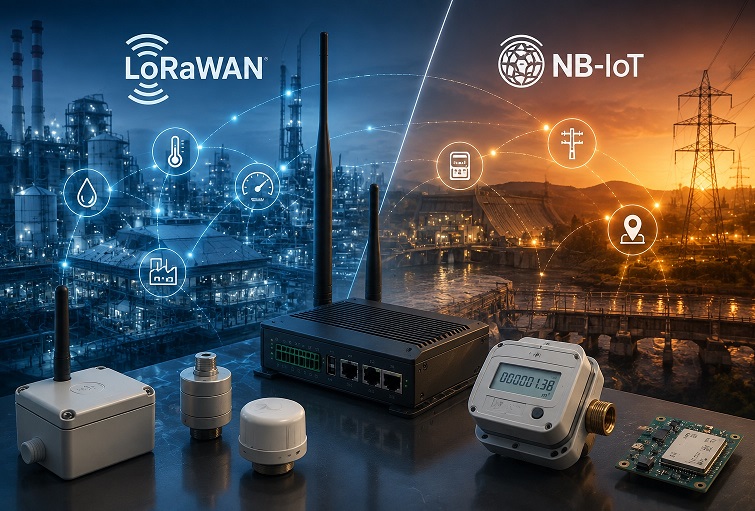
The right choice therefore depends on much more than nominal range or data rate. Power budget, network ownership, deployment geography, spectrum, latency, device management, security, maintenance requirements, and integration with existing IT and OT infrastructure all need to be considered.
Why Wireless Connectivity Matters in Industrial IoT
Industrial IoT systems connect sensors, meters, controllers, machines, vehicles, and other physical assets to software platforms responsible for monitoring, analysis, optimization, and automation.
In many cases, the data volume generated by an individual sensor is relatively small. A temperature sensor may only need to transmit a measurement every few minutes. A water meter might send a reading several times per day. A vibration sensor may periodically transmit selected statistical features rather than a continuous waveform.
The challenge is not therefore high bandwidth. It is maintaining reliable communication across large physical areas while consuming as little energy as possible.
Industrial environments introduce additional complications. Radio signals may need to pass through concrete walls, metal structures, machinery, underground spaces, utility cabinets, or other sources of attenuation and interference. Devices may also be installed in remote areas where service technicians cannot easily access them.
For these applications, a wireless technology must be evaluated according to several parameters:
- Communication range and indoor penetration
- Energy consumption and expected battery life
- Uplink and downlink data rates
- Latency and determinism
- Network capacity and device density
- Spectrum availability
- Infrastructure and subscription costs
- Security architecture
- Device provisioning and lifecycle management
- Firmware update capabilities
- Roaming and geographic coverage
- Integration with cloud, edge, IT, and OT systems
- Availability of industrial-grade modules and development tools
Short-range technologies such as Bluetooth Low Energy, Zigbee, and Wi-Fi remain excellent choices for localized applications. However, they are not always appropriate when thousands of devices are spread across a factory complex, utility network, agricultural area, or city.
This is where LPWAN technologies become useful.
What LPWAN Brings to IIoT
LPWAN technologies are optimized for devices that transmit relatively small quantities of information over long distances while consuming very little energy.
A typical LPWAN sensor spends most of its time in a low-power state. It wakes up, measures one or more parameters, establishes or uses a communication opportunity, transmits its data, and returns to sleep.
This operating model is fundamentally different from conventional broadband wireless networking. The goal is not to provide high throughput. The goal is to make small data exchanges inexpensive, reliable, and energy efficient.
LoRaWAN and NB-IoT implement this concept differently.
LoRaWAN generally uses a gateway-based architecture in unlicensed spectrum. An organization can deploy and manage its own gateways and network infrastructure.
NB-IoT operates within the cellular ecosystem and uses licensed spectrum managed by mobile network operators. Devices authenticate to the cellular network and communicate through carrier infrastructure.
This difference has consequences throughout the system architecture.
LoRaWAN Architecture and Deployment
LoRaWAN uses a star-of-stars topology. End devices communicate over LoRa radio links with one or more gateways. The gateways forward received packets to a LoRaWAN network server over an IP-based backhaul such as Ethernet, cellular, or Wi-Fi.
The network server handles functions such as device management, packet routing, deduplication, security procedures, and communication with application servers.
This separation between the radio layer and application infrastructure makes LoRaWAN particularly attractive for private deployments.
An industrial company can install gateways across a production site and connect them to an internal or cloud-based network server. There is no requirement to purchase cellular subscriptions for every sensor, and the organization can retain significant control over its network architecture.
A private LoRaWAN installation can therefore be useful for:
- Factory-wide environmental monitoring
- Machine condition monitoring
- Energy metering
- Water and gas metering
- Warehouse monitoring
- Asset tracking
- Agriculture and agricultural machinery
- Smart buildings
- Industrial safety monitoring
- Infrastructure monitoring
One important characteristic of LoRaWAN is that communication range depends heavily on antenna design, deployment conditions, spreading factor, frequency band, interference, and the physical environment. Claims of several kilometers are realistic in suitable outdoor conditions, but industrial buildings and dense urban environments can reduce effective range considerably.
Network planning remains important even when the technology is advertised as long range.
NB-IoT Architecture and Deployment
NB-IoT takes a different approach. Rather than requiring the enterprise to deploy its own radio access network, the technology uses cellular infrastructure operated by a mobile network provider.
The device contains an NB-IoT modem and normally uses a SIM or eSIM-based identity. The cellular network handles authentication, radio access, mobility procedures, and connectivity to the operator’s core network.
This model provides several advantages for geographically distributed assets.
An organization monitoring thousands of electrical meters across an entire country, for example, does not need to build and maintain its own radio gateway infrastructure. Devices can use the existing cellular network wherever suitable NB-IoT coverage is available.
NB-IoT is therefore well suited to applications such as:
- Utility metering
- Smart water meters
- Gas meters
- Distributed infrastructure monitoring
- Pipeline monitoring
- Environmental sensors
- Asset monitoring
- Street infrastructure
- Agricultural equipment
- Industrial telemetry
The tradeoff is that the organization becomes dependent on the operator’s coverage, commercial terms, network policies, and long-term service availability.
Radio Performance and Data Throughput
LoRaWAN and NB-IoT are both low-bandwidth technologies, but their radio architectures are fundamentally different.
LoRaWAN uses LoRa modulation based on Chirp Spread Spectrum. Its configurable spreading factors allow a system to trade data rate for receiver sensitivity and range. Lower data rates generally provide greater link budget and therefore better coverage, while higher data rates reduce airtime.
This flexibility is valuable in industrial installations because not every sensor requires the same communication performance.
A device located close to a gateway may use a relatively high data rate, while a remote sensor behind several walls may require a more robust configuration.
NB-IoT is derived from cellular LTE technology and uses a narrow 180 kHz radio channel. It is designed to provide strong coverage and reliable communication while supporting very low-power devices.
One practical advantage of NB-IoT is its cellular-grade network infrastructure. The operator controls the radio network, spectrum, and core network, which can provide more predictable service characteristics than a heavily congested unlicensed band.
However, the cellular protocol stack is more complex. Device registration, authentication, signaling, and network procedures can consume significant energy relative to the transmission of a very small payload.
Consequently, comparing the technologies purely by peak data rate is misleading. A proper engineering analysis should consider the entire transaction:
- Device wake-up
- Radio initialization
- Network access or synchronization
- Authentication and signaling
- Data transmission
- Optional reception or downlink
- Network release or transition to a low-power state
The energy required for the complete cycle is often more important than the theoretical maximum throughput.
Battery Life and Power Management
Battery life is one of the most important parameters in industrial wireless sensor design.
Replacing a battery in a laboratory prototype is trivial. Replacing thousands of batteries installed on industrial equipment, utility poles, pipelines, meters, or remote infrastructure can become a significant operational expense.
LoRaWAN is particularly efficient for devices that transmit small amounts of data infrequently. End devices can remain asleep for long periods and wake only when they need to transmit or receive according to the selected device class.
Class A devices, for example, are optimized for low power consumption and initiate their receive windows after an uplink transmission. This makes the technology suitable for battery-powered sensors that spend most of their time asleep.
With an appropriate traffic profile, hardware design, battery capacity, and radio environment, multi-year operation can be achievable.
NB-IoT also incorporates mechanisms specifically designed for low-power operation. Power Saving Mode (PSM) allows a device to remain registered while becoming largely unreachable for long periods, while extended Discontinuous Reception (eDRX) can reduce the frequency with which the modem needs to monitor the network.
However, cellular signaling can create relatively high energy peaks. The actual battery life therefore depends strongly on signal quality, transmission frequency, network configuration, operator implementation, firmware, and the time spent in different modem states.
For both technologies, battery-life calculations should be based on real traffic patterns rather than nominal modem specifications.
A meaningful power budget should include:
- Sleep current
- Wake-up current
- Transmit current
- Receive current
- Network access and registration
- Retransmissions
- Downlink activity
- Firmware updates
- Temperature effects
- Battery self-discharge
- Expected signal conditions
Laboratory measurements should ideally be followed by field testing under realistic environmental conditions.
Security Considerations
Security is particularly important in IIoT because a compromised sensor can potentially become a gateway into a larger industrial environment.
LoRaWAN incorporates security mechanisms based on AES-128 cryptography and separates network-level security from application-level encryption. This architecture allows network infrastructure operators to manage network communication without necessarily gaining access to application payloads.
The exact security posture, however, depends on how devices are provisioned, how keys are managed, and how the network server and application infrastructure are secured.
NB-IoT benefits from the mature security architecture of cellular networks. SIM and eSIM-based authentication, standardized cellular security mechanisms, and operator-managed infrastructure provide a well-established framework for device identity and network access.
Neither technology eliminates the need for secure device design.
Industrial deployments should additionally consider:
- Secure boot
- Hardware-backed key storage
- Device identity management
- Signed firmware
- Secure OTA updates
- Certificate or credential lifecycle management
- Network segmentation
- Protection of cloud APIs
- Monitoring and anomaly detection
- Physical security of deployed devices
The communication protocol is only one component of an IIoT security architecture.
Device Management and OTA Updates
Long-term industrial deployments require more than reliable data transmission. Devices must be provisioned, monitored, updated, diagnosed, and eventually decommissioned.
NB-IoT benefits from its integration with cellular operator infrastructure. SIM and eSIM technologies can simplify device identity and subscriber management, while carrier platforms can provide centralized connectivity management.
This can be particularly useful when thousands of devices are deployed across multiple countries or regions.
LoRaWAN provides considerable flexibility because organizations can operate their own network infrastructure. However, this also means that the enterprise or system integrator is responsible for a larger part of the infrastructure stack.
Over-the-air firmware updates deserve special attention. LPWAN networks are not designed for large software images to be transferred frequently. Firmware updates should therefore be carefully optimized, potentially using delta updates, compressed images, fragmentation mechanisms, and staged deployment.
The best communication technology is not necessarily the one that transfers firmware fastest. It is the one that supports the complete device lifecycle at an acceptable operational cost.
Spectrum and Regulatory Considerations
Spectrum is another fundamental difference between LoRaWAN and NB-IoT.
LoRaWAN commonly operates in regional unlicensed ISM bands. In Europe, 868 MHz is widely used, while 915 MHz is common in North America, with other regional allocations used elsewhere.
Unlicensed spectrum allows companies to deploy private networks without purchasing licensed spectrum. This can significantly reduce infrastructure costs and give industrial operators greater control.
The disadvantage is that the spectrum is shared. Interference from other systems is possible, and regional regulations may impose restrictions such as duty-cycle limitations.
Network design must therefore account for gateway placement, antenna performance, channel planning, interference, and device density.
NB-IoT uses licensed cellular spectrum. It can be deployed using different spectrum configurations within the cellular network, depending on operator infrastructure.
Licensed spectrum provides the operator with greater control over interference and network resources. This is particularly attractive for large-scale deployments where predictable connectivity is more important than complete control over the physical network.
The downside is straightforward: coverage is dependent on the cellular operator.
Before selecting NB-IoT, an engineering team should verify actual coverage at the intended installation sites rather than relying solely on general coverage maps. Industrial buildings, underground locations, substations, and shielded enclosures can produce very different conditions from those encountered by ordinary mobile users.
Industrial LPWAN Modules
The availability of industrial-grade modules is an important factor when selecting an LPWAN technology.
A communication module should be evaluated not only by its radio specifications but also by supported frequency bands, certifications, interfaces, software support, operating temperature range, security features, GNSS capabilities, firmware update mechanisms, and expected product longevity.
For NB-IoT and LTE-M designs, cellular module vendors such as Quectel, u-blox and other specialized suppliers provide modules targeting industrial IoT, asset tracking, metering, and telemetry applications.
For LoRaWAN, module suppliers commonly combine a low-power microcontroller with a LoRa transceiver or provide integrated LoRaWAN solutions based on semiconductor platforms from vendors such as Semtech.
Typical host interfaces include UART, SPI, I2C, GPIO, and sometimes USB. Depending on the module, manufacturers may provide an AT-command interface, a full software development environment, or both.
For a production design, engineers should also examine:
- Regional certifications
- Carrier certifications for cellular modules
- Available antenna configurations
- Hardware security capabilities
- Industrial temperature ratings
- Supply-chain continuity
- Minimum order quantities
- Firmware maintenance policy
- Long-term component availability
A technically suitable module is of little value if it becomes unavailable halfway through the expected ten-year product lifecycle.
LoRaWAN vs. NB-IoT: Practical Comparison
The two technologies are best understood as complementary rather than direct competitors.
| Parameter | LoRaWAN | NB-IoT |
|---|---|---|
| Network model | Private or public LPWAN | Cellular operator network |
| Spectrum | Usually unlicensed | Licensed cellular spectrum |
| Infrastructure ownership | Can be enterprise-owned | Primarily operator-owned |
| Typical device cost | Generally low | Generally higher |
| Power consumption | Very low for sparse traffic | Low, with PSM/eDRX |
| Data rate | Low | Generally higher than LoRaWAN |
| Latency | Variable | More predictable in cellular deployments |
| Coverage | Highly dependent on gateway placement | Dependent on cellular network coverage |
| Device identity | LoRaWAN credentials and keys | SIM/eSIM-based cellular identity |
| Roaming | Possible through ecosystem and roaming arrangements | Mature cellular roaming ecosystem |
| Private deployment | Strong advantage | Generally limited |
| Large geographic deployments | Requires gateway infrastructure | Strong advantage where cellular coverage exists |
| OTA firmware | Possible, but bandwidth constrained | Possible, with greater bandwidth flexibility |
| Best fit | Private sensor networks and low-power telemetry | Distributed assets and operator-managed connectivity |
These are general engineering characteristics rather than absolute rules. Actual performance depends on regional spectrum, network configuration, hardware, firmware, antenna design, traffic profile, and deployment environment.
Which Technology Should an IIoT Project Choose?
The decision should start with the application rather than the protocol.
LoRaWAN is often the stronger option when an organization needs a private network, wants control over infrastructure, operates a large number of inexpensive battery-powered sensors, and transmits small quantities of data at relatively low frequency.
For example, a factory could deploy several hundred sensors for temperature, humidity, machine vibration indicators, energy consumption, and environmental monitoring. A small number of strategically positioned gateways could provide connectivity across the facility while keeping sensor hardware simple and inexpensive.
NB-IoT becomes particularly attractive when devices are geographically distributed and the company does not want to build and maintain its own radio network.
A utility company monitoring thousands of meters across a country, for instance, can use cellular infrastructure instead of deploying its own gateways. Operator-managed connectivity also becomes valuable when centralized provisioning, roaming, and large-scale device management are important requirements.
There are also applications where neither technology is appropriate.
If the system requires millisecond-level deterministic control, continuous high-bandwidth sensor streams, or closed-loop motion control, a conventional industrial Ethernet, TSN, Wi-Fi, 5G, or another specialized technology may be more appropriate.
LPWAN should generally be viewed as a telemetry and low-rate control technology, not a replacement for every industrial communication protocol.
Hybrid Connectivity Can Be More Effective Than a Single Technology
Large industrial systems do not necessarily need to standardize on one wireless technology.
A layered architecture can use different communication technologies for different classes of devices.
For example, a production facility could use wired Ethernet or industrial Ethernet for deterministic machine control, Wi-Fi for mobile operator terminals, LoRaWAN for battery-powered environmental sensors, and cellular connectivity for remote assets.
Even LoRaWAN and NB-IoT can coexist.
A company might use LoRaWAN inside a controlled industrial site where it owns the network infrastructure, while NB-IoT is used for remote assets outside the facility.
This approach avoids forcing every device into the same communication architecture and allows the system designer to optimize each layer according to its specific requirements.
The Role of Edge Computing
LPWAN connectivity becomes considerably more effective when combined with edge computing.
Sending every raw measurement directly to a cloud platform is not always efficient. An edge gateway can aggregate sensor data, filter irrelevant measurements, detect anomalies, perform local calculations, and transmit only meaningful events through the LPWAN connection.
For example, instead of sending raw vibration data continuously, an industrial gateway could calculate RMS vibration, peak values, temperature compensation, and frequency-domain indicators locally. The LPWAN device then transmits a small diagnostic record rather than a large dataset.
This reduces network traffic and energy consumption while allowing the cloud platform to concentrate on higher-level analysis.
The combination of LPWAN sensors, edge processing, and cloud analytics is therefore becoming an important architecture for scalable IIoT deployments.
Future Development of LPWAN Connectivity
The future of industrial LPWAN connectivity is unlikely to be defined by one technology replacing the other.
Cellular IoT will continue to benefit from the evolution of the 4G and 5G ecosystem, while LoRaWAN will remain relevant where low-cost private networks and extremely low-power operation are important.
At the same time, industrial deployments are becoming more heterogeneous. A modern IIoT system may combine LPWAN, private 5G, industrial Ethernet, Wi-Fi, satellite connectivity, and edge computing within the same architecture.
The challenge for system designers will increasingly be selecting the appropriate connectivity layer for each device rather than choosing a single universal standard.
Conclusion
LoRaWAN and NB-IoT solve similar problems from fundamentally different directions.
LoRaWAN emphasizes low-cost, low-power connectivity and private network deployment. Its architecture is particularly attractive for industrial facilities and distributed sensor networks where organizations want control over infrastructure and need to operate large numbers of inexpensive devices for years.
NB-IoT builds on the cellular ecosystem. It is particularly compelling for geographically distributed devices where operator-managed coverage, standardized cellular security, centralized provisioning, and large-scale connectivity are more important than owning the underlying radio infrastructure.
Neither technology is universally superior.
The correct choice depends on the complete system architecture: how much data each device transmits, how often it communicates, how long its battery must last, where it will be installed, who will operate the network, what level of latency is required, how devices will be provisioned and updated, and how the connectivity layer will integrate with the company’s IT and OT infrastructure.
For many industrial projects, the most effective solution will not be to choose between LoRaWAN and NB-IoT at all. A hybrid connectivity architecture can combine private LPWAN networks, cellular IoT, edge computing, and conventional industrial communications, allowing each technology to perform the task for which it is best suited.
In IIoT, connectivity is not simply a radio specification. It is a long-term engineering decision that affects device cost, battery life, infrastructure, cybersecurity, maintenance, scalability, and the total cost of ownership throughout the entire product lifecycle.