How Could the First Genetic Information Arise Without a Designer
ScienceThe origin of life presents a deceptively simple question: how did the first system capable of storing information, reproducing itself, and evolving emerge from ordinary chemistry?
At first glance, the problem seems almost impossible. Modern organisms depend on DNA, RNA, proteins, membranes, molecular machines, and elaborate mechanisms for copying and interpreting genetic information. These systems are deeply interdependent. DNA stores sequences, RNA helps transfer and regulate them, and proteins perform most of the catalytic work. It is tempting to imagine that all of these components had to appear together before life could begin.
But that is probably the wrong way to frame the problem.
The earliest life did not need to possess anything resembling a modern cell. It did not need a genome, a genetic code in the modern sense, ribosomes, or sophisticated protein enzymes. It needed something much simpler: a chemical system capable of producing variants of itself, with some variants being better at doing so than others.
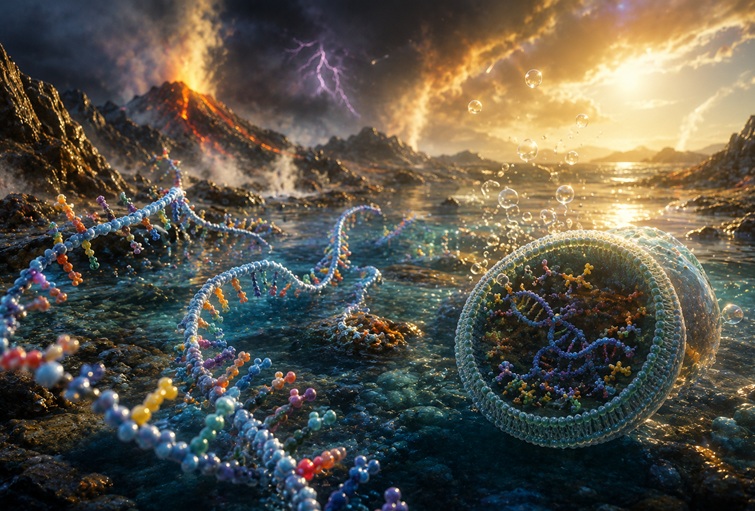
Once such a system existed, Darwinian evolution could begin.
This distinction is crucial because it changes the origin-of-life problem from “How was the first genome written?” to a much more tractable question: how can chemistry spontaneously produce molecules and networks in which structure influences reproduction, and reproduction creates opportunities for selection?
Information Is Not a Substance
The language of information can sometimes make the origin of life appear more mysterious than it actually is.
When biologists say that DNA contains information, they are describing a real and useful relationship between molecular sequences and biological functions. But information is not a physical substance stored inside a DNA molecule. There is no separate entity called “information” that has to be manufactured and inserted into a molecule.
A DNA sequence is a physical arrangement of chemical units. That arrangement has consequences because particular molecular structures interact with other molecules in particular ways. Cellular machinery interprets those sequences according to the biochemical rules of the organism.
The word “information” is therefore a description of a relationship between a physical pattern and its effects. The pattern itself is completely physical.
This is easier to see with an ordinary written symbol. A sequence of marks on paper can represent a letter, a mathematical expression, a word, or an entire message depending on the conventions used by the reader. The ink itself does not contain a miniature copy of the meaning. The physical pattern participates in an encoding system.
Biological sequences are different in an important respect. Their effects do not depend exclusively on a human convention. Molecular sequences have physical and chemical consequences. A particular RNA sequence can fold into a particular three-dimensional structure, and that structure can alter how the molecule interacts with other molecules. A DNA sequence can influence which RNA and proteins are produced. The biological “meaning” ultimately emerges from physical interactions.
This is why the appearance of genetic information does not necessarily require information to have been deliberately written into matter. A sequence can acquire biological significance through chemistry and selection.
The First Replicator Did Not Need to Be DNA
Modern biology places DNA at the center of heredity, but DNA is unlikely to have been the first molecule responsible for biological evolution.
DNA is exceptionally well suited for long-term information storage. Its chemical stability is advantageous for preserving genomes over many generations. But it is relatively poor at directly catalyzing chemical reactions.
RNA is much more versatile.
RNA is a polymer built from nucleotides, and its sequence allows it to fold into complex three-dimensional structures. Some folded RNA molecules can act as catalysts. These catalytic RNAs are known as ribozymes.
This dual role makes RNA particularly interesting in origin-of-life research. A molecule that can both carry a sequence and participate directly in chemical reactions could, in principle, bridge the gap between heredity and catalysis.
This idea is commonly known as the RNA world hypothesis. It does not necessarily claim that the first life consisted of modern RNA molecules. Rather, it proposes that an early stage of evolution may have been dominated by RNA-like molecules before the division of labor between DNA, RNA, and proteins became established.
The hypothesis has experimental support, although many details remain unresolved.
Researchers have demonstrated that nucleotides and some RNA-related building blocks can form through plausible prebiotic chemical pathways. Laboratory experiments have also produced ribozymes capable of catalyzing increasingly sophisticated reactions. At the same time, producing a complete self-replicating RNA system under realistic prebiotic conditions remains a major challenge.
That distinction matters. Demonstrating that individual components can form naturally is not the same as demonstrating that a complete first replicator formed spontaneously.
Random Sequences Are Not Meaningless
Suppose a collection of nucleotides begins forming chains.
The resulting sequences will initially be largely determined by chemistry and environmental conditions. There is no reason to assume that the first sequence must encode anything useful.
But “random” does not mean “chemically irrelevant.”
A sequence determines the structure of a polymer. Structure determines interactions. Interactions determine chemical behavior.
Consider a simplified example. Imagine two RNA molecules with slightly different sequences. One folds into a structure that weakly accelerates a reaction. Another folds into a structure that accelerates the same reaction more efficiently. A third may be chemically inactive.
There is no need for an external observer to label one sequence as meaningful and another as meaningless. Their differences are reflected directly in their physical behavior.
If one of these molecules somehow contributes to the production of molecules resembling itself, it gains a reproductive advantage. If another molecule interferes with that process, it becomes disadvantaged.
Selection can then begin acting on molecular populations.
This is one of the most important conceptual steps in understanding the origin of genetic information. Selection does not need pre-existing biological information. It can generate statistical enrichment of sequences associated with greater reproductive success.
Selection Can Create Information
Imagine a molecular population containing thousands of different sequences.
Most of them might be chemically uninteresting. Some might bind certain molecules. Others might stabilize particular structures. A small fraction could happen to catalyze reactions that increase the production or persistence of molecules similar to themselves.
Now introduce imperfect copying.
Whenever molecular reproduction is imperfect, variants appear. Some variants perform worse. Some perform better. The better-performing variants become more abundant.
After many cycles, the population is no longer a random sample of all possible sequences. It becomes enriched for sequences that work well under the prevailing conditions.
This process is fundamentally Darwinian.
Variation produces differences between molecular descendants. Differential reproduction changes their relative abundance. Selection therefore changes the composition of the population over time.
No conscious process has to decide which sequence is useful.
In this sense, biological information can emerge as a consequence of selection. A sequence that persists because it contributes to its own replication becomes statistically non-random within the population. Its abundance carries information about the environment and the chemical processes that favor it.
This does not mean that every random sequence will become functional. In fact, most possible RNA sequences are probably not particularly useful. The important point is that evolution does not require a functional sequence to be selected from an infinite library in a single step. It can build complexity through successive changes, provided there is a mechanism for heredity and differential reproduction.
The Critical Problem: Replication
This is where the origin-of-life problem becomes genuinely difficult.
For Darwinian evolution to operate efficiently, a system needs some form of heredity. A molecule or molecular network must somehow produce descendants that resemble their ancestors.
Modern organisms accomplish this using extraordinarily sophisticated molecular machinery. DNA polymerases copy DNA. RNA polymerases synthesize RNA. Ribosomes translate nucleotide sequences into proteins. Numerous auxiliary proteins repair, regulate, and coordinate these processes.
The first replicator obviously could not have depended on all of this machinery.
One possibility is that early replication was much less accurate and much less efficient than modern biological replication. Another is that the earliest evolutionary systems were not individual self-copying molecules at all, but networks of mutually supporting chemical reactions.
This distinction is important because the phrase “self-replicating molecule” can create an overly simplistic picture. Researchers are investigating several possible routes to primitive heredity, including autocatalytic chemical networks, template-directed polymerization, ribozyme-mediated replication, and protocells that concentrate useful molecules inside membrane compartments.
The actual transition may have involved several mechanisms rather than a single miraculous molecule.
Autocatalysis Changes the Game
One of the most important concepts in origin-of-life chemistry is autocatalysis.
An autocatalytic reaction is one in which a product helps promote the reaction that produces it. In its simplest form, the presence of a molecule increases the probability that more of that molecule, or a related molecule, will be produced.
This creates a feedback loop.
More molecules produce more molecules, which can accelerate further production.
Autocatalysis is not equivalent to biological reproduction. A modern organism is vastly more complicated than a simple autocatalytic reaction. Nevertheless, autocatalytic chemistry provides a plausible mechanism through which populations of molecules can become self-amplifying.
Some autocatalytic systems can also generate competition. If two chemical pathways use the same resources, the pathway that reproduces more efficiently can become dominant.
At that point, the chemistry begins to resemble primitive evolution.
Imperfect Replication Is Essential
Perfect replication might seem desirable, but evolution actually requires errors.
If a molecular system copied itself with absolute fidelity, no new variants would appear. The population could remain stable, but it would have little capacity to adapt.
On the other hand, excessive error rates destroy heredity. If every copy is almost completely different from its parent, advantageous structures cannot persist.
This creates what can be thought of as an error threshold. A primitive replicator must occupy a region where copying is accurate enough to preserve useful traits while still allowing enough variation for evolution to explore new possibilities.
Modern biological systems operate with sophisticated error-control mechanisms, but early chemical replicators probably did not have anything comparable.
The emergence of a sufficiently reliable but imperfect replication mechanism may therefore have been one of the decisive steps toward life.
From Molecular Selection to Genetic Systems
Once a chemical system can reproduce with variation, selection can begin to accumulate useful molecular features.
A molecule that binds its substrate more effectively may reproduce faster.
A catalyst that produces a useful intermediate may support the growth of a larger chemical network.
A sequence that folds into a more stable structure may persist longer.
A molecule that helps another molecule replicate may enter into a mutually beneficial relationship with it.
Over time, such interactions can produce increasingly complex systems.
Eventually, evolution could favor specialization. One molecule becomes better at storing structural information, another at catalysis, and another at facilitating replication. The result is the beginning of a division of labor.
This provides a possible route from relatively simple RNA-based systems toward the architecture of modern biology.
DNA could then emerge as a more stable information-storage molecule, while RNA retained important catalytic and regulatory roles. Proteins, with their enormous chemical diversity, could take over much of the catalytic workload.
The modern molecular hierarchy may therefore represent the outcome of a long evolutionary optimization process rather than the starting point of life.
Where Did the Genetic Code Come From?
There is another puzzle hidden inside the origin of modern biology: the genetic code itself.
Modern cells use nucleotide triplets called codons to specify amino acids during protein synthesis. This requires a sophisticated translation system involving messenger RNA, transfer RNA, ribosomal RNA, and many proteins.
The code cannot simply be assumed to have existed from the beginning.
Several hypotheses attempt to explain its emergence. Some suggest that early relationships between RNA sequences and amino acids were driven by direct chemical affinities. Others propose that the code developed through selection for error minimization. Additional models suggest that the code evolved gradually as metabolic and translational systems became more complex.
There is no consensus that a single mechanism explains the entire origin of the genetic code.
This is another reason to be cautious with the phrase “the first genetic code.” The earliest hereditary systems may not have possessed anything resembling the modern DNA-to-protein coding scheme.
Genetic coding in the modern sense could have been a later evolutionary innovation built on top of simpler forms of molecular heredity.
From Chemistry to Protocells
Replication alone is not enough to create a modern organism.
A population of replicating molecules would have benefited enormously from some form of physical compartmentalization.
Simple lipid molecules can spontaneously form structures such as vesicles in water. Under suitable conditions, these compartments can concentrate chemicals and separate them from the surrounding environment.
A protocell containing a set of mutually beneficial reactions could therefore have an advantage over molecules dispersed throughout a large environment.
Compartmentalization also changes the dynamics of selection.
If a useful molecular system remains together inside one compartment, the benefits of cooperation can be preserved. Compartments containing productive chemistry may grow or divide more successfully than compartments containing less effective chemistry.
This creates another level of selection: not only molecules, but collections of molecules can become subject to evolutionary competition.
The transition from molecular evolution to cellular life was probably one of the most consequential steps in the entire history of biology.
The Environment May Have Done Much of the Work
The early Earth was not a uniform chemical soup.
It contained oceans, minerals, volcanic environments, hydrothermal systems, atmospheric chemistry, wet and dry cycles, temperature gradients, and countless local environments with different physical conditions.
Different environments could have promoted different stages of prebiotic chemistry.
Mineral surfaces might have concentrated molecules.
Evaporation could have increased local concentrations of reactants.
Temperature gradients could have driven chemical cycles.
Wet-dry cycles might have promoted polymer formation.
Hydrothermal systems could have supplied chemical energy.
None of these environments has yet been demonstrated to be the definitive birthplace of life. The origin of life may even have involved several environments, with chemical products generated in one location being transported to another.
The important point is that the first evolutionary systems did not necessarily have to assemble in a single step under one set of conditions.
Why the Problem Is Still Unsolved
It would be misleading to suggest that science has already reconstructed the complete path from inorganic chemistry to the first cell.
We have not.
Researchers have demonstrated many individual pieces of the puzzle. Organic molecules can form through plausible prebiotic chemistry. Nucleotides and related compounds can be synthesized under certain conditions. RNA can fold into catalytic structures. Laboratory populations of molecules can undergo selection. Lipids can spontaneously form compartments. Artificial molecular systems can display replication-like behavior.
The unresolved question is how these pieces became connected into a continuously evolving system under realistic early-Earth conditions.
Several difficult transitions remain:
- Producing sufficiently complex building blocks.
- Concentrating them without destroying them.
- Forming polymers efficiently.
- Achieving template-directed replication.
- Maintaining replication despite molecular degradation.
- Establishing heredity with manageable error rates.
- Linking replication to useful chemical functions.
- Creating stable compartments.
- Establishing cooperation between different molecular components.
- Transitioning from primitive chemical evolution to cellular biology.
Each problem is individually challenging. Their combination is the real difficulty.
Information Did Not Have to Appear All at Once
The most useful lesson may be that asking where the “information in the first genome” came from imposes a modern biological concept on a system that probably did not have a genome.
Early evolution may have started with much simpler physical relationships.
A molecular structure affected a reaction.
That reaction affected the abundance of molecules.
Some molecular variants reproduced more successfully than others.
Their descendants inherited aspects of the structures that made them successful.
Selection gradually changed the population.
Over immense numbers of generations, these processes could produce increasingly sophisticated molecular systems.
Eventually, hereditary sequences became capable of controlling increasingly complex chemistry. The distinction between genotype and phenotype became more pronounced. Molecular machines evolved to replicate nucleic acids and translate sequences into proteins. Compartments became cells. Cells acquired metabolism, membranes, regulatory systems, and increasingly complex genomes.
The enormous quantity of information found in modern organisms is therefore not necessarily something that had to be present at the beginning. Much of it could have accumulated through evolutionary history.
Life as a Self-Reinforcing Chemical Process
The origin of life is sometimes described as a transition from “non-information” to “information.”
A more physically grounded description is a transition from uncontrolled chemistry to chemistry capable of maintaining and reproducing organized states.
Once a molecular system can influence its own future abundance, evolution becomes possible.
Once reproduction is imperfect, variation appears.
Once variants reproduce at different rates, selection occurs.
Once selection operates over sufficiently long periods, populations can become increasingly adapted to their environments.
This creates a powerful mechanism for accumulating complexity without requiring complexity to exist at the beginning.
The first successful replicating system did not need to understand what it was doing. It did not need a genome in the modern sense. It did not need a genetic code, a ribosome, or a cell.
It only needed chemistry capable of making descendants that were sufficiently similar to themselves, combined with enough variation for selection to act.
From that modest starting point, given geological time and enormous numbers of chemical experiments occurring simultaneously across the early Earth, increasingly sophisticated systems could emerge.
The central mystery of abiogenesis therefore may not be how a complete genetic system appeared from nowhere. It may be how chemistry crossed the threshold at which its own products began influencing their persistence and reproduction.
Once that threshold was crossed, evolution no longer needed to be invented. It became a property of the system itself.