Radiotrophic Life: Can Organisms Use Ionizing Radiation as an Energy Source
ScienceIonizing radiation is usually associated with one thing in biology: damage. High-energy photons and particles can break chemical bonds, generate reactive oxygen species, alter proteins and damage DNA. Yet some organisms appear to have evolved a very different relationship with radiation. Instead of merely tolerating it, certain melanized fungi grow toward radioactive sources and can exhibit enhanced growth when exposed to ionizing radiation.
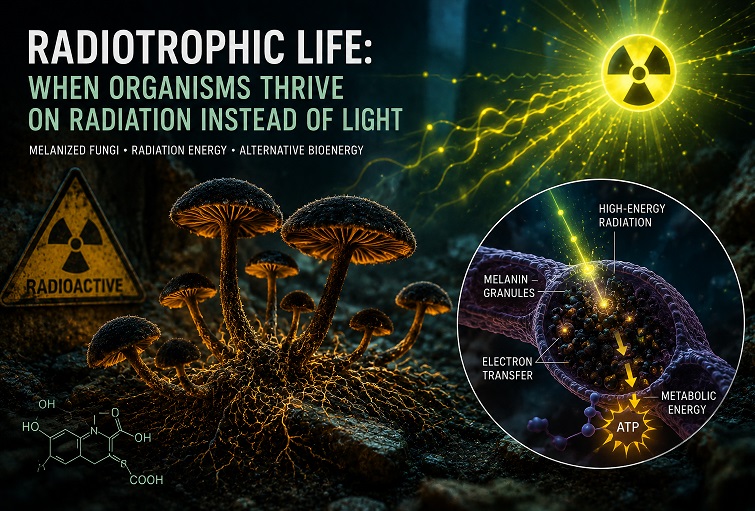
This phenomenon has led to the concept of radiotrophy, sometimes also called radiosynthesis by analogy with photosynthesis. The idea is intriguing: could biological systems capture energy from gamma rays or other ionizing radiation and use it to support metabolism?
The answer is more complicated than the popular description of “fungi that eat radiation” suggests. There is experimental evidence that radiation changes the electronic properties of melanin and can stimulate the growth and metabolic activity of some melanized fungi. There is also independent evidence that radiation can indirectly support microbial ecosystems by producing hydrogen through the radiolysis of water. But a complete, well-established metabolic pathway equivalent to photosynthesis has not yet been demonstrated in fungi.
Understanding the distinction is important because it reveals a much more interesting biological story.
Radiation Is an Energy Source, but Energy Alone Is Not Enough
The fundamental problem with using ionizing radiation biologically is not a lack of energy. It is almost the opposite.
Visible light contains photons energetic enough to drive specific photochemical reactions while remaining within a range that biological pigments and reaction centers can control. Photosynthetic organisms have evolved elaborate molecular machinery that absorbs selected wavelengths and converts their energy into chemical potential.
X-rays and gamma rays occupy a much higher-energy part of the electromagnetic spectrum. A single photon can carry enough energy to ionize molecules and initiate cascades of secondary electrons and reactive chemical species. The same property that makes ionizing radiation potentially useful as an energy source also makes it exceptionally destructive.
This creates a fundamental engineering problem for any hypothetical radiotrophic organism. It would have to capture part of the incoming energy while preventing the resulting chemical damage from overwhelming the cell.
Melanin is particularly interesting in this context because it interacts strongly with electromagnetic radiation and has long been recognized as an important protective pigment in many fungi.
Melanized Fungi and the Chernobyl Connection
The modern discussion of fungal radiotrophy is closely associated with observations made after the Chernobyl nuclear accident.
Researchers found numerous fungi capable of surviving in highly radioactive environments around the damaged reactor. Several melanized species also demonstrated what became known as positive radiotropism, meaning that their hyphae preferentially grew toward sources of ionizing radiation.
Importantly, this phenomenon is not limited to a single species or to fungi collected directly from Chernobyl. Experiments have reported directional responses in several fungal isolates, including species of Cladosporium, Penicillium and related genera. In one study involving 27 fungal responses, 18 showed stimulation of growth toward beta or gamma radiation sources.
One particularly well-studied organism is Cladosporium sphaerospermum, a darkly pigmented fungus associated with highly radioactive environments.
The observation is striking, but radiotropism should not automatically be interpreted as proof of radiotrophy. An organism may grow toward radiation because radiation changes its environment or metabolism without directly serving as its primary energy source. Distinguishing attraction, radiation resistance, metabolic stimulation and genuine energy harvesting requires carefully controlled experiments.
Why Is Melanin So Important?
Melanin is a complex biological pigment found throughout the living world. In fungi, it is often deposited in or around the cell wall, where it can provide protection against ultraviolet radiation, oxidative stress and ionizing radiation.
Its interaction with ionizing radiation is unusual.
Experiments have shown that irradiation changes the electronic properties of fungal melanin. In one widely cited study, irradiated melanin demonstrated substantially increased electron-transfer activity in an in-vitro redox system. The same research found enhanced growth and metabolic activity in several melanized fungi exposed to radiation compared with appropriate non-melanized or non-irradiated controls.
This suggests a possible mechanism in which melanin does more than simply absorb radiation and dissipate its energy harmlessly.
A simplified model is the following:
Ionizing radiation → melanin excitation and electron generation → altered redox chemistry → potentially increased availability of reducing equivalents for cellular metabolism
The actual mechanism is considerably more complicated. Melanin is not a conventional photosynthetic reaction center, and researchers have not established a complete biochemical pathway showing how absorbed gamma-ray energy is converted into ATP or biomass under natural conditions.
Nevertheless, the experimental observations are sufficiently unusual to make melanin a serious subject of research in radiation biology.
Protection and Energy Harvesting May Be Two Sides of the Same Process
One of the most interesting possibilities is that radioprotection and energy utilization are not necessarily separate functions.
When ionizing radiation enters biological material, it can generate secondary electrons and reactive chemical species. A pigment such as melanin can interact with these products, dissipate energy and participate in redox reactions.
If part of this process can be coupled to useful biochemical reactions, the organism could potentially obtain a metabolic benefit while simultaneously reducing radiation damage.
This would represent a very different strategy from photosynthesis.
A photosynthetic organism captures relatively controlled photon energy and channels it into a dedicated biochemical pathway. A melanized fungus exposed to gamma radiation may instead exploit a much less orderly physical process involving ionization, electron transfer, radical chemistry and redox reactions.
Researchers have therefore proposed that melanin could function as an energy-transducing material rather than simply as a passive radiation shield. Evidence for changes in melanin’s electron-transfer behavior after irradiation supports this hypothesis, although the complete biological mechanism remains unresolved.
Radiotrophy Is Not the Same as Radiation-Driven Chemosynthesis
There is another important phenomenon that is sometimes confused with fungal radiotrophy.
Natural radioactive decay can split water molecules through a process known as radiolysis. In geological environments, this chemistry can generate molecular hydrogen along with oxidizing compounds.
Hydrogen is an excellent electron donor for microorganisms. Consequently, microbes living deep underground can exploit chemical energy generated indirectly by radioactive decay.
This process is particularly important in the Earth’s deep subsurface. Studies have shown that radiolytic hydrogen can serve as a major energy source for microbial communities living kilometers below the surface. In some marine sediments, radiolysis may become an especially important source of biologically available energy at depth.
The distinction is fundamental:
Direct radiotrophy:
An organism interacts with ionizing radiation itself and potentially converts part of that energy into biologically useful energy.
Radiolysis-driven metabolism:
Radiation splits water and produces chemical compounds such as hydrogen, which microorganisms subsequently consume through ordinary metabolic pathways.
The second mechanism is already supported by substantial evidence. The first remains an active area of research, particularly in the case of melanized fungi.
Why Fungi Are Such Interesting Candidates
Fungi occupy an unusual position in this discussion because of their ecological and physiological characteristics.
Unlike plants, fungi do not normally obtain energy by fixing carbon through photosynthesis. They are primarily heterotrophs that acquire organic compounds from their environment and use them as both carbon sources and sources of chemical energy.
That makes them less dependent on a conventional light-driven primary-production system.
Fungal hyphae can also penetrate complex environments, grow over mineral surfaces and colonize locations where light is absent. Many fungal species already possess extensive systems for dealing with oxidative stress, environmental toxins and nutrient scarcity.
Melanin adds another layer of protection.
This combination creates an interesting evolutionary scenario. A fungus does not necessarily need to replace its entire metabolism with a radiation-powered equivalent of photosynthesis. It could instead use radiation as an auxiliary energy source that improves the efficiency of existing metabolism under nutrient-limited conditions.
This is a much more plausible interpretation of the current evidence than the idea that fungi simply replace food with gamma rays.
Why Plants Have Not Become Radiotrophic
The evolutionary comparison with plants is particularly revealing.
Plants are highly optimized for photosynthesis. Their molecular machinery is designed around photons in specific regions of the electromagnetic spectrum. Increasing photon energy beyond the range that the photosynthetic apparatus can safely process does not automatically make photosynthesis more efficient.
Ultraviolet radiation provides a useful example. Its photons carry more energy than visible light, but much of that energy is harmful because it can cause molecular damage, including DNA lesions.
X-rays and gamma rays create an even more severe problem. Their energy is sufficiently high to produce ionization and secondary radiation chemistry throughout biological tissue.
A hypothetical plant trying to use gamma radiation would therefore face two conflicting requirements. It would need to absorb the radiation efficiently while simultaneously preventing that radiation from destroying its photosynthetic machinery and genetic material.
Melanin could provide protection, but heavy pigmentation would also interfere with the optical processes on which conventional photosynthesis depends.
A fungus does not face the same evolutionary trade-off because it is not built around chlorophyll-based light harvesting.
This does not prove that plants could never evolve radiation-assisted metabolism. Evolution is capable of producing unexpected solutions. It does, however, help explain why melanized fungi are currently among the most interesting organisms for studying the phenomenon.
High Radiation Does Not Automatically Mean More Energy for Life
There is another misconception worth addressing.
If radiation can potentially provide useful energy, it might seem that increasing the radiation dose should increase biological productivity. In reality, the relationship is unlikely to be linear.
Ionizing radiation simultaneously provides energy and causes damage. At low or moderate exposure levels, a biological system with effective protective mechanisms might obtain some benefit from radiation-induced chemistry. As exposure increases, however, DNA damage, protein oxidation, membrane damage and cellular stress can eventually dominate.
The result is likely to be an optimum rather than unlimited growth.
This trade-off is visible in studies of melanized fungi. Their ability to survive radiation does not mean that they are immune to it. Melanin can reduce damage and may participate in radiation-associated electron transfer, but it cannot make cellular chemistry fundamentally insensitive to ionization.
Radiotrophy, if confirmed in a broader sense, would therefore be expected to operate within a constrained physiological window.
Evidence From Space
The phenomenon is not restricted to nuclear accident sites.
Melanized fungi have attracted attention in space biology because spacecraft expose microorganisms to unusual combinations of radiation, microgravity and environmental stress.
Experiments involving Cladosporium sphaerospermum on the International Space Station found evidence of a growth advantage under spaceflight conditions, although the authors emphasized that the experiment could not unambiguously distinguish radiotrophy from other possible explanations such as radioadaptive responses or the effects of microgravity. The experiment also explored whether fungal biomass could attenuate radiation.
This distinction matters. Space experiments are inherently complex because several environmental variables change simultaneously.
Nevertheless, the ability of melanized fungi to remain viable and grow in radiation-rich environments makes them attractive candidates for future research into biological radiation shielding, long-duration spaceflight and extraterrestrial biotechnology.
Could Radiotrophic Life Exist on Other Worlds?
The extraterrestrial implications are perhaps the most speculative part of the subject, but they are scientifically interesting.
A planet or moon does not need to receive large amounts of sunlight to possess a usable energy gradient. Radioactive minerals can provide a persistent source of energy over geological timescales, particularly underground.
On Earth, radiolysis already demonstrates that radioactive decay can indirectly support ecosystems. If similar processes occur on Mars, Europa or other planetary bodies, they could contribute to subsurface habitability.
A hypothetical subsurface ecosystem could operate something like this:
Radioactive minerals → water radiolysis → hydrogen and oxidants → microbial metabolism
That pathway does not require organisms to absorb gamma rays directly.
A more exotic possibility would involve organisms with pigments or other molecular structures capable of coupling ionizing radiation directly to metabolism. Melanized fungi provide an existence proof that biology can interact with ionizing radiation in unusual ways, but there is currently insufficient evidence to claim that extraterrestrial ecosystems would use a true radiotrophic metabolism.
The distinction between plausible and demonstrated biology is particularly important in astrobiology.
What Would It Take to Prove True Radiotrophy?
Demonstrating that radiation stimulates growth is not enough.
A convincing demonstration of radiotrophy would require evidence that the organism obtains a measurable metabolic benefit specifically from radiation and that the benefit can be separated from ordinary nutrient metabolism and radiation-induced environmental changes.
Several lines of evidence would be especially important.
First, researchers would need to establish that radiation exposure increases the organism’s energy budget under controlled nutrient conditions.
Second, the relevant energy-transfer pathway would have to be identified. If melanin is involved, researchers would need to determine how excited electrons or altered redox states are coupled to cellular metabolism.
Third, isotope-labeling experiments could determine whether radiation contributes to the production of new biomass rather than simply triggering stress responses or accelerating the consumption of an existing carbon source.
Finally, genetic and biochemical experiments would need to identify the molecular machinery responsible for the effect.
At present, some of these pieces exist independently, but they do not yet form a complete and universally accepted model of fungal radiosynthesis.
A More Realistic View of Radiation-Powered Life
The most interesting conclusion is not that fungi have discovered a biological equivalent of a nuclear reactor.
It is that evolution can exploit energy flows that appear overwhelmingly destructive from a human perspective.
Melanized fungi demonstrate several relevant capabilities at once. They can survive intense radiation, direct growth toward radiation sources, alter their metabolism in response to irradiation, and use melanin whose electronic properties change under exposure to ionizing radiation. Experimental work has therefore provided credible reasons to investigate whether melanin participates in radiation energy transduction.
At the same time, the strongest evidence should not be overstated. Radiation resistance is not radiotrophy, radiotropism is not proof of energy harvesting, and radiolysis-driven metabolism is not direct radiosynthesis.
These distinctions make the subject more interesting rather than less.
The broader lesson is that life does not necessarily require a single universal energy strategy. Photosynthesis dominates Earth’s surface because sunlight is abundant and relatively convenient. Deep underground, microorganisms can exploit chemical gradients created by geological processes. In radioactive environments, radiation can generate hydrogen and other chemical substrates, while melanized fungi may have evolved additional ways to interact directly with the radiation field.
Whether that last mechanism ultimately proves to be a genuine form of radiotrophy remains an open scientific question. What is already clear is that ionizing radiation is not simply an environmental hazard at the boundary of biology. Under the right conditions, it can become part of the energy landscape that determines where life can survive and how organisms adapt.