AI ROI in 2026: Why Workforce Capability Is the Missing Link
AIArtificial intelligence has moved well beyond the experimentation stage. Enterprises are investing heavily in generative AI platforms, machine learning systems, automation tools, copilots, data infrastructure, and AI-enabled business applications. Yet the financial return from these investments remains highly uneven.
Some organizations are already reporting substantial improvements in productivity and decision-making, while others have deployed multiple AI solutions without generating measurable business value. The difference is not necessarily the quality of the technology. Increasingly, the deciding factor is whether employees have the skills required to use AI effectively.
A 2026 survey of more than 500 enterprise leaders in the United States and United Kingdom, conducted with YouGov, illustrates this gap. Among the organizations surveyed, 21% reported significant positive ROI from AI initiatives, while 42% reported moderate returns. Another 17% said their organizations had not yet achieved positive ROI.
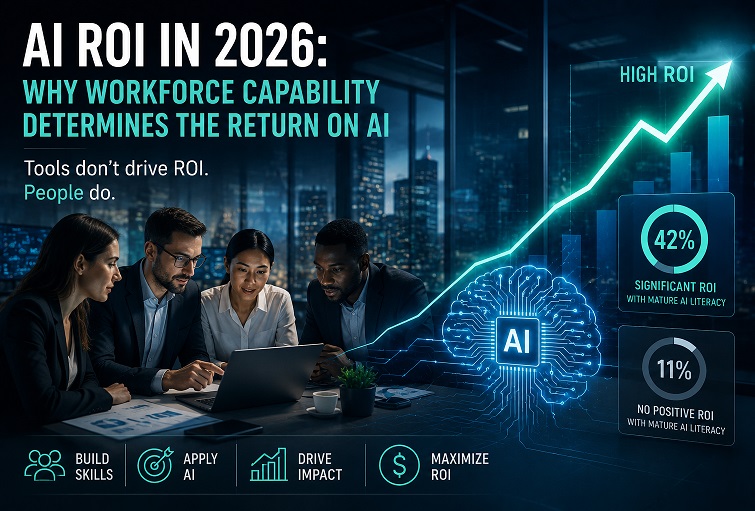
These figures suggest that simply increasing AI spending does not guarantee better financial outcomes. Organizations need the human capabilities required to convert technological investment into operational improvements.
The AI ROI gap is closely linked to workforce capability
One of the strongest patterns in the survey emerges when AI returns are compared with the maturity of organizational upskilling programs.
Among companies with mature, organization-wide data and AI literacy programs, the proportion reporting significant positive AI ROI rises from 21% to 42%. At the same time, the share reporting no positive ROI falls from 17% to 11%.
The relationship is difficult to ignore. Organizations that combine AI deployment with systematic workforce development are substantially more likely to report strong returns.
This does not mean that training alone creates AI ROI. Technology, data quality, infrastructure, governance, workflow design, and business strategy all matter. However, workforce capability determines how effectively those resources are converted into results.
An enterprise can purchase an advanced AI platform, but the platform itself does not identify the right business problem, determine whether an AI-generated answer is reliable, or decide how an insight should influence an operational decision. People still perform those tasks.
Why AI tools do not automatically create business value
AI is often discussed as a productivity technology, but productivity improvements do not occur simply because employees have access to an AI application.
To generate measurable value, employees need to understand where AI can be applied and where it should not be used. They must be able to formulate effective requests, provide appropriate context, assess generated information, identify errors, and integrate AI outputs into existing processes.
This creates several distinct capabilities:
- identifying suitable AI use cases
- selecting appropriate tools and models
- working effectively with enterprise data
- evaluating AI-generated results
- recognizing hallucinations and other model limitations
- protecting confidential and regulated information
- converting AI outputs into actionable decisions
- measuring the resulting business impact
Without these capabilities, AI can make individual tasks faster without necessarily making the overall process better.
For example, an employee might use a generative AI system to produce a report in half the usual time. If the resulting report contains inaccurate information and requires extensive manual verification, the apparent productivity gain may disappear. If the error reaches a customer or influences a business decision, the organization can actually suffer a negative return.
The same principle applies at scale.
In the 2026 survey, enterprise leaders identified several risks associated with insufficient AI skills. Inaccurate decision-making was cited by 32% of respondents, while 25% pointed to slower decision-making. Another 27% were concerned that insufficient AI capability could make it harder for their organizations to keep pace with competitors, and 16% identified security incidents as a significant risk.
The conclusion is straightforward: AI adoption without adequate workforce capability can increase both opportunity and exposure.
AI acts as a multiplier of existing capabilities
AI is frequently described as a general-purpose technology capable of transforming productivity. A more useful way to view it is as a multiplier.
When employees already understand their workflows, data, business objectives, and operational constraints, AI can amplify those capabilities. When the underlying skills are weak, the technology can amplify inefficiency, poor judgment, or bad processes just as easily.
The survey data supports this interpretation. Leaders associate stronger AI and data literacy with faster decision-making, cited by 48% of respondents, greater innovation, cited by 46%, and more accurate decision-making, cited by 41%.
Expected productivity improvements vary considerably between organizations and use cases, but the 10% to 20% range is frequently cited as a realistic target. Some organizations expect gains exceeding 20% in selected processes.
Achieving these improvements requires more than deploying a model. Employees have to redesign workflows around the technology, understand which tasks should remain under human control, and establish methods for validating AI-generated results.
This is why the economic impact of AI is often determined after deployment rather than at the moment a technology is purchased.
The problem with traditional AI training
Most enterprises recognize that their employees need AI skills. The problem is that many organizations still approach AI education as a conventional training problem.
According to the 2026 survey, 77% of organizations provide some form of AI training, and 68% give employees access to AI learning resources. Yet only 35% report having a mature workforce-wide AI upskilling program.
This difference is important.
Providing access to courses is not the same as building organizational capability. A library containing hundreds of AI courses may give employees plenty of educational material, but it does not necessarily tell them which skills are relevant to their roles or how those skills should be applied.
Leaders report several recurring weaknesses in existing training programs. Some 24% say there are insufficient hands-on projects or laboratory exercises. Another 23% report that learning paths are not sufficiently tailored to specific roles. Meanwhile, 26% struggle to measure the return generated by training itself.
These limitations create a familiar pattern: employees become aware of AI without becoming proficient users.
AI literacy needs to be connected to actual work
The requirements of an AI-enabled workforce are different from those of a conventional technical training program.
A software engineer, financial analyst, sales manager, HR specialist, supply chain planner, and manufacturing engineer will interact with AI in fundamentally different ways. A generic introduction to generative AI may be useful for all of them, but it cannot provide the complete skill set required for their respective jobs.
Effective programs therefore need to connect learning with real business processes.
For a financial team, that could involve analyzing large datasets, automating recurring reporting tasks, or using machine learning for forecasting. For marketing teams, the emphasis might be on customer segmentation, campaign analysis, content workflows, and experimentation. In manufacturing, AI education may focus on predictive maintenance, quality inspection, production optimization, or industrial data analysis.
The objective is not to turn every employee into a machine learning engineer. It is to give each employee enough understanding to recognize where AI can create value and to use it responsibly within their area of expertise.
From courses to continuous capability development
AI also creates a problem that traditional corporate education models were not designed to solve: the technology changes extremely quickly.
A training course that is accurate today may be incomplete several months later. Models improve, interfaces change, new tools appear, enterprise policies evolve, and organizations discover new applications for AI.
For this reason, AI literacy cannot be treated as a one-time certification.
A sustainable capability program should include continuous reinforcement, practical assignments, feedback, assessment, and periodic updates. Employees should be able to progress from basic concepts to role-specific applications and eventually to more advanced use cases.
This creates a learning cycle rather than a single training event:
Learn → apply → evaluate → improve → repeat.
The same principle applies to organizations themselves. As employees discover new AI applications, those experiences should feed back into business processes, governance policies, and future training programs.
Measuring AI capability is as important as measuring AI deployment
Another major obstacle is measurement.
Organizations often track the number of employees who have completed an AI course or the number of AI tools deployed across the enterprise. These metrics are useful, but they do not demonstrate business value.
A more meaningful measurement framework should connect learning to operational outcomes.
Depending on the use case, organizations can evaluate metrics such as processing time, error rates, customer response times, decision quality, automation rates, revenue generated, or hours saved.
For example, if an AI-assisted workflow reduces a process from two hours to 30 minutes, that improvement provides a much stronger indication of value than the number of employees who completed a training module about the technology.
Training itself can also be measured. Organizations can evaluate skill progression through assessments, practical projects, role-based benchmarks, and demonstrated proficiency.
The ultimate objective is to establish a measurable relationship between capability development and business performance.
What organizations with higher AI ROI tend to do differently
Enterprises that report stronger AI returns tend to share several characteristics.
First, they treat AI literacy as an organization-wide capability rather than something reserved for data scientists and IT departments. Business users, managers, analysts, and technical specialists all require different levels of AI competence.
Second, they connect training directly to business processes. Employees learn through practical scenarios rather than relying exclusively on lectures, videos, or theoretical material.
Third, they maintain continuous development programs instead of relying on isolated workshops. Skills are reinforced as technologies and business requirements evolve.
Fourth, they establish measurable progression. Organizations know what employees should be able to do at different skill levels and can track whether those capabilities are actually developing.
Finally, they connect AI projects to specific business objectives. Instead of asking where AI can be deployed, successful organizations ask which business problems justify the use of AI and what measurable outcome the technology is expected to deliver.
This approach changes AI from an experimental technology program into an operational capability.
Real-world examples show the importance of structured upskilling
Large enterprises are already experimenting with this model.
Bayer, for example, developed an enterprise Data Academy designed to provide employees with different levels of data and AI capability. The program supports multiple learner profiles, ranging from general data literacy to more advanced technical skills. According to reported results, more than 90% of participants said the training helped them develop innovative ideas or improve business processes.
Rolls-Royce has taken a similarly role-oriented approach to data and AI skills development. Its programs have focused on applying data capabilities to practical engineering and business processes, with reported improvements in the speed of certain data-related activities reaching orders of magnitude in some cases.
The important point in both examples is not the specific training platform or course catalog. The value comes from connecting education with actual organizational problems.
AI capability becomes economically meaningful when employees can take what they learn and apply it to processes that matter.
The next phase of enterprise AI is about returns, not experimentation
The first stage of enterprise AI adoption was largely focused on experimentation. Organizations wanted to understand what generative AI and machine learning could do, so they launched pilots, deployed assistants, tested models, and created proof-of-concept applications.
That phase is now giving way to a more demanding question: what did the investment actually achieve?
This shift changes the requirements for AI strategy.
Technology selection remains important, but it is only one part of the equation. Enterprises also need reliable data, appropriate infrastructure, governance frameworks, security controls, redesigned workflows, and employees who understand how to use the technology.
Workforce capability sits at the center of these elements because employees determine how AI interacts with the rest of the organization.
A technically sophisticated system cannot compensate indefinitely for poorly designed processes or insufficient user knowledge.
Building the foundation for sustainable AI returns
The organizations most likely to generate consistent returns from AI will not necessarily be those that deploy the largest number of models or purchase the most expensive platforms.
They will be the organizations that understand how technology, people, data, and processes interact.
That requires a shift from AI adoption to AI capability building. Instead of measuring success primarily through the number of tools deployed, enterprises need to evaluate whether employees can identify valuable use cases, operate AI systems effectively, challenge their outputs, and integrate them into measurable business processes.
The strategic question is therefore changing.
It is no longer enough to ask which AI platform an organization should purchase or how quickly it can deploy generative AI across the workforce. The more important question is whether the organization has the capabilities required to turn those technologies into repeatable business outcomes.
AI can provide enormous leverage, but leverage only produces meaningful returns when there is something capable of using it.
In 2026, workforce capability is increasingly becoming that missing component in the AI ROI equation.