The Rise of Humanoid Robots: How Physical AI Is Learning to Operate in the Real World
RoboticsHumanoid robots have become one of the most visible areas of the current robotics boom. Videos of machines walking, running, dancing, climbing stairs and performing tasks on factory floors create the impression that general-purpose robots are approaching commercial maturity.
The reality is more complicated. Modern humanoids have made substantial progress in locomotion, perception and manipulation, but reliable autonomous operation in an uncontrolled industrial environment remains a difficult engineering problem. The limiting factor is increasingly software rather than mechanical design. Robots need better models, better training data and more effective ways to combine information from multiple sensors.
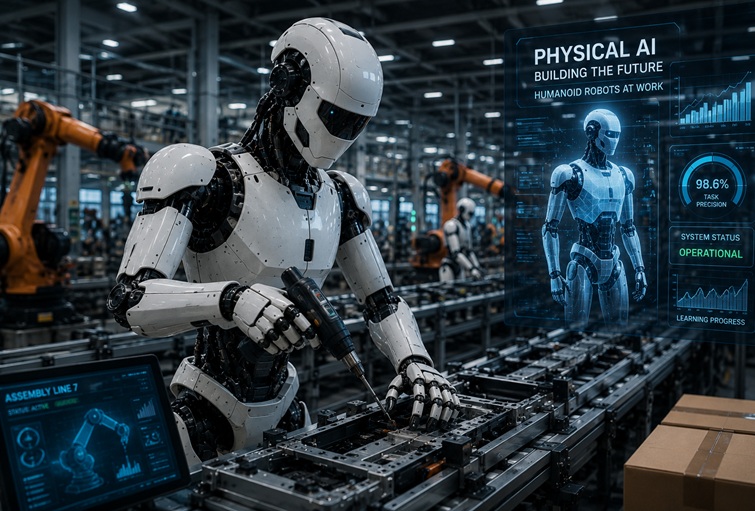
This is where physical AI enters the picture.
From artificial intelligence to physical intelligence
Traditional AI operates primarily in a digital environment. A language model processes text, an image model processes pixels, and a recommendation system processes structured data. Their outputs are also digital.
Physical AI has to close the loop between computation and the physical world. A robot observes its surroundings through cameras, microphones, force sensors and other devices, interprets those observations, decides what to do and generates commands for motors and actuators. The result is not a paragraph or an image, but a physical action.
This difference has profound implications for AI development.
Large language models benefit from an enormous supply of training material. The internet contains billions of pages of text, images and other digital information. Robotics has nothing comparable. A robot cannot learn how to manipulate an object reliably simply by reading about it. It needs examples of physical interaction, including successful actions, failures, contact forces, object motion and changes in the environment.
The shortage of high-quality physical interaction data is therefore one of the central challenges facing robotics.
Over the past few years, researchers have increasingly explored Vision-Language-Action models, or VLAs. These systems connect visual perception and natural-language instructions with physical actions. Instead of producing a textual response to an image, a VLA can use visual information and task instructions to determine the next movement of a robot.
This approach represents an important step toward general-purpose robotic intelligence, but it does not solve every problem.
Why one model may not be enough
A robot interacts with the world through several sensory modalities. Cameras provide visual information. Depth sensors provide spatial structure. Force and tactile sensors reveal physical contact. Microphones capture speech and environmental sounds. Specialized sensors could eventually provide information about temperature, chemical composition, smell and other properties.
Combining all of these inputs into a single model is technically attractive, but requires enormous quantities of synchronized multimodal training data.
An alternative is to use an agent-based architecture in which specialized models handle different types of information. A vision model can interpret an image, a speech model can process an instruction, a tactile model can detect contact or slippage, and a planning model can coordinate the resulting information.
This architecture has a practical advantage. Individual components can be upgraded independently. If a better vision model becomes available, it can potentially replace the existing perception module without rebuilding the entire robotic system.
The disadvantage is that every interface between components can become a source of information loss and latency. A unified multimodal model can preserve relationships between different sensor streams more naturally, while a collection of specialized models requires an additional orchestration layer.
The industry is therefore likely to move through both stages. Modular architectures can make current systems practical, while larger multimodal models may eventually absorb many of those capabilities into a common representation.
Why humanoid robots are useful
Physical AI and humanoid robotics are related but not synonymous.
A humanoid robot is primarily a physical platform designed around a human-like body structure. Physical AI is the intelligence that allows a machine to perceive and act in a physical environment. A robot can therefore use physical AI without having a human-shaped body, just as a humanoid can operate with relatively limited intelligence.
An industrial robotic arm equipped with cameras, force sensors and an advanced control system is an example of physical AI without a humanoid form. Conversely, a humanoid performing a predefined dance routine may have a sophisticated mechanical platform but little general-purpose physical intelligence.
So why build humanoids at all?
The main argument is compatibility with the existing human environment.
Factories, warehouses, offices and public buildings have largely been designed around human bodies. Doors have handles at human height. Control panels contain buttons and switches designed for human hands. Workstations, shelves, tools and storage systems follow human dimensions.
A humanoid can potentially operate in these environments without requiring the facility to be redesigned around a specialized machine.
There is another important advantage: humans already generate enormous amounts of behavioral data. Video recordings, demonstrations and motion-capture datasets can provide examples of how people interact with objects. A robot with a broadly human-like body can potentially use some of this information as a basis for learning.
That does not mean humanoids should reproduce human anatomy exactly. Robotics engineers can deliberately depart from human proportions when doing so improves performance. A rotating torso, additional degrees of freedom or a different hand design may make a robot considerably more effective than a literal mechanical copy of a person.
The useful concept is therefore not “a robot that looks human.” It is a general-purpose physical platform capable of operating in infrastructure designed for humans.
The robot’s sensory systems
Vision
Vision remains the primary sensory channel for most modern robots.
RGB cameras provide information about objects, surfaces, people and the overall geometry of the environment. Vision-language models have already learned substantial semantic knowledge from large image and text datasets, which gives robotic systems a useful starting point.
A robot does not necessarily need to learn from scratch that a cup is an object, that a door has a handle or that a screwdriver can be used as a tool. A large pretrained model may already possess much of this semantic knowledge.
The difficult part is connecting that knowledge to physical action.
A VLA model attempts to make this connection by associating visual observations and instructions with robot actions. The model must determine not only what an object is, but where it is, how it can be manipulated and which movement should occur next.
Depth sensing provides additional information. RGB-D cameras can estimate the distance to objects, while lidar can generate a three-dimensional representation of the surrounding environment. These sensors are particularly useful for navigation and spatial reasoning.
Directly incorporating three-dimensional data into general-purpose robotic models remains challenging because suitable training datasets are much smaller than conventional image datasets.
Touch and force feedback
Vision alone is insufficient for many forms of manipulation.
Humans often stop looking directly at an object once their hand approaches it. When picking up a cup, for example, visual information establishes its approximate position, but tactile and force feedback determines whether the fingers have made contact and whether the grip is sufficient.
Robots need similar feedback.
Force sensors can measure the interaction between the robot and an object. More advanced tactile sensors can detect the distribution of pressure across a surface and identify events such as contact, vibration and the onset of slipping.
This information becomes particularly important for fine manipulation.
Consider inserting a connector, tightening a screw or assembling a small mechanical component. A camera may establish the approximate position of the part, but it cannot always determine whether two surfaces are properly engaged. The robot needs to feel the interaction through force or tactile sensors.
Deformable objects create another problem. Folding clothes, manipulating cables or wiping a surface require continuous feedback because the object changes shape during the operation.
Electronic skin is one potential long-term solution. Flexible sensor arrays can measure pressure, shear forces and vibration across large areas of a robotic hand or body. Some experimental systems also integrate temperature or chemical sensing.
Commercial robots generally use more limited force and tactile sensing today, particularly in their hands and joints. As sensor technology improves, tactile data is likely to become increasingly important in robotic foundation models.
Hearing and environmental audio
Audio is another underused source of information.
A robot equipped with multiple microphones can estimate the direction of a sound and distinguish between different acoustic events. Speech recognition allows humans to issue natural-language instructions, but environmental sounds can also contain information about physical events.
For example, a robot may hear the sound produced when a component clicks into place, a material tears, a motor begins to fail or a hard object breaks.
Current robotic architectures frequently convert speech into text and then discard the original audio signal. A typical pipeline consists of speech detection, transcription, language-model processing and speech synthesis.
That approach works well for human communication, but it loses information contained in non-verbal sounds.
A genuinely multimodal physical intelligence system could eventually associate acoustic events directly with actions. The challenge is once again data. Existing robotic datasets contain relatively little useful, synchronized audio associated with specific physical events.
Speech and natural-language interaction
Speech is likely to remain one of the simplest ways for humans to communicate with general-purpose robots.
A human should eventually be able to say something such as “move those boxes to the other side of the workstation” without specifying every movement. The robot’s planning system would translate the high-level instruction into a sequence of actions.
Speech generation has a separate role. A robot working alongside humans may need to communicate changes in its state, warn about hazards or coordinate actions with another machine.
The most useful systems will probably combine verbal communication with physical behavior rather than treating speech as an independent chatbot function.
A robot could say that it is losing its grip while simultaneously adjusting its hand position. The communication and physical control would form one continuous interaction.
Smell and taste
Chemical sensing is much less important for most industrial robots, but it could become valuable in specialized applications.
Electronic noses use arrays of chemical sensors to detect patterns associated with particular substances. Similar concepts can be applied to food inspection, environmental monitoring or leak detection.
Taste sensing is even more specialized, but there are already experimental electronic systems capable of characterizing properties such as sweetness, acidity or saltiness.
A robotic cooking system, for example, could potentially use chemical and sensory feedback to compare a prepared dish with a target profile.
These modalities are unlikely to become standard components of every humanoid robot. Their value will depend heavily on the application.
A robotic “brain” with several layers
The computational architecture of a humanoid robot is likely to be hierarchical.
At the lowest level is real-time control. Motors, joints and actuators must react to disturbances within very short time intervals. Balance and whole-body control cannot depend on a remote cloud service with unpredictable network latency.
This can be thought of as the robot’s fastest control layer. It maintains stability, executes trajectories and reacts to physical disturbances.
Above it is a reactive intelligence layer responsible for interpreting the immediate environment and selecting appropriate movements. Compact models can operate locally and respond quickly to changes.
At the highest level is planning and reasoning. Large language models, vision-language models or other foundation models can interpret complex instructions, decompose goals and select strategies.
This division resembles the distinction between fast and deliberate cognition in humans, although the analogy should not be taken literally. Robotic systems also require an additional layer dedicated specifically to physical stability and control.
Computational requirements create another architectural choice.
Latency-sensitive control must remain on the robot. More demanding reasoning can potentially run on an edge server or in a data center. As humanoid deployments increase, cloud infrastructure could become an important part of the robotics ecosystem because training and inference for large physical-AI models can require substantial computational resources.
The result may be a distributed architecture in which the robot carries the components that must react immediately, while larger models run remotely.
World models and autonomous behavior
A robot needs more than perception and motor control. It needs some understanding of how the environment behaves.
World models attempt to provide this capability by predicting how a scene may change after an action. If a robot pushes an object, for example, the model should estimate where the object is likely to move.
Video-generation models have demonstrated that AI systems can learn statistical representations of how scenes evolve over time. This has created interest in using generative models as part of robotic planning.
One possible approach is to generate a predicted visual sequence for a proposed action and then execute a corresponding motor trajectory.
The concept is similar to mental simulation. Before performing a physical action, humans can anticipate its likely consequences. A robot could theoretically perform a comparable simulation before committing to a movement.
The problem is computational cost and accuracy.
A useful robotic world model must produce predictions quickly enough for real-time operation. It also needs to remain reliable when the environment differs from the training data. Generating a visually convincing future scene is not necessarily equivalent to predicting the exact physical consequences of an action.
This is one reason world models remain an active area of research rather than a solved component of autonomous robotics.
The role of emotion and social behavior
Humanoid robots will increasingly work in environments shared with humans, making communication and social cues relevant.
A robot operating in a warehouse might need to signal that it has detected a hazard. A service robot may need to communicate uncertainty. A collaborative manufacturing robot could use voice, posture or other signals to indicate its next action.
However, there is little technical reason to reproduce human psychology in full.
Robots do not need human emotions to interact effectively with people. They need predictable communication mechanisms that allow humans to understand their state and intentions.
The distinction matters because anthropomorphic behavior can create unrealistic expectations. A robot may look and sound human while having very different capabilities and limitations.
Where humanoids make economic sense in factories
The most compelling industrial application for humanoids may not be replacing entire production lines.
Modern factories are already highly automated. Dedicated machines are usually better than general-purpose robots when the task is stable, repetitive and well defined.
The remaining manual work is often the difficult “long tail” of operations.
A factory may have hundreds of automated processes but still require people to perform a small number of irregular tasks. A component may occasionally fall from a conveyor. A machine may require a manual reset. A box may have to be moved to an unusual location. An operator may need to interact with equipment that was never designed for robotic automation.
Building a dedicated automation system for every such exception can be economically unattractive.
A general-purpose humanoid could potentially handle these tasks using the existing infrastructure.
This creates an interesting alternative to the traditional concept of a fully automated factory. Instead of rebuilding a facility as a highly structured environment for machines, manufacturers could retain much of their existing infrastructure and use general-purpose robots to automate the remaining manual operations.
Humanoids also offer potential advantages in environments that are difficult or undesirable for people, including repetitive, uncomfortable or hazardous tasks.
However, these advantages only matter if the robot can operate reliably enough to justify its cost.
Reliability is the real benchmark
A successful demonstration proves that a robot can perform a task. Industrial deployment requires proof that it can perform the same task repeatedly.
This distinction is fundamental.
A robot that succeeds nine times out of ten may look impressive in a video. In an industrial process involving thousands of cycles, a 10 percent failure rate is unacceptable.
Even a much lower failure rate can create problems when failures require human intervention. If a robot needs an operator to recover it every few hundred cycles, the company has not eliminated labor. It has simply changed the nature of the work.
Reliability therefore has to be evaluated at the system level.
The robot must perceive correctly, plan correctly, execute the movement, maintain balance, interact safely with equipment and recover from unexpected conditions. Every component contributes to the final failure rate.
This is particularly important for humanoids because their mechanical complexity creates many potential failure modes.
Safety is another major consideration. A large, dynamically moving robot operating near humans creates risks that are different from those associated with a fixed industrial arm.
The industry therefore needs not only better models but also robust safety systems, fault detection, redundant control mechanisms and appropriate standards for autonomous operation.
The transition to production will be gradual
The path from laboratory demonstrations to widespread industrial deployment is unlikely to happen in a single step.
The first practical applications are likely to involve relatively constrained tasks such as inspection, monitoring and simple material handling.
The next stage will involve more complex manipulation, including picking objects, moving containers and interacting with large controls.
Fine manipulation will come later because it requires better hands, tactile sensing, force control and much more reliable learned policies.
This staged approach also makes economic sense. Manufacturers can begin with applications where the cost of failure is manageable and gradually increase the robot’s responsibilities as reliability improves.
The industry should also become more skeptical of demonstrations that show only a single successful attempt. Meaningful benchmarks will need to include long-duration operation, recovery from errors, environmental variation and performance under realistic production conditions.
The biggest bottleneck is data
Mechanical progress in humanoid robotics has been rapid. Modern platforms can walk dynamically, recover from disturbances, climb stairs and perform increasingly sophisticated movements.
Software and training data are now becoming equally important.
A general-purpose robot needs examples of physical interactions across thousands of environments. It must learn not only what successful actions look like but also how to recognize mistakes and recover from them.
Large datasets of real robot trajectories are emerging, but they remain small compared with the datasets used to train language and vision models.
Several approaches could help close this gap.
One is collecting more real-world robot data. Another is learning from human demonstrations. Simulation can generate large quantities of synthetic experience, while reinforcement learning can allow robots to improve through trial and error in controlled environments.
Video is another potentially valuable source of information. If models can learn useful relationships between observed human actions and physical consequences, existing video archives could become an enormous training resource.
The long-term goal is to reduce the amount of manually collected and annotated robotic data required to teach new skills.
When will humanoid robots become mainstream?
It is difficult to assign a precise date to the transition from experimentation to mass deployment.
The technology is already capable of performing useful tasks under controlled conditions. What remains uncertain is whether those capabilities can be generalized, maintained and economically deployed across thousands of machines.
A major breakthrough may come from a new model architecture, better multimodal learning, cheaper data collection or more effective simulation. It may also come from improvements in hardware, particularly batteries, actuators, hands and tactile sensors.
The economics will ultimately determine the speed of adoption.
A humanoid does not need to outperform a human at every task. It needs to perform a sufficiently valuable set of tasks at a sufficiently low operating cost, with predictable reliability and acceptable safety.
Once a robot demonstrates that capability in a real production environment, replication becomes much easier. A successful software policy can potentially be transferred to a large fleet of similar machines, allowing improvements to propagate across thousands of robots.
That scalability is one of the most important differences between robotics and traditional automation.
The next phase of physical AI
The humanoid robot should not be viewed simply as a mechanical replacement for a human worker. It is becoming the physical endpoint of a much larger AI stack involving foundation models, computer vision, multimodal perception, planning, reinforcement learning, simulation, real-time control and cloud computing.
The first generation of practical systems will probably remain highly modular. Vision, language, planning, tactile perception and motor control will be handled by different components connected through an orchestration layer.
Over time, those components may converge into increasingly capable multimodal models that understand the environment and physical actions in a common representation.
The ultimate objective is not necessarily a machine that perfectly imitates human behavior. It is a system that can enter an unfamiliar environment, understand what needs to be done, learn the required skills and perform them safely with limited supervision.
That is a substantially harder problem than making a robot walk or manipulate an object in a carefully prepared demonstration.
Humanoid robotics has therefore entered an important transition. The question is no longer whether machines can reproduce selected human movements. They clearly can. The more consequential question is whether physical AI can become reliable enough to turn those movements into useful, repeatable work.
The companies and research groups that solve the problems of data, multimodal perception, manipulation, autonomy and reliability will determine how quickly that transition takes place. Once those pieces begin to work together, humanoid robots could move from impressive demonstrations to a practical layer of industrial infrastructure.