
Cloud Security Risks in 2026: Key Threats, Operational Challenges, and Practical Defenses
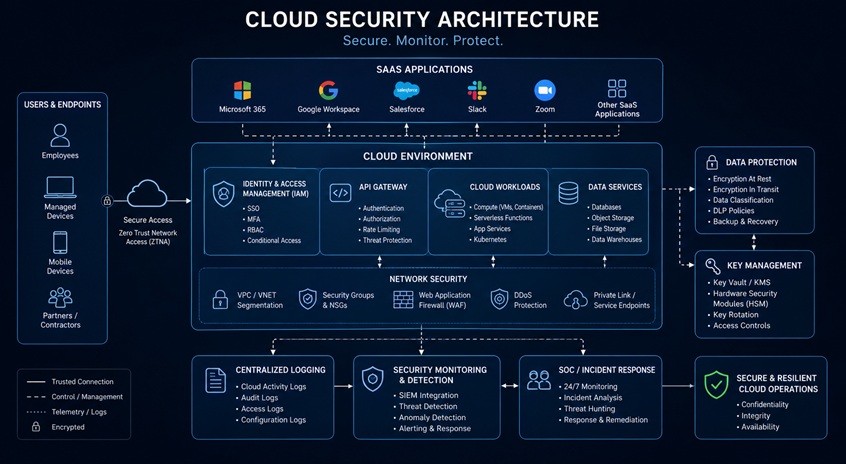
Cybersecurity Cloud SecurityCloud infrastructure has become the operational backbone of modern business. Organizations rely on platforms such as Microsoft 365, Google Workspace, SaaS ecosystems, and multi-cloud deployments to support distributed teams, accelerate product delivery, and scale globally. At the same time, attackers have shifted their focus toward cloud-native environments, identity systems, APIs, and third-party integrations.
Traditional network boundaries no longer exist in the same form they did a decade ago. Security teams now defend environments where users connect from unmanaged devices, workloads move dynamically between cloud providers, and sensitive data is constantly exchanged across applications and services.
As organizations continue expanding their cloud footprint, the security challenges become less about perimeter defense and more about visibility, identity governance, configuration management, and operational resilience.
This article examines the most significant cloud security risks organizations face in 2026 and outlines practical strategies for reducing exposure.
1. Misconfigured Cloud Resources
Misconfiguration remains one of the leading causes of cloud-related security incidents. Publicly exposed storage buckets, overly permissive IAM roles, unrestricted databases, and improperly configured network rules continue to create unnecessary attack surfaces.
Cloud platforms prioritize usability and rapid deployment. As a result, development and operations teams often provision services quickly without validating security controls thoroughly. A single incorrect permission setting can expose sensitive customer data, internal documents, or production infrastructure to the public internet.
In large environments, configuration drift becomes another serious issue. Even if systems are initially secured correctly, changes introduced over time can gradually weaken the overall security posture.
Mitigation strategies
- Enforce infrastructure-as-code validation
- Continuously audit cloud configurations
- Apply least-privilege policies to all resources
- Use automated posture management tools
- Conduct regular external exposure assessments
2. Identity and Access Management Weaknesses
Cloud security has effectively become identity security. Attackers no longer need to exploit sophisticated malware when compromised credentials can provide direct access to business-critical systems.
Many organizations still grant excessive permissions to employees, contractors, and service accounts. Administrative privileges accumulate over time, dormant accounts remain active, and shared credentials continue to exist in environments where accountability should be strictly enforced.
Compromised identities allow attackers to move laterally across services, exfiltrate data, disable monitoring systems, and establish persistence without triggering traditional endpoint defenses.
Mitigation strategies
- Implement least-privilege access controls
- Eliminate standing administrative privileges
- Enforce phishing-resistant MFA
- Monitor anomalous login behavior
- Regularly review and revoke unused permissions
3. Human Error and Operational Oversights
Cloud environments are highly complex. Even experienced administrators can make mistakes under operational pressure.
Security incidents frequently originate from routine actions:
- Incorrectly shared documents
- Public collaboration links
- Misapplied access policies
- Accidental exposure of credentials
- Improperly secured development environments
As organizations scale, operational complexity increases faster than many security teams can realistically manage.
Mitigation strategies
- Standardize deployment procedures
- Reduce manual configuration changes
- Introduce security reviews into deployment pipelines
- Conduct regular employee security training
- Use policy enforcement automation wherever possible
4. API and Integration Security Risks
Modern cloud environments rely heavily on APIs for communication between services, applications, and external platforms. APIs now represent one of the most targeted components of cloud infrastructure.
Weak authentication, excessive token permissions, exposed endpoints, and insecure third-party integrations can create direct entry points for attackers. Since APIs often operate silently in the background, malicious activity may remain undetected for long periods.
Organizations increasingly depend on SaaS integrations that introduce additional risk outside the direct control of internal security teams.
Mitigation strategies
- Require strong authentication for all APIs
- Limit token scope and lifespan
- Monitor API usage patterns continuously
- Inventory all third-party integrations
- Apply rate limiting and anomaly detection
5. Visibility Gaps Across Multi-Cloud Environments
Many organizations now operate across multiple cloud providers and SaaS platforms simultaneously. Security telemetry becomes fragmented across different dashboards, logging systems, and monitoring tools.
Without centralized visibility, attackers can exploit blind spots to maintain persistence undetected. Correlating suspicious behavior across environments becomes significantly more difficult when logs and alerts are distributed across isolated systems.
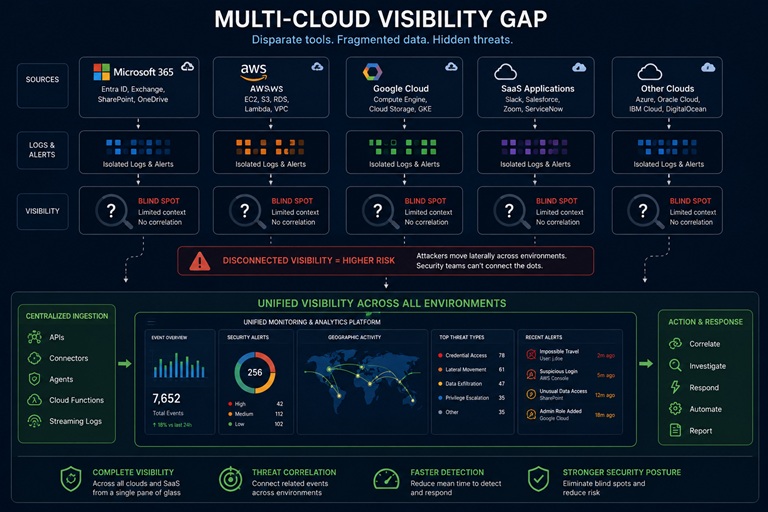
This challenge is especially severe for smaller security teams with limited resources.
Mitigation strategies
- Centralize logging and security telemetry
- Normalize events across platforms
- Deploy unified monitoring solutions
- Continuously map identities and assets
- Improve cross-platform incident correlation
6. Shadow IT and Unauthorized SaaS Usage
Employees regularly adopt unauthorized cloud applications to improve productivity or bypass operational friction. These tools often enter environments without security review, compliance validation, or centralized oversight.
While many shadow IT applications appear harmless, they frequently process sensitive business data without adequate safeguards. Organizations may lose visibility into how information is stored, shared, or retained.
Shadow IT also expands the attack surface significantly, especially when employees reuse credentials across unsanctioned services.
Mitigation strategies
- Discover unmanaged SaaS applications continuously
- Define approved software policies clearly
- Educate employees about SaaS risks
- Restrict unauthorized OAuth permissions
- Monitor data movement into external platforms
7. Cloud Data Breaches and Data Loss
Cloud data breaches rarely result from a single catastrophic failure. More commonly, they emerge from combinations of weak access controls, exposed services, excessive permissions, and inadequate monitoring.
Once sensitive data leaves a controlled environment, recovery becomes extremely difficult. Regulatory exposure, legal costs, reputational damage, and operational disruption often follow.
Organizations handling customer information, intellectual property, healthcare records, or financial data face particularly severe consequences after a breach.
Mitigation strategies
- Classify sensitive data systematically
- Encrypt data both at rest and in transit
- Restrict access based on business need
- Monitor abnormal download activity
- Implement reliable backup and recovery procedures
8. Supply Chain and Third-Party Exposure
Modern businesses depend heavily on software vendors, cloud service providers, MSPs, and external integrations. Every third-party connection introduces additional risk.
Attackers increasingly target vendors because compromising a single provider can create access paths into thousands of customer environments simultaneously. Supply chain attacks have become highly efficient and scalable.
Organizations frequently underestimate the level of trust granted to external applications and service providers.
Mitigation strategies
- Perform security assessments on vendors
- Review third-party access permissions regularly
- Limit integration scope wherever possible
- Monitor partner activity continuously
- Establish contractual security requirements
9. Ransomware Targeting Cloud Infrastructure
Ransomware operations have evolved beyond endpoint encryption. Threat actors now target cloud identity systems, backup repositories, SaaS platforms, and administrative consoles directly.
In many cases, attackers focus on data theft and extortion instead of encryption alone. Exfiltrated customer records, financial documents, and intellectual property are leveraged to pressure organizations into paying ransom demands.
Cloud-native ransomware campaigns often prioritize stealth and persistence before executing disruptive actions.
Mitigation strategies
- Harden privileged accounts aggressively
- Separate backup infrastructure from production systems
- Monitor for unusual administrative activity
- Restrict lateral movement opportunities
- Develop tested incident response procedures
10. AI-Driven Threat Operations
Artificial intelligence is increasingly being weaponized by attackers. Automated reconnaissance, AI-assisted phishing campaigns, synthetic voice impersonation, and adaptive malware are becoming more common.
Attackers now generate highly personalized social engineering campaigns at scale. Traditional indicators of phishing, such as poor grammar or generic messaging, are rapidly disappearing.
Deepfake-enabled business email compromise attacks are also growing more sophisticated, particularly against finance and executive teams.
Mitigation strategies
- Strengthen identity verification procedures
- Train employees to validate sensitive requests
- Deploy behavioral detection technologies
- Use adaptive authentication systems
- Monitor abnormal communication patterns
11. Insider Threats
Not all threats originate externally. Employees, contractors, and trusted partners can intentionally or accidentally expose sensitive information.
Insider incidents often involve:
- Unauthorized data transfers
- Credential misuse
- Policy violations
- Intellectual property theft
- Improper handling of regulated data
Because insiders already possess legitimate access, their activity is often difficult to distinguish from normal operations.
Mitigation strategies
- Monitor user behavior anomalies
- Segment sensitive systems carefully
- Restrict high-risk actions
- Audit privileged activity continuously
- Establish clear data handling policies
12. MFA Fatigue and Authentication Abuse
Multi-factor authentication remains essential, but attackers have adapted their techniques accordingly.
MFA fatigue attacks rely on repeated push notifications designed to pressure users into approving malicious login attempts. In many cases, users eventually accept requests simply to stop the interruptions.
This technique becomes particularly effective when combined with stolen credentials and social engineering.
Mitigation strategies
- Adopt number-matching MFA methods
- Use phishing-resistant authentication technologies
- Block impossible travel scenarios
- Monitor repeated MFA failures
- Educate employees on prompt abuse attacks
13. Compliance and Regulatory Complexity
Organizations operating in regulated industries face increasing pressure to comply with frameworks such as:
- GDPR
- HIPAA
- PCI DSS
- ISO 27001
- SOC 2
- CMMC
Cloud adoption complicates compliance because data often moves dynamically across regions, services, and providers. Security teams must continuously validate that configurations align with evolving legal and industry requirements.
Compliance failures can result in significant financial penalties and operational disruption.
Mitigation strategies
- Maintain centralized compliance visibility
- Automate policy validation
- Track data residency requirements
- Conduct regular security assessments
- Align cloud architecture with regulatory obligations
14. Encryption Failures and Key Management Issues
Encryption remains a foundational cloud security control, but implementation gaps are still common.
Organizations sometimes assume encryption is enabled by default across all services. In practice, poorly managed keys, legacy systems, weak cryptographic standards, or inconsistent encryption policies can expose sensitive information.
Improper key management may completely undermine otherwise strong encryption strategies.
Mitigation strategies
- Enforce encryption across all sensitive workloads
- Rotate cryptographic keys regularly
- Restrict access to key management systems
- Audit encryption policies continuously
- Use hardware-backed key protection where appropriate
15. DDoS and Service Availability Attacks
Distributed denial-of-service attacks continue to threaten cloud-hosted applications and internet-facing services.
Although major cloud providers offer built-in mitigation capabilities, sophisticated attacks can still degrade availability, overwhelm application layers, or create operational disruption during critical periods.
Availability remains a core component of cloud security, especially for customer-facing platforms.
Mitigation strategies
- Use managed DDoS protection services
- Implement traffic filtering and rate limiting
- Design systems for geographic redundancy
- Monitor traffic anomalies in real time
- Prepare operational failover procedures
What Cloud Security Actually Means
Cloud security is the collection of technologies, operational practices, governance models, and defensive controls used to protect cloud-hosted infrastructure, applications, identities, and data.
Unlike traditional security models built around physical network boundaries, cloud security focuses heavily on:
- Identity verification
- Access governance
- Continuous monitoring
- Configuration integrity
- Data protection
- Threat detection
- Incident response
Security in the cloud operates under a shared responsibility model. Cloud providers secure the underlying infrastructure, while customers remain responsible for securing workloads, identities, applications, and data within their environments.
Misunderstanding this division of responsibility remains a major source of security exposure.
Why Cloud Security Matters
For most organizations, the cloud now supports critical business operations. Productivity platforms, customer databases, collaboration systems, software development environments, and financial applications increasingly reside outside traditional corporate networks.
A serious cloud security incident can result in:
- Financial loss
- Regulatory penalties
- Operational downtime
- Data exposure
- Reputational damage
- Loss of customer trust
Security maturity directly affects organizational resilience. Businesses that fail to secure cloud environments effectively may struggle to recover from modern cyberattacks.
Conversely, organizations with mature cloud security programs gain stronger operational continuity, improved compliance readiness, and greater confidence in scaling digital operations.
Cloud Security Best Practices
Effective cloud security is built on operational discipline rather than individual tools alone.
Strong security programs typically focus on several core principles:
1. Identity-first security
Protect identities aggressively through strong authentication, privilege management, and continuous monitoring.
2. Continuous visibility
Maintain centralized insight into assets, users, configurations, and activity across all cloud platforms.
3. Least-privilege access
Ensure users and applications only receive permissions required for their specific functions.
4. Automation and policy enforcement
Reduce manual administration by enforcing security baselines automatically.
5. Security monitoring and response
Continuously detect suspicious behavior and maintain tested incident response procedures.
6. Vendor and supply chain governance
Evaluate third-party providers carefully and limit unnecessary external access.
7. Data-centric protection
Classify, encrypt, monitor, and govern sensitive information consistently across environments.
Final Thoughts
Cloud adoption continues to accelerate, but so does the sophistication of cloud-focused threat activity. Organizations can no longer rely on traditional perimeter-based security assumptions when defending modern infrastructure.
The most successful cloud security strategies combine visibility, identity governance, automation, and continuous monitoring. Businesses that proactively address misconfigurations, excessive permissions, shadow IT, and third-party exposure significantly reduce their risk profile.
Cloud security is no longer a specialized concern reserved for enterprise-scale organizations. It has become a core operational requirement for businesses of every size operating in a digital-first environment.