CloakBrowser and the New Generation of Anti-Detection Browsers
Cybersecurity Browser, CloakBrowserFor years, browser automation existed in an arms race between developers and detection systems. Every improvement in automation frameworks such as Selenium, Puppeteer, or Playwright was quickly met by increasingly sophisticated anti-bot infrastructure deployed by Cloudflare, DataDome, PerimeterX, FingerprintJS, and dozens of proprietary detection engines.
The modern web no longer identifies users solely through cookies or IP addresses. Browser fingerprinting has become the dominant mechanism for identifying automated traffic, linking accounts, enforcing anti-fraud policies, and distinguishing humans from scripts. In response, an entire category of software emerged around the concept of “anti-detect” browsing.
Most anti-detect browsers have historically relied on JavaScript injection, runtime patching, or browser configuration tricks to modify identifiable signals. CloakBrowser takes a different approach. Instead of manipulating fingerprints after the browser launches, it modifies Chromium itself at the source-code level.
That architectural decision is what has made CloakBrowser one of the most discussed browser automation projects in the cybersecurity and scraping communities in 2026.
What Is CloakBrowser?
CloakBrowser is a Chromium-based anti-detection browser designed for stealth browser automation and profile isolation. It functions as a drop-in replacement for Playwright, Puppeteer, and related automation frameworks while attempting to eliminate the fingerprinting artifacts commonly associated with automated browsing.
Unlike traditional stealth plugins, CloakBrowser modifies Chromium directly through dozens of low-level C++ patches compiled into the browser binary itself. The project positions this as a fundamentally different strategy from JavaScript-level spoofing.
The distinction matters because most modern anti-bot systems no longer rely on simplistic checks such as navigator.webdriver. Detection engines now analyze inconsistencies across rendering pipelines, GPU characteristics, timing behavior, font enumeration, audio processing, WebGL output, canvas entropy, browser APIs, and hardware reporting.
Runtime spoofing often creates contradictions between layers of the browser stack. CloakBrowser attempts to avoid these contradictions by altering the behavior of Chromium internally before the browser process even starts.
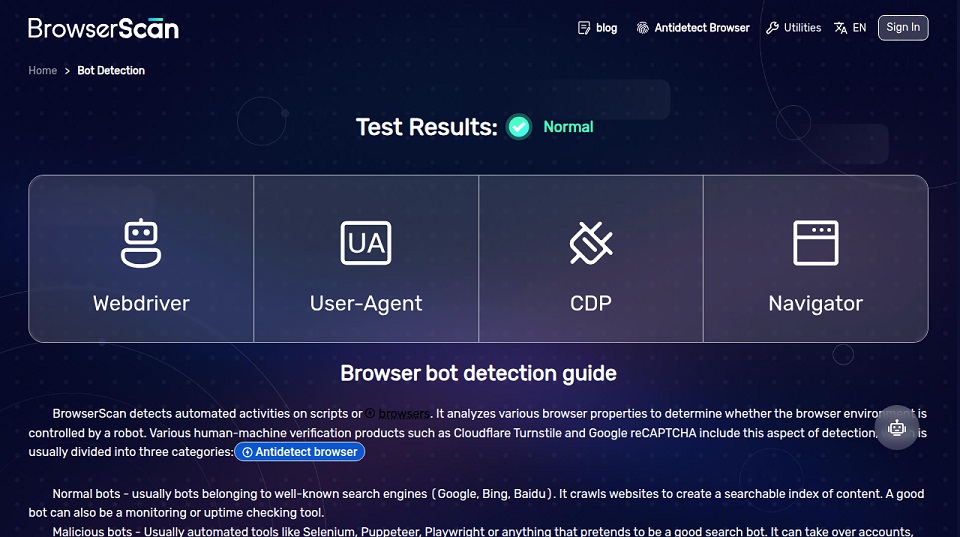
The browser currently supports:
- Playwright
- Puppeteer
- Selenium
- AI-driven browser agents
- Persistent browser profiles
- Proxy integration
- Fingerprint isolation
- Humanized interaction simulation
- Docker-based deployment
- Self-hosted profile management
The project is distributed as open-source software with Python and JavaScript packages.
Why Browser Fingerprinting Became a Security Battleground
To understand why CloakBrowser matters, it is necessary to understand how browser fingerprinting evolved.
Modern anti-bot systems no longer depend on static identifiers. Instead, they build probabilistic models based on hundreds of client-side signals collected within milliseconds after page load.
These signals may include:
- GPU vendor and renderer
- Canvas rendering output
- WebGL behavior
- AudioContext fingerprints
- Screen dimensions
- Installed fonts
- Hardware concurrency
- Memory characteristics
- Timezone and locale
- Input timing patterns
- Touch support
- TLS fingerprints
- Browser startup timing
- Storage behavior
- Sensor APIs
A single mismatch may not trigger detection, but clusters of inconsistencies often do.
For example, a browser reporting macOS fonts while exposing a Windows GPU stack is suspicious. A browser claiming to be a residential laptop while demonstrating server-grade CPU behavior is suspicious. A headless Chromium instance exposing missing GPU acceleration or abnormal rendering timing is suspicious.
Traditional stealth plugins attempted to patch these leaks reactively using JavaScript. The problem is that injected scripts themselves became detectable.
This led to a shift toward lower-level browser modification.
Academic research over the last several years has repeatedly demonstrated how browser spoofing and fingerprint manipulation can bypass identity systems when implemented deeply enough in the browser stack.
CloakBrowser’s Core Architecture
CloakBrowser’s most important technical characteristic is its use of source-level Chromium patching.
According to public project documentation, the browser incorporates dozens of C++ modifications directly into Chromium’s engine.
These patches reportedly affect:
- Canvas rendering
- WebGL reporting
- GPU fingerprints
- Audio fingerprints
- Font enumeration
- Hardware reporting
- Browser automation leaks
- Storage behavior
- Incognito detection vectors
Instead of injecting JavaScript after the page loads, the browser changes how Chromium internally generates these signals.
This is a significant distinction because anti-bot vendors increasingly inspect the integrity of the JavaScript execution environment itself. Any evidence of tampering, monkey-patching, or injected runtime hooks can become a detection vector.
CloakBrowser attempts to avoid this category of detection entirely.
The project also includes a secondary stealth layer focused on automation leakage reduction. This targets fingerprints commonly exposed through Chrome DevTools Protocol automation stacks used by Playwright and Puppeteer.
In practice, CloakBrowser functions less like a browser extension and more like a customized Chromium fork optimized for stealth automation.
Fingerprint Isolation and Profile Management
One of the defining features of anti-detect browsers is profile isolation.
A conventional browser shares numerous artifacts across sessions:
- Cookies
- IndexedDB storage
- LocalStorage
- Service workers
- Cache state
- TLS behavior
- Browser entropy patterns
Anti-detect browsers separate these environments into isolated profiles designed to appear as unrelated devices.
CloakBrowser includes a profile management system that allows users to create persistent browser identities with separate fingerprints and proxy configurations.
The practical purpose is straightforward: each profile behaves as a distinct machine from the perspective of remote websites.
This matters in environments where platforms aggressively correlate accounts across shared infrastructure. Social media moderation systems, ad platforms, marketplaces, fraud engines, and e-commerce systems frequently link accounts through browser fingerprints even when IP addresses differ.
A properly isolated browser profile attempts to minimize that correlation.
Proxy Integration and Network Consistency
Fingerprint spoofing alone is insufficient.
Modern anti-fraud systems correlate browser identity with network behavior. A browser claiming to be a German macOS laptop while connecting through a low-reputation Indonesian datacenter proxy immediately appears suspicious.
CloakBrowser supports proxy integration and reportedly synchronizes locale and timezone characteristics with proxy geography.
This reflects an important reality in modern detection systems: consistency matters more than randomness.
Many older anti-detect tools focused on generating highly randomized fingerprints. That strategy often produced impossible or statistically rare device combinations.
Contemporary anti-detection strategies instead prioritize coherence:
- Realistic hardware combinations
- Stable entropy patterns
- Persistent identities
- Geographic consistency
- Human interaction timing
- Predictable browser history
The industry has gradually moved from “maximum spoofing” toward “plausible authenticity.”
Human Behavior Simulation
One increasingly important detection layer involves behavioral analysis.
Modern anti-bot systems monitor:
- Mouse movement curvature
- Scroll acceleration
- Keyboard timing
- Focus changes
- Click hesitation
- Session pacing
Static automation patterns are often easy to identify even when the browser fingerprint itself appears legitimate.
CloakBrowser includes optional “humanized” interaction behavior designed to simulate natural mouse paths, realistic typing cadence, and non-linear scrolling patterns.
This reflects the broader shift in bot detection from static fingerprint analysis toward behavioral telemetry.
Detection vendors increasingly combine:
- Browser fingerprinting
- Network intelligence
- Behavioral analytics
- Historical reputation systems
Stealth automation now requires all four layers to appear coherent.
Compatibility With Automation Frameworks
One reason CloakBrowser has attracted attention is its compatibility model.
Instead of introducing a completely new automation framework, the browser acts as a near drop-in replacement for Playwright and Puppeteer.
This significantly lowers adoption friction.
Most organizations already using browser automation have existing infrastructure built around:
- Playwright scripts
- Puppeteer workflows
- Selenium pipelines
- Dockerized browser containers
- CI/CD automation systems
Rewriting entire automation stacks is expensive. CloakBrowser instead attempts to preserve existing APIs while replacing the underlying browser binary.
From an engineering perspective, this is strategically important because the browser layer becomes modular.
Security and Cybersecurity Use Cases
Despite the controversy surrounding anti-detect browsers, there are legitimate cybersecurity and operational use cases.
These include:
Threat Intelligence Collection
Security researchers frequently encounter anti-bot protections while investigating malicious infrastructure, phishing kits, scam operations, or fraud campaigns.
A detectable automation environment may immediately block access or trigger alternate malicious payloads.
Fraud Research
Fraud analysts often need to understand how adversaries abuse account systems, ad networks, and marketplaces. Anti-detection tooling can assist in controlled research environments.
Ad Verification
Advertising verification companies routinely use isolated browser environments to detect fraudulent ad delivery, cloaking campaigns, or geographic manipulation.
Competitive Intelligence
Large-scale e-commerce monitoring often triggers rate limiting and bot detection systems.
Security Testing
Organizations evaluating their own anti-bot infrastructure may use stealth browsers during red-team exercises to test resilience against advanced automation.
That said, the dual-use nature of anti-detect browsers cannot be ignored.
The Ethical and Legal Gray Area
Anti-detect browsers exist in a legally and ethically complicated space.
The same technologies useful for legitimate research are also widely used for:
- Credential abuse
- Account farming
- Fake engagement
- Ad fraud
- Ticket scalping
- Sneaker botting
- Spam infrastructure
- Large-scale scraping
- Marketplace manipulation
The cybersecurity industry has debated anti-detection tooling for years because the boundary between privacy enhancement and fraud enablement is often thin.
Critics argue that these browsers undermine anti-fraud ecosystems by weakening device identity systems.
Supporters counter that fingerprinting itself represents a major privacy problem and that users should have the ability to control how their browser exposes entropy.
Both arguments contain truth.
Browser fingerprinting has undeniably become invasive. At the same time, identity obfuscation can complicate fraud prevention and abuse mitigation.
Comparison With Traditional Anti-Detect Browsers
CloakBrowser’s primary differentiator is architectural depth.
Most established anti-detect browsers historically relied on one or more of the following techniques:
- JavaScript injection
- Runtime patching
- Browser extension manipulation
- Configuration spoofing
- Proxy rotation
CloakBrowser instead modifies Chromium itself.
This potentially reduces detectable inconsistencies between browser layers.
However, commercial anti-detect platforms still maintain advantages in operational tooling, including:
- Team collaboration
- Cloud synchronization
- Session orchestration
- Fleet management
- Browser profile marketplaces
- Large-scale account operations
Community discussions increasingly frame CloakBrowser as a stealth browser engine rather than a complete anti-detect ecosystem.
That distinction is important.
Stealth browsing is only one layer in modern operational security.
Performance Considerations
Low-level browser modification introduces engineering tradeoffs.
Maintaining a custom Chromium fork is difficult because Chromium evolves rapidly. Internal APIs, rendering pipelines, sandboxing behavior, and detection surfaces change continuously.
Any anti-detect browser built at the source-code level must constantly adapt to:
- Chromium releases
- Detection vendor updates
- New fingerprinting vectors
- Browser security changes
- Rendering engine modifications
This maintenance burden historically caused many stealth browsers to lag behind stable Chromium releases.
Performance overhead is another concern.
Fingerprint manipulation, behavioral simulation, and profile isolation can increase:
- Memory usage
- Browser startup time
- CPU overhead
- Rendering complexity
The long-term viability of CloakBrowser will depend heavily on whether the project can sustain rapid Chromium parity while maintaining stealth effectiveness.
Open Source Transparency Versus Trust Risk
One notable aspect of CloakBrowser is its open-source positioning.
In theory, open-source transparency improves trust because researchers can audit the codebase and inspect modifications directly.
In practice, however, running heavily modified browser binaries always carries security implications.
Any custom Chromium fork introduces additional attack surface:
- Supply-chain risk
- Malicious patches
- Sandbox regressions
- Security update delays
- Dependency exposure
Organizations adopting anti-detect tooling in production environments should treat these browsers as high-risk software components requiring strict isolation and monitoring.
The irony is difficult to ignore: software designed to evade detection must itself be trusted deeply by the user.
The Future of Anti-Detection Browsing
The broader significance of CloakBrowser extends beyond one project.
It reflects a larger industry transition.
Bot detection systems are evolving from simplistic automation checks toward multi-layer identity analysis driven by machine learning and behavioral telemetry. In response, stealth automation is moving deeper into the browser stack itself.
Future anti-detection systems will likely involve:
- Kernel-level fingerprint consistency
- GPU virtualization awareness
- Behavioral machine learning
- WASM fingerprinting analysis
- TLS stack correlation
- Hardware-backed attestation
At the same time, privacy advocates continue pushing back against pervasive browser fingerprinting across the web.
This tension ensures that anti-detect technology will continue evolving.
The battle is no longer just about automation. It is about digital identity itself.
Final Thoughts
CloakBrowser represents one of the most technically ambitious anti-detect browser projects to emerge in recent years.
Its core idea is straightforward but significant: stop spoofing the browser externally and instead modify the browser internally at the Chromium source-code level.
Whether that strategy remains effective long term depends on how quickly detection vendors adapt. Historically, every stealth breakthrough eventually becomes another signal in the detection pipeline.
Still, CloakBrowser demonstrates how far browser fingerprinting warfare has progressed. What began as simple headless browser detection has evolved into a highly specialized contest involving rendering engines, GPU telemetry, behavioral modeling, and browser internals.
For cybersecurity professionals, the project offers a useful lens into the current state of anti-bot technology. For defenders, it highlights how sophisticated modern stealth tooling has become. For privacy advocates, it raises difficult questions about the future of browser-based identity.
And for the broader web ecosystem, it signals that the distinction between “real users” and “automated users” is becoming increasingly difficult to define.