How Intelligent Document Processing Is Adapting to the Era of AI Agents
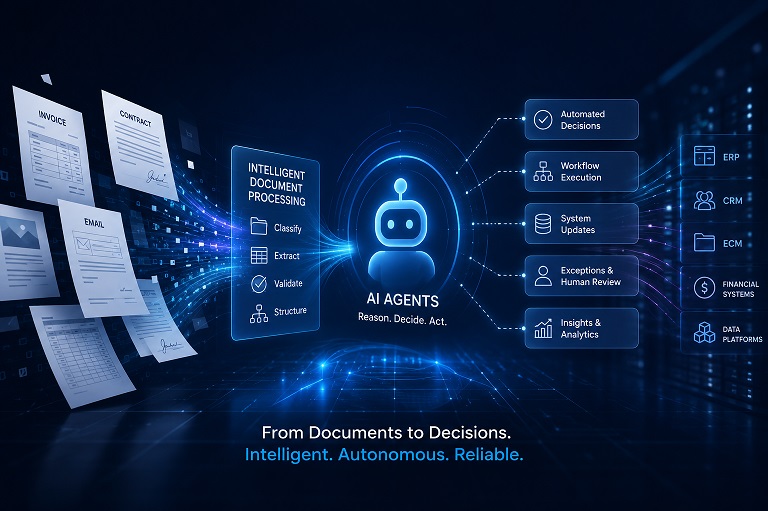
AIThe rise of agentic AI has changed the conversation around enterprise automation. Organizations are no longer focused solely on automating isolated workflows or reducing manual data entry. The new objective is broader: systems capable of understanding context, making decisions, coordinating actions across applications, and completing complex business processes with minimal human intervention.
As large language models continue to improve, many companies are beginning to question whether traditional intelligent document processing platforms are still necessary. If modern AI systems can read contracts, summarize emails, interpret invoices, and answer questions in natural language, why maintain a separate document processing layer at all?
The assumption is understandable, but it overlooks a critical distinction between language fluency and operational reliability.
Large language models are exceptionally effective at interpreting text and generating human-like responses. However, enterprise document workflows demand far more than conversational understanding. Production-grade automation requires deterministic outputs, traceability, validation, structured extraction, governance, and consistency across massive volumes of documents and communications.
In practice, this means intelligent document processing is not becoming obsolete. It is becoming more important.
The emergence of AI agents does not eliminate the need for document understanding infrastructure. Instead, it raises the standards for what document processing systems must deliver. As enterprises move toward end-to-end autonomous operations, the quality, reliability, and auditability of document interpretation become foundational requirements rather than optional enhancements.
The Central Role of Documents in Enterprise Operations
Despite years of digital transformation initiatives, most enterprise processes still revolve around documents.
Invoices initiate payment cycles. Purchase orders launch procurement workflows. Contracts define obligations and approvals. Loan packages trigger underwriting procedures. Claims forms drive insurance operations. Employee onboarding depends on identity verification, compliance paperwork, and policy acknowledgments.
Even highly digitized organizations continue to rely heavily on documents because documents remain the primary carriers of business intent, obligations, approvals, and evidence.
The challenge is that most of this information is not cleanly structured.
Research consistently shows that the majority of enterprise data exists in unstructured or semi-structured formats. Emails, PDFs, scanned forms, handwritten notes, attachments, policy documents, and long-form agreements contain information that is essential for business operations but difficult to process reliably using conventional automation techniques.
This has historically been one of the largest barriers to enterprise automation.
Traditional rule-based systems perform well when inputs are predictable and standardized. Real-world business documents rarely meet those conditions. Layouts vary, formats evolve, terminology changes, and exceptions occur constantly. A single invoice template may contain dozens of variations across vendors, currencies, languages, or regional compliance requirements.
When automation systems misunderstand these inputs, downstream processes suffer.
An incorrectly extracted payment term can delay financial settlements. A misclassified contract clause may introduce compliance risks. An inaccurate interpretation of underwriting documentation can affect lending decisions. Errors introduced at the document layer tend to propagate through entire workflows.
This issue becomes even more significant in agentic environments.
AI agents operate by reasoning over available information and taking actions based on that reasoning. If the underlying document interpretation is flawed, the agent may confidently execute incorrect decisions at scale. The more autonomous the system becomes, the more important trustworthy document understanding becomes.
For that reason, modern intelligent document processing serves as the reliability layer beneath agentic automation.
Why Prompting Alone Is Not Enough
There is growing enthusiasm around the idea that prompting a large language model can replace traditional extraction pipelines entirely. In experimental settings, this often appears viable. A model can read a document and return useful answers with impressive flexibility.
The difficulty emerges when moving from experimentation into production environments.
Enterprise document processing requires repeatability under highly variable conditions. Systems must process millions of documents while maintaining stable performance across inconsistent scans, noisy OCR outputs, multilingual content, nested tables, handwritten annotations, and incomplete submissions.
A conversational answer generated by a language model may sound convincing, but enterprise workflows require more than plausible outputs. They require verifiable evidence.
Production systems must answer questions such as:
- Where exactly did this extracted value originate?
- Which section of the document supported this interpretation?
- What confidence level was assigned to the result?
- How can auditors validate the decision?
- What changed between model versions?
- How are exceptions handled?
Pure prompting approaches often struggle with these operational requirements because language models are optimized primarily for probabilistic generation rather than deterministic governance.
This is why modern intelligent document processing platforms increasingly combine several capabilities rather than relying on a single model:
- OCR and layout analysis
- Classification engines
- Structured extraction models
- Validation layers
- Human-in-the-loop review
- Audit logging
- Version control
- Orchestration frameworks
- LLM-based reasoning components
The objective is not simply to read documents. The objective is to produce trusted operational data that can safely drive automated business decisions.
What Modern Intelligent Document Processing Must Deliver
As AI agents become more deeply integrated into enterprise operations, document processing systems must evolve accordingly. Several capabilities are becoming essential.
High-Confidence Extraction at Enterprise Scale
Accuracy in controlled demonstrations is no longer sufficient. Enterprise systems must maintain reliable performance under real operational conditions.
Modern document workflows involve scanned PDFs, mobile uploads, poor image quality, varying templates, complex tabular structures, multilingual content, and rapidly changing document formats. Systems must process these inputs while meeting strict latency and SLA requirements.
Scalability is equally important. Organizations may process thousands or millions of documents daily, meaning extraction quality must remain stable under significant throughput demands.
Transparent Evidence and Traceability
Trust is a prerequisite for autonomous systems.
If an AI agent makes a decision based on extracted information, organizations need visibility into how that conclusion was reached. Every extracted field should be traceable back to its original location in the source document.
This traceability is essential for compliance, auditing, dispute resolution, and operational governance. It also enables human reviewers to validate outputs efficiently without manually reprocessing entire document sets.
Production-Ready Governance
One of the most common reasons automation initiatives fail is the gap between prototype success and production deployment.
Experimental notebook workflows may demonstrate technical feasibility, but enterprise deployment requires observability, versioning, monitoring, rollback mechanisms, controlled releases, and governance frameworks.
Without these controls, even small model adjustments can introduce operational instability across critical business processes.
Organizations increasingly expect document processing systems to function as managed infrastructure rather than isolated AI experiments.
Human Oversight for Exception Handling
Fully autonomous document workflows remain unrealistic in many regulated or high-risk environments.
Human review continues to play an important role, particularly for ambiguous cases, low-confidence extractions, policy exceptions, or compliance-sensitive decisions.
The most effective systems are not purely automated. They are collaborative architectures where AI handles routine processing while humans supervise edge cases and complex judgment scenarios.
Where AI Agents Create the Most Value
While intelligent document processing provides structured and reliable data extraction, AI agents introduce higher-level reasoning and orchestration capabilities.
This distinction is important.
Document processing systems transform unstructured information into usable data. AI agents use that data to coordinate actions, apply business logic, evaluate conditions, and interact across enterprise systems.
Together, these technologies enable a shift from task automation to decision automation.
Consider a modern loan origination workflow.
Historically, analysts manually reviewed loan packages, categorized documents, extracted applicant information, validated financial records, compared data across systems, and routed cases for underwriting review. These processes were time-consuming and highly dependent on manual effort.
In an agentic workflow, the process changes substantially.
Incoming documents are automatically classified and processed through intelligent extraction systems. Large language models interpret contextual information across the document set, including supporting communications and narrative content. AI agents evaluate the extracted information against lending policies, identify discrepancies, request additional documentation when necessary, and update downstream systems automatically.
Human reviewers intervene only when exceptions or policy conflicts arise.
The result is not simply faster processing. It is a fundamentally different operational model in which systems participate directly in decision-making workflows.
The Emerging Architecture of Agentic Document Automation
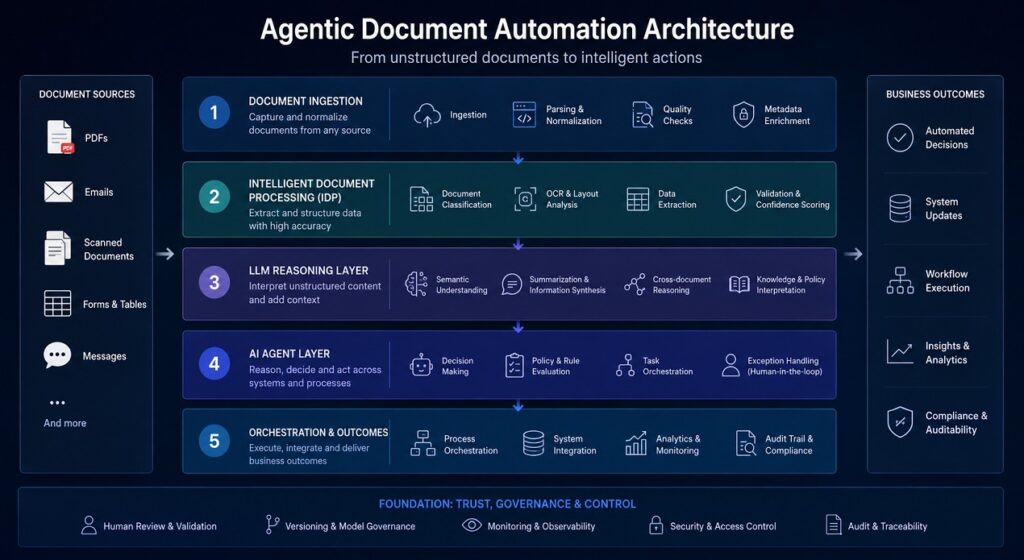
Modern enterprise automation increasingly follows a layered architecture.
At the foundation, intelligent document processing systems handle ingestion, OCR, classification, extraction, and validation. These systems generate structured, reliable outputs from highly variable document inputs.
Above that layer, large language models provide contextual understanding. They interpret unstructured language, synthesize information across documents, summarize findings, and support semantic reasoning.
AI agents operate at the orchestration layer. They apply business rules, coordinate actions across applications, trigger workflows, evaluate outcomes, and manage exceptions.
Finally, orchestration platforms coordinate long-running processes, approvals, escalations, and human interventions across the broader enterprise environment.
Each layer serves a distinct purpose:
- IDP systems provide trustworthy structured data
- LLMs provide contextual interpretation
- AI agents provide reasoning and action execution
- Orchestration layers manage workflow coordination
This architecture reflects a broader shift in enterprise AI strategy. Organizations are no longer asking only what information can be extracted from documents. They are increasingly asking what actions and business outcomes those documents should trigger.
Expanding Use Cases Beyond Traditional Extraction
Traditional intelligent document processing was primarily focused on structured extraction tasks such as invoices, claims forms, purchase orders, and standardized applications.
The integration of LLMs and AI agents significantly expands the scope of automatable workflows.
Examples now include:
- Contract analysis and clause interpretation
- Regulatory summarization
- Due diligence review
- Customer communication analysis
- Compliance validation
- Insurance case assessment
- Procurement risk evaluation
- Cross-document reasoning workflows
- Automated policy enforcement
These use cases involve far more than field extraction. They require contextual reasoning across multiple documents, systems, and business rules.
This is where the combination of IDP, LLMs, and agentic orchestration becomes particularly powerful.
From Data Extraction to Autonomous Operations
The future of document automation is not about replacing intelligent document processing with large language models. It is about integrating document intelligence into broader autonomous systems.
Intelligent document processing remains the mechanism that transforms chaotic business inputs into reliable operational data. Large language models contribute semantic understanding and contextual reasoning. AI agents connect those insights to actions, workflows, and business decisions.
Together, these technologies are enabling a new generation of enterprise systems capable of processing information, evaluating conditions, and executing complex workflows with increasing levels of autonomy.
As organizations continue investing in agentic AI, the importance of trustworthy document understanding will only grow. Autonomous systems are only as reliable as the information they consume.
In enterprise automation, documents remain one of the primary sources of that information.