Gemini Spark and the Rise of Persistent AI Agents
AI Gemini SparkIntroduction
The AI industry is rapidly moving beyond conversational assistants toward autonomous systems capable of handling real operational work. At Google I/O 2026, Google introduced Gemini Spark, a cloud-native AI agent designed to operate continuously in the background rather than waiting for direct user interaction.
Unlike traditional chatbots that become inactive once a browser tab is closed, Spark remains active on Google’s infrastructure and continues executing tasks independently. The platform is deeply integrated into Google Workspace, allowing it to monitor emails, coordinate calendars, draft documents, automate workflows, and eventually interact with external services without requiring constant supervision.
Google’s strategy differs from competing approaches developed by OpenAI, Anthropic, and Microsoft. While many AI agents rely heavily on browser automation or desktop-level interaction, Spark focuses on persistent execution through structured API integrations across Google’s ecosystem. The result is an assistant that behaves less like a chatbot and more like a continuously running software operator.
This article examines how Gemini Spark works, the infrastructure behind it, its automation model, privacy implications, ecosystem integrations, pricing structure, and how it compares with other emerging AI agent platforms.
What Is Gemini Spark?
Gemini Spark is a persistent AI agent built on top of Google’s Gemini 3.5 Flash model family and powered by an orchestration layer internally referred to as Antigravity. The system is designed to execute tasks continuously using dedicated cloud resources hosted on Google Cloud.
Traditional AI assistants operate through request-response interactions. A user opens an application, submits a prompt, receives a response, and the session effectively ends. Spark introduces a fundamentally different execution model. Once configured, the agent can continue operating even when the user’s device is offline.
Spark connects directly to Workspace services including:
- Gmail
- Google Calendar
- Google Docs
- Google Sheets
- Google Slides
- Google Drive
Instead of relying on screen interpretation or browser scraping, Spark uses structured APIs to interact with these services. This architecture improves reliability, reduces workflow fragility, and allows the system to operate with a deeper understanding of structured data relationships across applications.
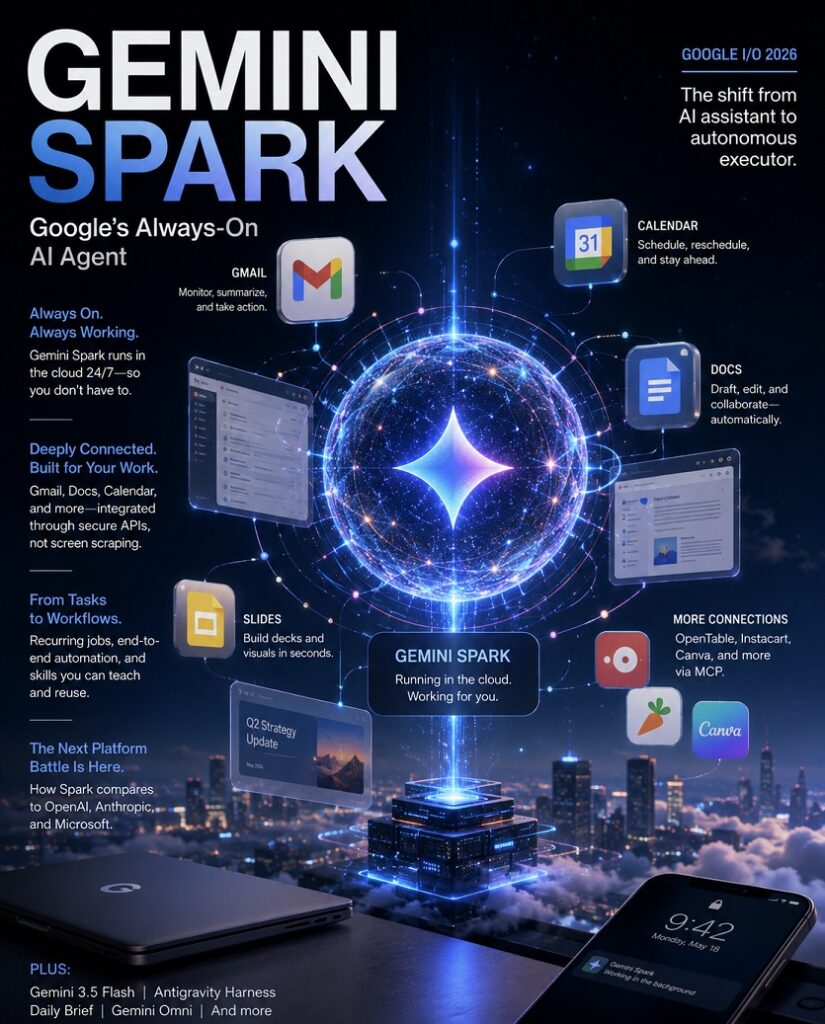
This API-centric design also allows Spark to maintain awareness of structured data relationships across applications. For example, a calendar event can automatically reference emails, documents, spreadsheets, and participant information without requiring manual context reconstruction.
Persistent Execution and Background Processing
The defining characteristic of Spark is persistent execution.
Most AI assistants are event-driven. They activate only when a user interacts with them. Spark instead operates more like a long-running backend service.
The system can monitor incoming emails, react to spreadsheet updates, trigger workflows automatically, coordinate actions across services, and resume interrupted processes without requiring user intervention.
For users managing large operational workloads, this changes the role of AI from passive assistant to active process coordinator.
A project manager, for instance, could configure Spark to monitor a shared inbox for vendor submissions, categorize incoming attachments, update tracking spreadsheets, notify stakeholders, and schedule review meetings automatically.
The agent does not require continuous prompts once workflows are configured.
Workflow Automation
Spark is heavily focused on multi-step automation.
Rather than handling isolated commands, the platform is designed to orchestrate chains of actions across applications.
Scheduled Operations
Users can create recurring workflows tied to dates, times, or periodic triggers.
Typical use cases include invoice generation, reporting pipelines, meeting summaries, budget reconciliation, and automated client communication.
A freelancer could configure Spark to:
- Read tracked hours from a Google Sheet
- Generate an invoice in Google Docs
- Export the invoice as PDF
- Draft an email to the client
- Send the email on the first day of every month
- Archive the invoice automatically
The workflow executes without manual intervention.
Conditional Triggers
Spark also supports event-based automation.
Instead of relying solely on schedules, workflows can activate when specific conditions occur.
The system can also react to conditional events such as unusual financial activity, missed deadlines, contract expirations, or customer messages requiring escalation.
This moves Spark closer to enterprise automation platforms while preserving natural language configuration.
Teachable Behaviors and Reusable Skills
One of Spark’s more ambitious features is persistent behavioral learning.
Users can create reusable operational behaviors called skills. These skills allow Spark to emulate workflows, communication styles, or decision patterns.
For example, Spark can analyze previous emails, document editing patterns, communication tone, and organizational preferences in order to replicate recurring workflows more accurately.
A sales professional could train Spark to draft outreach emails using the same structure, pacing, and tone found in previous successful campaigns.
An operations manager could teach Spark how to generate internal reports using specific formatting conventions and approval workflows.
Once learned, these behaviors persist across future sessions.
This capability reflects a broader trend in AI toward personalization through behavioral adaptation rather than static prompting.
Multi-Agent Infrastructure
Under the surface, Spark appears to rely on a distributed multi-agent orchestration model.
Google has described Antigravity as capable of coordinating multiple sub-agents simultaneously. Rather than processing every task sequentially, the system can divide complex operations into specialized parallel workloads.
A large workflow might involve multiple specialized agents working simultaneously, with separate processes handling email parsing, spreadsheet extraction, scheduling coordination, and output validation in parallel.
Parallel execution improves responsiveness for workflows involving substantial data processing or multiple services.
This architecture is especially relevant for enterprise-scale automation, where long-running processes frequently involve asynchronous operations.
Third-Party Integrations
Google is extending Spark beyond Workspace through support for external services using MCP integrations.
Initial launch partners include:
- Canva
- OpenTable
- Instacart
These integrations enable Spark to perform actions inside external platforms rather than merely retrieving information.
Potential use cases include creating presentation assets in Canva, booking reservations through OpenTable, managing orders via Instacart, and coordinating logistics across external services.
Google has indicated that additional integrations are planned over time.
The broader strategic goal appears clear: transform Spark into a universal orchestration layer capable of operating across both Google’s ecosystem and third-party platforms.
Desktop Integration and Local Execution
Although Spark primarily operates in the cloud, Google is also expanding desktop integration.
The macOS Gemini desktop application is expected to support Spark-based workflows involving local files and desktop context.
This hybrid approach combines persistent cloud execution with local file awareness, desktop automation, and voice-driven interaction.
Voice interaction appears to be a significant focus.
Google demonstrated speech-to-draft systems capable of transforming unstructured spoken instructions into organized documents, tasks, and workflows.
This aligns with a broader industry trend toward multimodal interfaces where users interact with AI systems conversationally rather than through traditional software menus.
Privacy and Security Considerations
Persistent AI agents introduce a fundamentally different security model compared with traditional assistants.
A chatbot session typically involves temporary context. Spark instead maintains ongoing access to connected systems.
To operate effectively, the agent may require ongoing access to emails, calendars, documents, third-party platforms, and in some cases financial or transactional workflows.
This creates obvious convenience advantages, but also increases the importance of permission management.
Google has stated that:
- Integrations are disabled by default
- Users choose which services Spark can access
- High-risk actions require confirmation
- Users can revoke permissions at any time
- Agents are intended to operate under explicit user-defined boundaries
Still, the shift toward standing authorization is significant.
Granting continuous access to operational systems creates a broader attack surface than isolated chatbot interactions.
Security discussions around Spark will likely focus on permission granularity, auditability, authentication systems, encryption practices, and the reliability of human override mechanisms.
The long-term success of persistent AI agents may depend as much on trust infrastructure as on model capability.
The Evolution of the Gemini Ecosystem
Spark was not the only major announcement tied to Google’s 2026 Gemini roadmap.
Several complementary systems were introduced alongside it.
Daily Brief
Daily Brief functions as a proactive summarization agent.
The system analyzes:
- Calendar events
- Emails
- Pending tasks
- User priorities
- Ongoing projects
It then generates a personalized morning briefing containing:
- Schedule summaries
- Suggested priorities
- Follow-up reminders
- Action recommendations
- Contextual alerts
Unlike traditional notifications, Daily Brief attempts to synthesize information into operational guidance.
Neural Expressive Interface
Google also redesigned the Gemini interface under a new design framework referred to as Neural Expressive.
The updated system focuses heavily on multimodal interaction.
Responses can now include interactive timelines, visual summaries, embedded graphics, narrated elements, and other structured multimedia formats.
The practical objective is reducing cognitive overhead when processing large volumes of AI-generated information.
Gemini Omni
Gemini Omni expands Gemini into multimodal video generation.
The model accepts combinations of:
- Text
- Images
- Video clips
It can then generate new video outputs with contextual modifications.
Potential applications range from cinematic scene generation and virtual avatars to animated presentations and marketing content production.
Omni positions Google more aggressively in the rapidly growing generative video market.
Competitive Landscape
The competition around AI agents has intensified significantly.
Every major AI company is attempting to define the next computing interface.
OpenAI
OpenAI’s strategy centers on browser-based and cloud-executed agents integrated with ChatGPT.
Its ecosystem emphasizes general-purpose reasoning, web automation, tool calling, and cloud-based execution environments.
Anthropic
Anthropic has focused heavily on desktop-oriented workflows through Claude Cowork and Claude Code.
Anthropic’s systems prioritize developer workflows, screen awareness, long-context reasoning, and terminal-level interaction.
Microsoft
Microsoft continues integrating Copilot deeply into Microsoft 365.
Microsoft’s main advantage remains its deep integration into enterprise productivity infrastructure and the broader Windows ecosystem.
Apple’s Direction
Apple is expected to expand Siri significantly using external AI partnerships and on-device intelligence models.
Apple’s likely differentiator will be privacy-centric local execution combined with ecosystem integration.
What Makes Spark Different?
Spark’s main differentiator is not necessarily raw intelligence.
The defining distinction is persistent cloud execution tightly integrated with Google’s services.
Other platforms offer capable assistants, but Spark attempts to behave more like a continuously running digital operator.
The model is particularly effective for users already embedded inside Google Workspace.
Because Spark relies on structured APIs rather than interface scraping, workflows tend to be more reliable, context-aware, and easier to maintain over time.
However, this approach also introduces limitations.
Spark is currently most effective inside environments that Google directly controls or officially integrates with.
In contrast, desktop-level agents may offer broader flexibility across arbitrary software environments.
Infrastructure Implications for Developers
Beyond the consumer product itself, Spark highlights Google’s larger infrastructure ambitions.
The underlying orchestration capabilities exposed through Antigravity may ultimately matter more than Spark as a standalone product.
For developers, the most important aspects are persistent cloud execution, multi-agent orchestration, long-running workflow coordination, and stateful contextual memory.
These systems point toward a future where AI agents operate as distributed software workers rather than reactive interfaces.
Developers building automation systems, orchestration pipelines, and autonomous operational tools are likely to study this architecture closely.
Pricing and Availability
Google reorganized its AI subscription tiers alongside the Spark launch.
Current positioning includes:
AI Ultra
The flagship AI Ultra plan includes:
- Access to Gemini Spark
- Increased usage limits
- Priority infrastructure allocation
- Expanded Gemini API capacity
- 20TB of cloud storage
- YouTube Premium
- Early experimental feature access
Spark availability initially remains limited to the United States and selected beta participants.
AI Plus and Pro
Lower-tier subscriptions include access to other Gemini capabilities such as:
- Daily Brief
- Gemini Omni
- Expanded generation limits
However, Spark itself is restricted to premium tiers.
Is the Pricing Justified?
The answer depends heavily on the user’s workflow.
For casual users, the pricing may appear difficult to justify.
Many consumers do not need continuous AI automation operating across calendars, inboxes, and cloud documents.
For professionals heavily dependent on Google Workspace, the equation changes.
The strongest value proposition lies in reducing administrative overhead through workflow orchestration, reporting automation, scheduling management, and client communication handling.
If Spark successfully eliminates repetitive administrative labor, the subscription cost could become economically rational for certain users.
Developers and technical teams may also view the subscription as indirect access to advanced infrastructure capabilities rather than merely an assistant product.
Still, there are legitimate concerns.
Spark remains a beta platform with limited regional availability. Competing systems from OpenAI and Anthropic currently offer more mature public tooling in several categories.
Google is effectively asking users to pay premium pricing for early access to an emerging operational model.
The Broader Industry Shift
The introduction of Spark reflects a larger transition happening across the AI industry.
The first generation of AI assistants focused primarily on generating information.
The next generation focuses on executing actions.
This distinction is critical.
Answering questions is fundamentally different from:
- Managing workflows
- Sending emails
- Scheduling meetings
- Processing financial operations
- Coordinating external services
- Monitoring systems continuously
AI systems are evolving from conversational tools into operational infrastructure.
Persistent agents represent one of the clearest signals of that transition.
The broader question is not whether these systems will become more autonomous. That trajectory already appears inevitable.
The real debate concerns how much authority users should delegate to autonomous systems, what safeguards are necessary, and how accountability should function once AI agents begin operating independently.
The standards governing autonomous agents are still being established in real time.
Final Assessment
Gemini Spark is one of the most ambitious consumer AI agent systems released so far.
Its importance lies less in any individual feature and more in the architectural direction it represents.
Google is attempting to redefine AI assistants as persistent operational entities rather than temporary conversational tools.
The combination of persistent cloud execution, deep Workspace integration, multi-agent orchestration, and cross-service automation creates a compelling vision for large-scale productivity automation.
At the same time, the platform raises important questions around privacy, permissions, reliability, and long-term trust.
Whether Spark succeeds commercially will depend on several factors:
- Execution reliability
- User trust
- Integration breadth
- Cost justification
- Security transparency
- Ecosystem adoption
Regardless of its immediate adoption curve, Spark demonstrates where the industry is heading.
AI agents are becoming less like chat interfaces and more like autonomous software systems operating continuously in the background of everyday digital life.