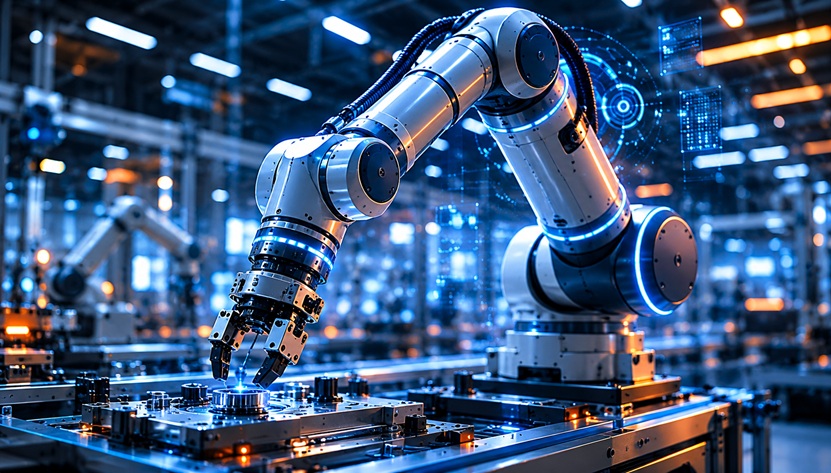
Collaborative Robots (Cobots) and the Transformation of Adaptive Manufacturing
Robotics CobotIntroduction
Manufacturing is undergoing a structural shift. Production systems that once prioritized scale and repetition are increasingly being redesigned around flexibility, responsiveness, and shorter product cycles. Supply chain instability, labor shortages, regionalization of manufacturing, and rising demand for product customization have forced industrial companies to rethink how factories operate.
Traditional industrial automation was built for consistency. Fixed robotic cells, dedicated tooling, and rigid production sequences performed exceptionally well in stable, high-volume environments. However, modern manufacturing conditions are far less predictable. Production lines now need to adapt quickly to changing demand, fluctuating inventory availability, and increasingly fragmented product portfolios.
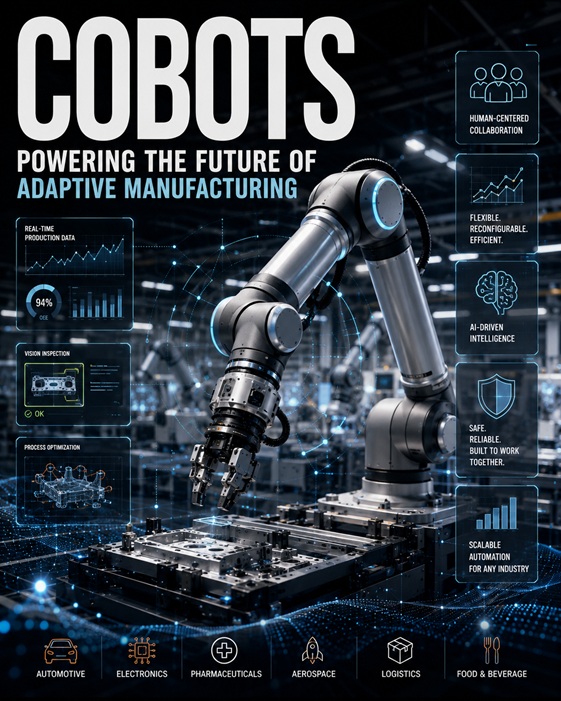
Collaborative robots, commonly known as cobots, have emerged as one of the most important technologies enabling this transition. Unlike conventional industrial robots that typically operate inside isolated safety cages, cobots are designed to work alongside human operators in shared environments. Their combination of flexibility, simplified deployment, and intelligent automation is reshaping how manufacturers approach production efficiency.
Cobots are no longer limited to experimental pilot projects or small-scale automation tasks. They are now being integrated into assembly operations, machine tending, packaging, inspection systems, welding, laboratory automation, and warehouse logistics across industries ranging from electronics and automotive manufacturing to pharmaceuticals and food processing.
The broader significance of cobots lies not simply in automation itself, but in the operational model they support: adaptive manufacturing systems capable of evolving continuously without requiring large-scale infrastructure redesigns.
Why Traditional Automation Is No Longer Enough
For decades, industrial robotics focused primarily on maximizing throughput in highly repetitive production environments. Automotive manufacturing became the defining example of this model, where robotic systems could repeat identical movements millions of times with minimal variation.
That approach remains effective for mass production, but it becomes increasingly inefficient in environments characterized by:
- Frequent product changes
- Smaller production batches
- Shorter product lifecycles
- Custom manufacturing requirements
- Volatile demand forecasting
Reconfiguring traditional robotic systems often requires extensive engineering work, production downtime, and costly integration efforts. In some facilities, changing a robotic workflow can take weeks or even months.
Modern manufacturers increasingly need systems that can be redeployed rapidly, reprogrammed easily, and integrated into existing production environments without major reconstruction.
Cobots address many of these limitations directly.
What Makes Cobots Different
Collaborative robots differ from traditional industrial robots in both design philosophy and operational purpose.
Rather than prioritizing maximum speed and payload capacity alone, cobots are engineered around adaptability, usability, and safe human interaction. Most systems include integrated force sensing, motion monitoring, collision detection, and simplified programming interfaces that allow operators to configure tasks without advanced robotics expertise.
This significantly lowers the barrier to automation adoption.
In many cases, operators can train cobots by physically guiding robotic arms through desired movements. Modern interfaces also rely heavily on graphical programming environments, reducing dependence on specialized coding knowledge.
As a result, deployment timelines are substantially shorter compared with conventional automation projects.
For manufacturers operating under tight production schedules, this reduction in integration complexity can have a major operational impact.
Human-Robot Collaboration in Real Production Environments
The term “collaborative robot” is often misunderstood. Cobots are not intended to replace human workers entirely. Their primary value comes from augmenting human capabilities while automating repetitive or physically demanding tasks.
This hybrid operational model is particularly effective in processes that require a combination of:
- Precision
- Dexterity
- Decision-making
- Quality control
- Repetitive motion handling
In electronics manufacturing, for example, cobots are frequently used for screwdriving, component placement, inspection assistance, and packaging operations where consistency is critical but complete automation remains impractical.
In machine shops, cobots commonly load and unload CNC equipment while human technicians focus on setup, programming, and process optimization.
In pharmaceutical environments, collaborative robots assist with sterile handling procedures, sample preparation, and laboratory logistics while maintaining strict repeatability requirements.
Because cobots can safely operate near personnel under properly configured conditions, manufacturers can redesign workflows around cooperative task execution rather than complete physical separation between humans and machines.
Flexibility as a Core Manufacturing Requirement
One of the most important characteristics of cobots is operational flexibility.
Unlike fixed robotic systems designed around static production sequences, cobots can often be reassigned to new tasks within hours rather than weeks. End effectors can be swapped quickly, motion routines adjusted dynamically, and workflows updated with minimal engineering overhead.
This flexibility is especially valuable in high-mix, low-volume manufacturing environments where production requirements change frequently.
Manufacturers increasingly prioritize systems capable of supporting:
- Rapid product transitions
- Short production runs
- Seasonal demand fluctuations
- Customized product variants
- Fast prototyping cycles
In these environments, production agility can become more valuable than pure throughput optimization.
Cobots enable factories to adapt without requiring extensive infrastructure replacement every time production requirements evolve.
The Role of Artificial Intelligence in Collaborative Robotics
The newest generation of collaborative robots is becoming increasingly intelligent through the integration of AI-driven software systems.
Machine learning models are now being applied to improve:
- Motion optimization
- Path planning
- Defect detection
- Predictive maintenance
- Gripping accuracy
- Workflow coordination
Vision systems powered by neural networks allow cobots to recognize objects with far greater flexibility than earlier machine vision technologies. Instead of relying entirely on rigid positional programming, modern systems can identify variable part orientations, detect anomalies, and adjust movements dynamically.
This is particularly important in manufacturing environments where part positioning may vary slightly between cycles.
AI-enhanced robotics also improves operational resilience. Systems can learn from repeated execution patterns, identify inefficiencies, and optimize movement trajectories over time to reduce cycle duration and energy consumption.
As edge computing hardware becomes more powerful, many of these adjustments can now occur locally in real time without requiring constant cloud connectivity.
Computer Vision and Sensor Fusion
Advances in sensor technology have significantly expanded the capabilities of collaborative robots.
Modern cobot systems increasingly combine multiple sensing modalities simultaneously, including:
- High-resolution cameras
- Force-torque sensors
- Infrared sensing
- Depth perception systems
- LIDAR-based spatial mapping
This sensor fusion approach improves environmental awareness and enables more sophisticated interaction with dynamic production environments.
For example, a cobot equipped with advanced vision systems can distinguish between component variations, verify assembly accuracy, and detect production defects during operation.
In logistics environments, sensor-rich mobile cobot systems can navigate changing warehouse layouts while avoiding obstacles and coordinating with human workers.
These capabilities move collaborative robotics beyond simple repetitive automation into more adaptive operational behavior.
Mobile Robotics and Reconfigurable Automation
One of the most important recent developments in industrial automation is the convergence between collaborative robotics and autonomous mobile systems.
Instead of assigning robots permanently to fixed workstations, manufacturers are increasingly deploying mobile robotic platforms capable of transporting cobots throughout production facilities.
This creates a far more dynamic automation model.
A robotic system may assist with assembly operations during one production phase, then relocate automatically to support packaging, inspection, or material handling tasks elsewhere in the facility.
Mobile deployment reduces underutilization and allows automation resources to be distributed more efficiently across changing production requirements.
For factories that undergo frequent layout changes or seasonal production adjustments, this mobility introduces a level of operational adaptability that traditional automation architectures struggle to match.
Smart Factories and Industrial Connectivity
Cobots are becoming central components of broader smart factory strategies.
Modern production environments increasingly rely on interconnected systems capable of exchanging operational data continuously across machines, software platforms, and analytics engines.
Collaborative robots are commonly integrated with:
- Manufacturing execution systems
- Industrial IoT platforms
- ERP software
- Warehouse management systems
- Predictive analytics tools
This connectivity allows manufacturers to monitor production performance in real time, coordinate workflows more efficiently, and respond rapidly to operational disruptions.
Production data generated by cobots can also support long-term optimization efforts through trend analysis, maintenance forecasting, and process refinement.
As 5G infrastructure and industrial edge computing continue to mature, synchronization between robotic systems is expected to become increasingly responsive and decentralized.
Workforce Implications
The expansion of collaborative robotics is changing workforce requirements across manufacturing industries.
Contrary to early fears surrounding industrial automation, cobots are often deployed to address labor shortages rather than eliminate entire categories of employment. Many manufacturing sectors continue to struggle with recruitment challenges, aging workforces, and increasing difficulty filling physically repetitive positions.
Cobots help alleviate some of these pressures by automating tasks associated with:
- Repetitive strain
- Hazardous environments
- Precision repetition
- Heavy material handling
- Overnight production operations
At the same time, workforce expectations are shifting toward higher technical competency.
Operators increasingly require familiarity with:
- Robotic configuration
- Automation diagnostics
- Sensor calibration
- Data interpretation
- Human-machine interface systems
As a result, industrial training programs are evolving to include robotics operation and automation literacy as standard skill sets.
Safety and Regulatory Considerations
Although collaborative robots are designed for safer interaction, deployment still requires careful risk assessment and regulatory compliance.
Safety systems typically rely on combinations of:
- Speed limitation
- Force monitoring
- Emergency stop protocols
- Collision detection
- Workspace scanning
International standards governing collaborative robotics continue to evolve as adoption increases.
Manufacturers must evaluate:
- Task-specific hazards
- Human interaction zones
- Payload risks
- End-effector safety
- Emergency response procedures
Improper implementation can undermine many of the safety advantages associated with collaborative systems.
Successful deployment depends not only on robotic hardware, but also on thoughtful workflow engineering and operational oversight.
Economic Considerations and ROI
Collaborative robots are often viewed as more economically accessible than traditional industrial robotics, particularly for small and mid-sized manufacturers.
Several factors contribute to this perception:
- Lower integration complexity
- Reduced infrastructure requirements
- Faster deployment timelines
- Lower programming overhead
- Greater redeployment flexibility
However, evaluating total return on investment requires a broader perspective.
Manufacturers must account for:
- Maintenance requirements
- Software licensing
- System upgrades
- Integration costs
- Employee training
- Production downtime during implementation
The most successful deployments typically occur when cobots are integrated strategically into workflows where they deliver measurable operational improvements rather than being introduced simply for automation visibility.
The Future of Collaborative Automation
Collaborative robotics is still in a relatively early stage of development compared with traditional industrial automation.
Several long-term trends are likely to shape the next phase of adoption:
- Greater AI autonomy
- More advanced perception systems
- Improved dexterity
- Expanded mobile deployment
- Cloud-coordinated robotic fleets
- Real-time adaptive manufacturing systems
As robotic systems become more context-aware and increasingly capable of autonomous decision-making, the distinction between industrial automation and intelligent operational infrastructure will continue to blur.
Factories are gradually evolving into continuously adaptive production environments where machines, software platforms, and human workers operate as interconnected systems rather than isolated tools.
Cobots represent one of the clearest indicators of this transition.
Conclusion
Collaborative robots are redefining the role of automation in modern manufacturing.
Their importance extends beyond efficiency gains alone. Cobots enable a fundamentally different approach to industrial operations, one centered around flexibility, rapid adaptation, and continuous workflow optimization.
Unlike traditional robotic systems built for rigid repetition, collaborative robots support production environments that must evolve constantly in response to changing market conditions, supply chain disruptions, and shifting customer expectations.
Their integration with AI systems, computer vision, industrial connectivity platforms, and mobile robotics is accelerating the transition toward highly adaptive manufacturing ecosystems.
For manufacturers, the strategic question is no longer whether collaborative automation will become standard, but how quickly organizations can integrate these technologies effectively while maintaining operational resilience and workforce readiness.
The factories gaining competitive advantage over the next decade are likely to be those capable of combining human expertise with intelligent, flexible automation at scale.