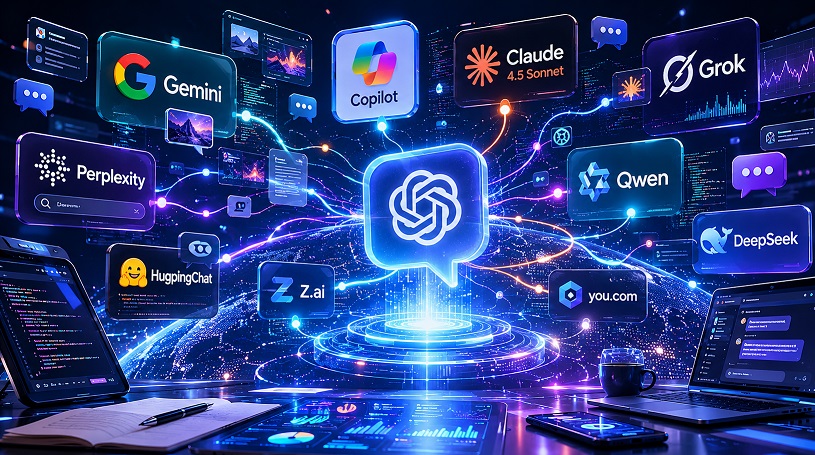
Major Alternatives to ChatGPT in 2026: The AI Assistant Landscape
AIIntroduction
The generative AI market has evolved rapidly since large language models entered the mainstream at the beginning of the decade. What started as experimental conversational systems has grown into a highly competitive ecosystem of AI platforms focused on productivity, research, software development, automation, multimodal generation, and enterprise integration.
ChatGPT remains one of the most recognizable AI products globally, but the market surrounding it has changed dramatically. Competing systems now specialize in areas where early conversational models struggled, including long-context reasoning, live web retrieval, multimodal processing, autonomous workflows, code generation, enterprise search, and real-time collaboration.
The current generation of AI assistants differs not only in model quality, but also in architectural philosophy. Some platforms emphasize reasoning and technical precision. Others focus on productivity integration, real-time information retrieval, open-source transparency, or multimodal creative workflows.
As organizations and individual users increasingly rely on AI systems for day-to-day work, choosing the right assistant has become less about identifying a single “best” model and more about understanding which platform aligns with specific operational needs.
This article examines the most important AI assistants and conversational platforms currently competing in the broader post-ChatGPT ecosystem.
Google Gemini
Google’s Gemini platform has become one of the most comprehensive AI ecosystems available in the consumer and enterprise markets. Rather than functioning purely as a chatbot, Gemini increasingly operates as a multi-layered productivity platform integrated deeply into Google’s infrastructure.
Its strongest advantage is ecosystem-level integration. Because the system connects directly to services such as Gmail, Google Docs, Drive, Maps, Calendar, and YouTube, it can coordinate workflows across applications more effectively than isolated conversational systems.
Gemini also places significant emphasis on multimodal processing. Modern versions support text generation, image synthesis, video creation, document analysis, voice interaction, and large-context reasoning within a unified environment.
One of the most technically significant features is its long-context architecture. High-end Gemini models can process extremely large documents, large codebases, and long-form research material without aggressive truncation. This has made the platform particularly attractive for analytical and research-oriented workloads.
Google has also invested heavily in AI-assisted content production. Video generation systems, multimodal editing tools, and persistent task-oriented agents increasingly position Gemini as both a creative platform and an automation layer.
For users already embedded in Google’s ecosystem, Gemini often functions less like an external AI assistant and more like an intelligent orchestration layer for existing productivity infrastructure.
Microsoft Copilot
Microsoft’s approach to conversational AI focuses heavily on enterprise productivity and workflow integration.
Rather than positioning Copilot purely as a standalone assistant, Microsoft has embedded AI capabilities throughout its broader software ecosystem, including Word, Excel, PowerPoint, Outlook, Teams, Windows, and developer tools.
This integration strategy is particularly important in enterprise environments where organizational data already exists inside Microsoft infrastructure. Copilot can leverage documents, spreadsheets, meetings, presentations, and communication channels as operational context for AI-assisted workflows.
In practical terms, this means the system can summarize meetings, generate reports, draft presentations, analyze spreadsheets, and automate repetitive administrative tasks directly within familiar software environments.
Microsoft has also prioritized accessibility features such as voice interaction, document analysis, multilingual support, and integrated search capabilities.
One of Copilot’s strongest differentiators is its enterprise deployment model. Organizations can integrate AI functionality without forcing employees to adopt entirely new platforms or workflows.
For many businesses, this incremental integration approach lowers friction compared with deploying standalone AI systems.
Claude
Anthropic’s Claude family has become one of the most respected alternatives for technical reasoning, software engineering, and long-context analytical work.
Claude distinguishes itself through a strong emphasis on reliability, structured reasoning, and conversational stability. While many AI platforms optimize aggressively for speed or broad consumer appeal, Claude has gained a reputation for producing more consistent analytical output in complex tasks.
Its coding capabilities are especially notable. Claude performs well in:
- Multi-file code analysis
- Refactoring
- Technical debugging
- Documentation generation
- Architectural reasoning
- Long-form technical explanations
The platform is also widely used for research-oriented workflows because of its large context windows and relatively coherent handling of long documents.
Anthropic has focused heavily on safety-oriented model behavior and enterprise reliability, making Claude increasingly popular among organizations that require stable operational performance rather than purely experimental features.
While some competing systems prioritize multimodal creativity or broad ecosystem integration, Claude remains strongest in technical reasoning and structured analytical workflows.
Perplexity
Perplexity occupies a unique position within the AI market because it operates primarily as an AI-native search and research platform rather than a conventional conversational assistant.
Its core advantage is source-grounded information retrieval. Instead of generating responses without attribution, Perplexity emphasizes citation-based answers connected directly to live web sources.
This approach addresses one of the longstanding criticisms of generative AI systems: unverifiable or fabricated information.
Perplexity is especially effective for:
- Research workflows
- Current-event analysis
- Technical information gathering
- Comparative analysis
- Academic exploration
- Rapid information synthesis
The platform combines conversational interaction with web indexing, allowing users to refine searches iteratively while maintaining contextual continuity.
Over time, Perplexity has expanded beyond simple search augmentation into a broader AI productivity environment that includes document analysis, recurring research tasks, and organizational knowledge retrieval.
For users who prioritize factual grounding and rapid research workflows, Perplexity often provides a more practical experience than purely generative conversational systems.
Grok
Grok represents a different branch of AI assistant development, one focused heavily on real-time information streams and social platform integration.
Unlike many conversational systems trained primarily on static datasets, Grok is closely integrated with live social data environments, allowing it to respond rapidly to developing discussions, trends, and breaking events.
This real-time orientation makes Grok particularly useful for:
- Trend monitoring
- Social sentiment analysis
- Live event commentary
- Fast-moving news environments
- Internet culture analysis
The system also adopts a less formal conversational tone compared with many enterprise-oriented AI platforms.
Technically, Grok has continued expanding into multimodal capabilities, coding assistance, reasoning systems, and document understanding. However, its strongest identity remains tied to real-time conversational awareness and dynamic information processing.
For users interested in fast-moving online discourse and continuously updating information ecosystems, Grok offers capabilities that differ significantly from traditional productivity-focused assistants.
Qwen
Qwen has emerged as one of the most important large-scale AI platforms originating from China’s rapidly expanding AI sector.
The platform combines strong multilingual capabilities with increasingly advanced multimodal processing, coding functionality, and long-context reasoning.
Qwen’s development strategy emphasizes flexibility across use cases rather than narrow specialization. Modern deployments support:
- Software development
- Document analysis
- Image understanding
- Web application generation
- Research synthesis
- Interactive content creation
One of Qwen’s strengths is the breadth of model variants available for different workloads, ranging from lightweight deployment models to large-scale multimodal systems optimized for enterprise-grade applications.
The platform has also gained traction among developers because several model families support relatively open deployment and customization approaches compared with tightly controlled proprietary ecosystems.
As global AI competition expands, Qwen increasingly represents a technically serious competitor in both research and production environments.
DeepSeek
DeepSeek has attracted significant attention within technical communities because of its strong reasoning performance and research-oriented model development strategy.
The platform is particularly well regarded for mathematical reasoning, software engineering workflows, and analytical problem solving.
Unlike consumer-oriented AI assistants focused heavily on conversational polish, DeepSeek places greater emphasis on transparent benchmark performance and technical capability.
Its models are commonly used for:
- Algorithmic reasoning
- Scientific workflows
- Competitive programming
- Code generation
- Technical analysis
- Structured problem solving
DeepSeek’s rapid progress has also intensified broader industry discussions regarding open research ecosystems, model efficiency, and the increasing global decentralization of AI innovation.
For developers and technically oriented users, DeepSeek often serves as a strong alternative to more commercially packaged consumer AI products.
HuggingChat and the Open-Source Ecosystem
Not all AI platforms are built around closed commercial ecosystems.
HuggingChat represents the broader open-source movement within generative AI, where transparency, self-hosting, and customization take priority over tightly controlled proprietary deployment.
Built on open models and supported by the Hugging Face ecosystem, HuggingChat allows developers and organizations to experiment with customizable conversational systems while maintaining greater control over infrastructure and data handling.
This approach appeals particularly to:
- Researchers
- Universities
- Independent developers
- Privacy-sensitive organizations
- Open-source communities
The open-source AI ecosystem continues evolving rapidly, and while proprietary systems still dominate commercial deployments in many areas, open models are closing capability gaps at an accelerating pace.
For organizations concerned about vendor lock-in, infrastructure sovereignty, or model transparency, open-source ecosystems remain strategically important.
You.com and Hybrid AI Search Platforms
You.com represents another category of AI system that blends conversational interfaces with search, productivity tooling, and customizable workflows.
Rather than functioning as a single monolithic assistant, the platform allows users to select between multiple underlying models depending on task requirements.
This modular architecture reflects a broader trend within the AI industry: users increasingly prefer flexible orchestration systems capable of combining multiple specialized models rather than relying on a single universal assistant.
Hybrid AI platforms like You.com focus heavily on:
- Search augmentation
- Research workflows
- Multi-model experimentation
- Content creation
- Workflow customization
As the AI market matures, interoperability and model orchestration are likely to become increasingly important competitive factors.
The Rise of Specialized AI Assistants
One of the clearest trends in 2026 is the fragmentation of AI use cases into specialized operational domains.
Earlier generations of AI products attempted to position themselves as universal assistants capable of handling every category of task equally well. Modern systems increasingly differentiate through specialization.
Some platforms optimize for:
- Software engineering
- Scientific reasoning
- Enterprise workflows
- Creative production
- Research synthesis
- Search augmentation
- Real-time information retrieval
- Autonomous task execution
This specialization trend mirrors earlier shifts in software markets, where generalized platforms gradually gave way to ecosystems of focused tools optimized for specific professional workflows.
The result is a more mature and technically diverse AI landscape.
Enterprise Adoption and Infrastructure Competition
The competition between AI platforms is no longer limited to conversational quality alone.
Increasingly, the most important battleground involves infrastructure integration and enterprise deployment.
Major vendors are competing across several dimensions simultaneously:
- Context window size
- Multimodal processing
- AI agents and automation
- Enterprise security
- Workflow orchestration
- API ecosystems
- Real-time data access
- Custom model deployment
As organizations integrate AI systems more deeply into operational infrastructure, reliability, governance, compliance, and deployment flexibility become just as important as raw model intelligence.
This shift is gradually transforming AI assistants from standalone productivity tools into embedded operational infrastructure.
The Future of Conversational AI
The next stage of AI development is likely to move beyond traditional chatbot interfaces entirely.
Modern systems are increasingly evolving toward:
- Persistent AI agents
- Autonomous workflow orchestration
- Cross-application coordination
- Multimodal production environments
- Long-running task execution
- Personalized contextual memory
The distinction between “assistant,” “search engine,” “automation platform,” and “operating system layer” is beginning to blur.
Future AI systems will likely function less as tools users manually invoke and more as continuously active coordination systems operating across digital environments.
This transition raises important technical and societal questions regarding privacy, autonomy, verification, and human oversight.
At the same time, it also represents one of the largest shifts in human-computer interaction since the emergence of smartphones and cloud computing.
Conclusion
The AI assistant market has expanded far beyond a single dominant chatbot.
Modern alternatives now compete across highly specialized areas including enterprise productivity, software engineering, multimodal generation, live search, research synthesis, and autonomous workflow execution.
Different platforms excel under different operational conditions. Some prioritize factual grounding and citations. Others focus on coding performance, ecosystem integration, or real-time information retrieval.
As the industry matures, the idea of a single universal AI assistant is becoming less realistic. Instead, the market is evolving toward interconnected ecosystems of specialized models and workflow-oriented platforms.
For users and organizations evaluating AI systems in 2026, the most important question is no longer which assistant is universally superior, but which platform architecture best aligns with specific workflows, infrastructure requirements, and long-term operational goals.