Understanding Modern Ransomware Attacks and Building Effective Defenses
CybersecurityIntroduction
Ransomware remains one of the most disruptive cybersecurity threats facing organizations today. What began as relatively simple malware designed to lock individual computers has evolved into a sophisticated criminal business model capable of disrupting multinational corporations, healthcare providers, educational institutions, manufacturers, and government agencies.
Modern ransomware campaigns are no longer limited to encrypting files and demanding payment for recovery. Many threat groups now combine data theft, extortion, credential harvesting, and network disruption into coordinated operations designed to maximize financial pressure on victims.
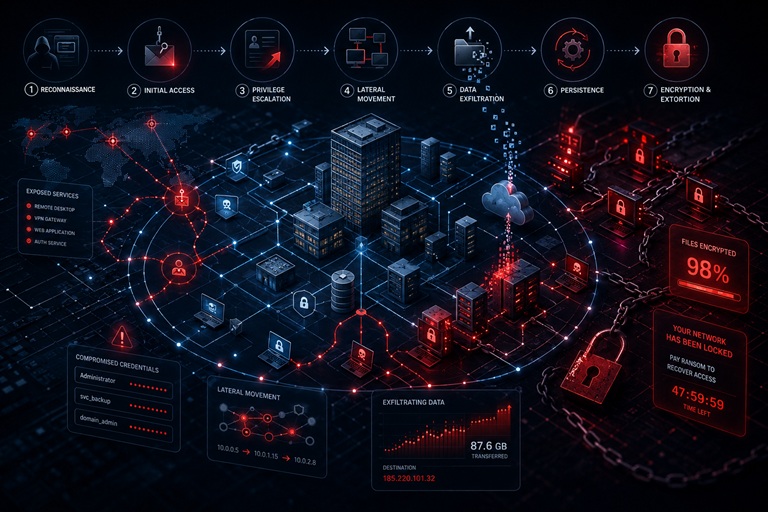
The growing professionalization of cybercrime has transformed ransomware into a multi-billion-dollar underground industry. Specialized groups now focus on different stages of an attack, from gaining initial access to negotiating ransom payments. As a result, organizations must understand how ransomware campaigns actually unfold if they hope to detect and stop them before critical damage occurs.
The Evolution of Ransomware
Early ransomware variants typically relied on opportunistic infection methods and relatively simple encryption mechanisms. Attackers would infect a system, encrypt local files, and demand payment in exchange for a decryption key.
Today’s ransomware ecosystem is significantly more complex.
Many modern operations employ a strategy known as double extortion. Before deploying encryption tools, attackers first steal sensitive information from the target environment. Victims are then threatened not only with operational disruption but also with public disclosure of confidential data.
Some groups have expanded this model further through triple extortion tactics, targeting customers, partners, or suppliers associated with the victim organization. These approaches increase pressure while creating additional reputational and regulatory risks.
As a result, ransomware has evolved from a technical problem into a business continuity and risk management challenge.
How Modern Ransomware Operations Work
Contrary to popular belief, ransomware deployment is often the final stage of a much larger intrusion.
Attackers typically spend considerable time inside compromised environments before launching encryption routines. During this period, they conduct reconnaissance, identify critical assets, harvest credentials, and establish persistence mechanisms.
A successful ransomware attack often follows a structured sequence:
- Reconnaissance and target selection
- Initial compromise
- Privilege escalation
- Lateral movement
- Data collection and exfiltration
- Persistence establishment
- Ransomware deployment
- Extortion and negotiation
The exact sequence varies between threat actors, but most large-scale attacks follow a similar operational pattern.
Stage One: Reconnaissance and Target Selection
Before launching an attack, threat actors gather information about potential victims.
This reconnaissance process may involve scanning internet-facing infrastructure, analyzing public records, reviewing employee information on social media, and identifying exposed services.
Attackers often seek organizations that exhibit characteristics such as:
- Weak security controls
- Outdated software
- Large attack surfaces
- High dependency on continuous operations
- Valuable intellectual property
- Sensitive customer data
Industries where downtime can create immediate financial consequences are frequently targeted because they may feel greater pressure to restore operations quickly.
Stage Two: Initial Access
Initial access represents one of the most critical phases of any ransomware operation.
Attackers commonly gain entry through:
- Phishing campaigns
- Stolen credentials
- Exposed remote access services
- Vulnerable web applications
- Software vulnerabilities
- Supply chain compromises
A growing number of ransomware groups no longer obtain access themselves. Instead, they purchase access from specialized criminal brokers who focus exclusively on compromising organizations and selling entry points to other threat actors.
This division of labor has significantly increased the efficiency and scale of ransomware operations.
Stage Three: Establishing Persistence
Once attackers gain access, they seek methods to maintain control over the environment.
Persistence mechanisms may include:
- Scheduled tasks
- Malicious services
- Backdoor accounts
- Remote administration tools
- Registry modifications
- Compromised authentication systems
Attackers often create multiple persistence paths to ensure they can regain access if one method is discovered and removed.
Many modern intrusions rely heavily on legitimate administrative tools rather than custom malware. This tactic allows malicious activity to blend into normal network operations, making detection more difficult.
Stage Four: Privilege Escalation
Limited access is rarely sufficient for a large-scale ransomware deployment.
Attackers therefore focus on obtaining elevated privileges, particularly administrative or domain-level credentials.
Techniques commonly used include credential dumping, password spraying, token theft, and exploitation of misconfigured identity systems.
Control over privileged accounts provides attackers with broader visibility and the ability to move freely throughout the environment.
Once administrative access is achieved, the risk of widespread compromise increases dramatically.
Stage Five: Lateral Movement
Lateral movement allows attackers to expand their presence across the network.
Rather than attacking a single system, threat actors seek access to:
- File servers
- Backup infrastructure
- Database systems
- Virtualization platforms
- Domain controllers
- Cloud environments
The objective is to identify the systems most critical to business operations.
Compromising backup infrastructure is particularly common because it reduces the victim’s ability to recover independently after encryption occurs.
In many incidents, attackers spend days or weeks mapping internal environments before executing the final stage of the attack.
Stage Six: Data Exfiltration
Data theft has become one of the defining characteristics of modern ransomware campaigns.
Before encrypting systems, attackers frequently collect:
- Financial records
- Customer databases
- Intellectual property
- Internal communications
- Employee information
- Legal documentation
The stolen information serves as leverage during negotiations.
Even organizations capable of restoring encrypted systems from backups may face extortion demands if sensitive information has already been exfiltrated.
This shift has significantly changed the economics of ransomware defense because backups alone no longer eliminate risk.
Stage Seven: Ransomware Deployment
The final operational stage involves activating the ransomware payload.
At this point, attackers attempt to maximize impact by encrypting critical assets simultaneously across multiple systems.
Targets commonly include:
- Shared file repositories
- Business applications
- Virtual machines
- Storage systems
- User workstations
- Operational databases
Many ransomware variants also disable security tools, terminate backup services, and remove recovery mechanisms before encryption begins.
The objective is simple: create enough disruption to pressure the victim into paying.
Time-to-Ransom and Why Speed Matters
One of the most important trends in modern ransomware activity is the shrinking window between initial compromise and ransomware deployment.
Some threat groups can move from initial access to full-scale encryption in less than a single working day.
Automation, improved tooling, and access brokers have dramatically accelerated attack timelines.
For defenders, this means prevention and early detection are far more valuable than reactive response.
Once attackers achieve privileged access and begin lateral movement, opportunities for containment become increasingly limited.
Organizations that rely solely on post-compromise detection often discover intrusions too late.
Common Indicators of Ransomware Activity
Although ransomware attacks vary significantly, certain warning signs frequently appear during the early stages of compromise.
Security teams should pay close attention to:
- Unusual authentication activity
- Unexpected privilege escalation
- New administrative accounts
- Large-scale file transfers
- Suspicious PowerShell execution
- Remote administration tool deployment
- Disabled security controls
- Unauthorized access to backup systems
Individually, these events may not indicate ransomware. Together, however, they often reveal an active intrusion that requires immediate investigation.

Building an Effective Defense Strategy
There is no single solution capable of eliminating ransomware risk entirely.
Effective defense requires multiple layers of security working together.
Organizations should focus on several foundational areas:
Identity Security
Compromised credentials remain one of the most common attack vectors.
Strong identity controls should include:
- Multi-factor authentication
- Privileged access management
- Conditional access policies
- Continuous authentication monitoring
Identity systems have effectively become the new security perimeter.
Vulnerability Management
Attackers routinely exploit known vulnerabilities that remain unpatched for extended periods.
A mature vulnerability management program should prioritize:
- Internet-facing assets
- Remote access infrastructure
- Critical business systems
- Identity services
Reducing exposure significantly decreases opportunities for initial compromise.
Endpoint Detection and Response
Traditional antivirus solutions alone are often insufficient against modern ransomware operations.
Advanced endpoint monitoring can help detect:
- Suspicious process execution
- Credential theft activity
- Persistence mechanisms
- Lateral movement behavior
The goal is to identify attackers before encryption begins.
Network Segmentation
Flat networks provide attackers with opportunities to move freely between systems.
Segmentation restricts lateral movement and limits the potential impact of a successful compromise.
Critical systems, backup infrastructure, and sensitive data repositories should be isolated wherever possible.
Backup and Recovery Planning
Reliable backups remain an essential component of ransomware resilience.
However, backups must be:
- Regularly tested
- Isolated from production systems
- Protected from unauthorized modification
- Available for rapid restoration
A backup strategy that has never been tested should not be considered a recovery strategy.
The Human Factor
Technology alone cannot prevent ransomware attacks.
Human error continues to play a significant role in many successful compromises.
Regular security awareness programs help employees identify:
- Phishing attempts
- Social engineering tactics
- Credential theft schemes
- Suspicious attachments
- Fraudulent communications
Creating a security-conscious culture can significantly reduce the likelihood of successful initial access attempts.
Looking Ahead
Ransomware continues to evolve as threat actors adopt new technologies, automation capabilities, and business models.
Artificial intelligence, increasingly sophisticated malware frameworks, and expanding cybercriminal marketplaces are likely to further accelerate attack capabilities.
At the same time, defensive technologies are becoming more effective at detecting malicious behavior before encryption occurs.
The organizations most likely to withstand future ransomware threats will be those that prioritize visibility, resilience, identity security, and rapid incident response rather than relying on a single defensive solution.
Conclusion
Ransomware has evolved into one of the most significant cybersecurity challenges facing modern organizations. Today’s attacks involve far more than file encryption; they often include data theft, credential compromise, extortion, and long-term operational disruption.
Understanding the attack lifecycle is essential for effective defense. From initial access and privilege escalation to lateral movement and data exfiltration, every stage presents opportunities for detection and containment.
Organizations that invest in layered security controls, employee awareness, strong identity protection, continuous monitoring, and tested recovery procedures place themselves in a far stronger position to resist modern ransomware campaigns.
While ransomware is unlikely to disappear anytime soon, its impact can be significantly reduced through preparation, visibility, and proactive security practices.