AI Engineer Interview Guide: Essential Questions, Technical Skills, and Preparation Strategies
AIIntroduction
The rapid adoption of generative AI has transformed the software industry and created one of the fastest-growing technical roles: the AI engineer. Unlike traditional machine learning specialists who primarily focus on model development, AI engineers are responsible for integrating artificial intelligence into production systems that solve real business problems.
Modern AI applications rarely consist of a single model. They combine large language models, retrieval systems, vector databases, external APIs, monitoring infrastructure, and traditional software components into complete products. Building such systems requires knowledge that spans software engineering, machine learning, distributed systems, and cloud architecture.
Hiring processes have evolved accordingly. Companies increasingly evaluate candidates based on their ability to design, deploy, and maintain reliable AI-powered applications rather than simply explain theoretical concepts.
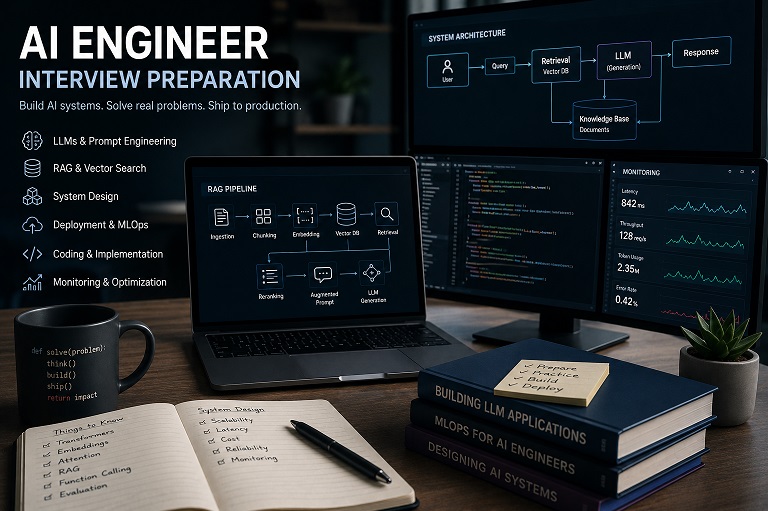
This guide explores the most common AI engineering interview topics, explains the reasoning behind typical questions, and outlines practical strategies for preparing for technical interviews.
Understanding the AI Engineer Role
Before preparing for interviews, it is important to understand what employers expect from an AI engineer.
An AI engineer bridges the gap between research and production. Their responsibilities often include:
- Integrating foundation models into applications.
- Designing retrieval-augmented generation systems.
- Building AI agents and automated workflows.
- Optimizing latency and inference costs.
- Deploying AI services to cloud environments.
- Monitoring model behavior after deployment.
- Ensuring reliability, scalability, and security.
Unlike research scientists, AI engineers rarely train foundation models from scratch. Instead, they focus on adapting existing models to business requirements while maintaining operational efficiency.
Foundational AI Concepts
Most interviews begin with basic questions designed to verify core understanding.
What Is an AI Model?
An AI model is a computational system designed to perform tasks associated with human intelligence, such as language understanding, image recognition, or decision making.
Machine learning models represent a subset of AI systems that learn patterns directly from data rather than relying solely on predefined rules.
Modern AI products often combine both approaches. A chatbot, for example, may use a large language model alongside rule-based validation and structured business logic.
What Is a Large Language Model?
A large language model (LLM) is a transformer-based neural network trained on massive text datasets to predict the next token in a sequence.
LLMs power applications such as:
- Conversational assistants
- Document summarization
- Content generation
- Code completion
- Information retrieval
- AI agents
AI engineers typically treat these models as configurable reasoning engines within larger software architectures.
What Is Tokenization?
Neural networks cannot process raw text directly.
Tokenization converts text into numerical units called tokens, which become the model’s input representation.
The tokenizer influences:
- Context window size
- Processing costs
- Inference speed
- Language representation
Understanding tokenization is particularly important because many commercial AI services charge based on token usage.
Training Versus Inference
Training updates model parameters by learning from data.
Inference uses an already trained model to generate predictions or responses.
Most AI engineering work focuses on inference optimization rather than large-scale model training.
Prompt Engineering Fundamentals
Prompt engineering has become a standard interview topic.
A prompt is more than a simple instruction. In production environments, prompts often contain:
- System instructions
- User requests
- Business rules
- Retrieved knowledge
- Conversation history
- Output formatting requirements
Effective prompt engineering involves systematic experimentation rather than guesswork.
Interviewers may ask candidates to improve prompts by increasing accuracy, reducing ambiguity, or enforcing structured outputs.
Fine-Tuning Versus Prompt Optimization
A common interview question explores the differences between prompting and fine-tuning.
Prompt engineering modifies model behavior during inference without changing the underlying model.
Fine-tuning updates model parameters using additional training data.
Prompt optimization is generally preferred when:
- Requirements change frequently.
- Deployment speed matters.
- Training resources are limited.
Fine-tuning becomes valuable when highly specialized behavior or domain adaptation is required.
Retrieval-Augmented Generation
Retrieval-Augmented Generation, commonly known as RAG, has become a central topic in AI engineering interviews.
Traditional language models rely only on their training data.
RAG introduces external knowledge during inference by retrieving relevant documents and incorporating them into the prompt.
A typical RAG architecture includes:
- Document ingestion
- Data cleaning
- Text chunking
- Embedding generation
- Vector storage
- Similarity search
- Result reranking
- Prompt construction
- LLM response generation
Advantages include:
- Reduced hallucinations
- Access to current information
- Improved factual accuracy
- Domain-specific knowledge integration
Interviewers frequently ask candidates to explain the complete RAG pipeline and discuss potential failure points.
Embeddings and Vector Databases
Embeddings convert text, images, or other data into dense numerical vectors that capture semantic meaning.
Similar concepts are mapped to nearby locations within high-dimensional vector space.
Embeddings support applications such as:
- Semantic search
- Recommendation systems
- Document retrieval
- Duplicate detection
- Knowledge management
Vector databases optimize storage and retrieval of embedding vectors.
Candidates should understand concepts including:
- Cosine similarity
- Euclidean distance
- Approximate nearest neighbor search
- Metadata filtering
- Hybrid retrieval
Hallucinations and Reliability
Hallucinations occur when language models generate plausible but incorrect information.
Several factors contribute to hallucinations:
- Limited training coverage
- Ambiguous prompts
- Missing context
- Excessive generation randomness
Practical mitigation strategies include:
- Retrieval augmentation
- Structured outputs
- Confidence estimation
- Source attribution
- Response validation
- Multi-step verification
Interviewers often focus on practical mitigation rather than theoretical explanations.
Transformer Architecture
Candidates should understand transformer models at a conceptual level.
Transformers process tokens simultaneously using self-attention mechanisms.
Self-attention enables models to evaluate relationships between words regardless of their position in the sequence.
Important concepts include:
- Self-attention
- Multi-head attention
- Positional encoding
- Decoder architecture
- Context windows
Deep mathematical derivations are rarely required for AI engineering positions, but conceptual understanding is expected.
Generation Parameters
Several inference parameters influence model behavior.
Temperature
Controls randomness during generation.
Lower values produce predictable responses.
Higher values increase diversity.
Top-k Sampling
Restricts token selection to the highest probability candidates.
Top-p Sampling
Selects tokens from a probability distribution whose cumulative probability exceeds a specified threshold.
AI engineers should understand how these settings affect production reliability.
Function Calling and AI Agents
Modern language models can invoke external tools.
Examples include:
- Database queries
- Search engines
- Weather services
- Payment systems
- Scheduling APIs
Function calling enables AI agents to perform multi-step tasks rather than simply generate text.
Interview questions may involve designing an agent that:
- Receives user input
- Selects appropriate tools
- Executes external actions
- Synthesizes final responses
AI System Design Questions
System design interviews evaluate practical engineering ability.
Designing an AI Chatbot
A complete architecture may include:
User interface
↓
API gateway
↓
Authentication
↓
Conversation memory
↓
Prompt orchestration
↓
Knowledge retrieval
↓
Language model
↓
Output validation
↓
Monitoring and analytics
Candidates should discuss:
- Latency
- Cost management
- Security
- Scalability
- Logging
- Rate limiting
Designing a Document Intelligence Platform
A document processing system may include:
- File ingestion
- OCR
- Document segmentation
- Embedding generation
- Vector storage
- Semantic retrieval
- LLM reasoning
- Citation generation
Interviewers typically focus on architecture decisions and trade-offs.
Scaling AI Systems
Production AI services must handle varying workloads.
Common optimization strategies include:
Caching
Store repeated responses to reduce API usage.
Request Batching
Combine multiple requests into larger inference operations.
Quantization
Reduce model precision to improve speed and reduce memory consumption.
Horizontal Scaling
Deploy multiple inference servers behind load balancers.
Speculative Decoding
Use smaller draft models to accelerate generation.
Candidates should understand both performance improvements and associated trade-offs.
AI Deployment and MLOps
Deploying AI systems requires traditional DevOps knowledge combined with machine learning infrastructure.
Key technologies include:
- Docker
- Kubernetes
- FastAPI
- Serverless architectures
- CI/CD pipelines
Production deployments often require:
- Automated testing
- Canary releases
- Version management
- Rollback procedures
Monitoring Production AI
Deployment is only the beginning.
AI systems require continuous monitoring.
Important metrics include:
Technical metrics:
- Latency
- Throughput
- Error rates
- Resource utilization
Business metrics:
- User satisfaction
- Task completion rates
- Conversion rates
- Customer retention
Model metrics:
- Hallucination frequency
- Retrieval accuracy
- Response relevance
- Citation correctness
Model Drift
Production systems evolve over time.
Changes in user behavior, data sources, or business requirements may reduce model effectiveness.
Common drift types include:
Data drift
Input distributions change.
Concept drift
Relationships between inputs and outputs evolve.
Behavioral drift
User expectations shift over time.
Monitoring systems should detect these changes before significant performance degradation occurs.
Scenario-Based Interview Questions
Scenario questions evaluate problem-solving abilities.
Incorrect Responses
Possible investigation steps include:
- Review prompts.
- Validate retrieved documents.
- Check conversation history.
- Test output constraints.
- Analyze user feedback.
Rising Latency
Potential causes:
- API bottlenecks
- Increased token counts
- Network issues
- Cache failures
- Infrastructure overload
Increasing Costs
Optimization options include:
- Prompt compression
- Caching
- Dynamic model routing
- Token budgeting
- Usage quotas
Poor Retrieval Performance
Areas to inspect:
- Chunk size
- Embedding model quality
- Metadata filters
- Similarity thresholds
- Reranking algorithms
Interviewers typically evaluate troubleshooting methodology rather than memorized answers.
Coding Expectations
Most AI engineering interviews include programming exercises.
Common tasks involve:
Python programming
REST API development
Data processing
Prompt construction
Vector search
JSON parsing
Async workflows
Candidates should also understand:
- Error handling
- Logging
- Retry mechanisms
- Rate limiting
- Unit testing
AI Engineer Versus Machine Learning Engineer
Although the roles overlap, their priorities differ.
Machine learning engineers typically focus on:
- Training pipelines
- Feature engineering
- Model optimization
- Statistical evaluation
AI engineers focus on:
- Foundation model integration
- RAG architectures
- AI agents
- Production deployment
- API orchestration
- End-user applications
Interview questions generally reflect these distinctions.
Common Interview Mistakes
Many otherwise qualified candidates make avoidable errors.
Frequent mistakes include:
Discussing theory without practical implementation.
Ignoring system trade-offs.
Treating language models as fully autonomous systems.
Neglecting monitoring and operational concerns.
Failing to quantify project outcomes.
Strong candidates explain not only what they built but why specific architectural decisions were made.
How to Prepare for AI Engineering Interviews
Effective preparation should combine theory and practical experience.
Build Real Projects
Create complete applications such as:
- RAG assistants
- Document search platforms
- AI customer support systems
- Multi-agent workflows
Practice System Design
Be comfortable designing architectures from user request to production monitoring.
Learn Deployment Tools
Gain hands-on experience with:
- Docker
- Kubernetes
- Vector databases
- Cloud platforms
- CI/CD systems
Study Production Failures
Understanding operational problems often provides more interview value than memorizing algorithms.
Build a Portfolio
Employers increasingly prefer candidates who can demonstrate deployed AI systems rather than isolated notebooks.
Final Thoughts
AI engineering combines software engineering, machine learning, cloud infrastructure, and modern language model technologies into a single discipline. Interviews increasingly emphasize practical problem solving over theoretical knowledge, with a strong focus on building systems that are reliable, scalable, and economically viable.
Candidates who understand the complete lifecycle of AI applications, from prompt design and retrieval pipelines to deployment and monitoring, are well positioned for modern AI engineering roles. Technical knowledge remains essential, but practical experience building and operating production systems is often the strongest differentiator during the hiring process.