Meshtastic Node Roles and Network Design: Building an Efficient LoRa Mesh
Electronics MeshtasticPart I: Meshtastic Node Roles and Network Design: Building an Efficient LoRa Mesh
Part II: Infrastructure Nodes, Routing Priorities, and Best Practices in Meshtastic
Part III: Relay Policies, Power Management, and Practical Node Configuration in Meshtastic
Introduction
One of the biggest misconceptions among new Meshtastic users is that every node should be configured to relay as much traffic as possible. While that sounds logical at first glance, it often produces the opposite result. A poorly configured network generates unnecessary retransmissions, increases channel utilization, creates packet collisions, and ultimately reduces the reliability of communication.
Meshtastic was designed as a decentralized mesh networking platform where every node participates in routing decisions. Unlike conventional radio repeaters, Meshtastic devices constantly evaluate network conditions, remember neighboring nodes, collect telemetry, maintain routing information, and decide whether retransmitting a packet is actually beneficial.
Because every node influences the behavior of the entire mesh, selecting the correct device role is one of the most important configuration decisions. A network consisting entirely of infrastructure nodes will usually perform worse than one where most devices operate as ordinary clients.
Before configuring any hardware, it is worth defining the purpose of the network itself.
Designing the Network Before Configuring Devices
Every deployment has different priorities.
A hiking group typically wants reliable messaging, GPS position sharing, and long battery life. An emergency response team may prioritize maximum coverage and interoperability with external mapping systems. A community mesh covering an entire city must balance coverage against network congestion, while a private infrastructure deployed on industrial facilities may value deterministic routing over user mobility.
Meshtastic supports all of these scenarios, but no single configuration fits every environment.
The default settings supplied by the firmware primarily target small portable deployments. They work remarkably well for outdoor activities where a limited number of users exchange short text messages, periodically transmit location updates, and occasionally forward traffic through nearby nodes.
As networks become larger, however, infrastructure planning becomes increasingly important. Simply placing additional nodes on rooftops without understanding how routing priorities work often decreases overall network performance instead of improving it.
Understanding device roles is therefore essential before expanding any deployment.
How a Meshtastic Node Operates
Unlike a traditional radio modem, every Meshtastic node performs several functions simultaneously.
A single device can:
- transmit and receive LoRa packets
- relay messages from neighboring nodes
- maintain a database of discovered devices
- exchange telemetry
- report GPS location
- participate in routing decisions
- suppress unnecessary retransmissions
- provide Bluetooth, Wi-Fi, or serial connectivity to external clients
The firmware continuously evaluates received packets and determines whether retransmission is necessary. This decision depends on multiple factors, including packet priority, hop count, previous retransmissions, signal quality, and the role assigned to the node.
The selected role modifies this behavior by changing retransmission priorities, power-saving policies, and service availability.
Understanding Meshtastic Device Roles
Meshtastic includes several predefined roles, each optimized for a particular deployment scenario. Although many users experiment with specialized configurations, the project documentation strongly recommends using the standard client roles unless there is a clear operational reason to choose something else.
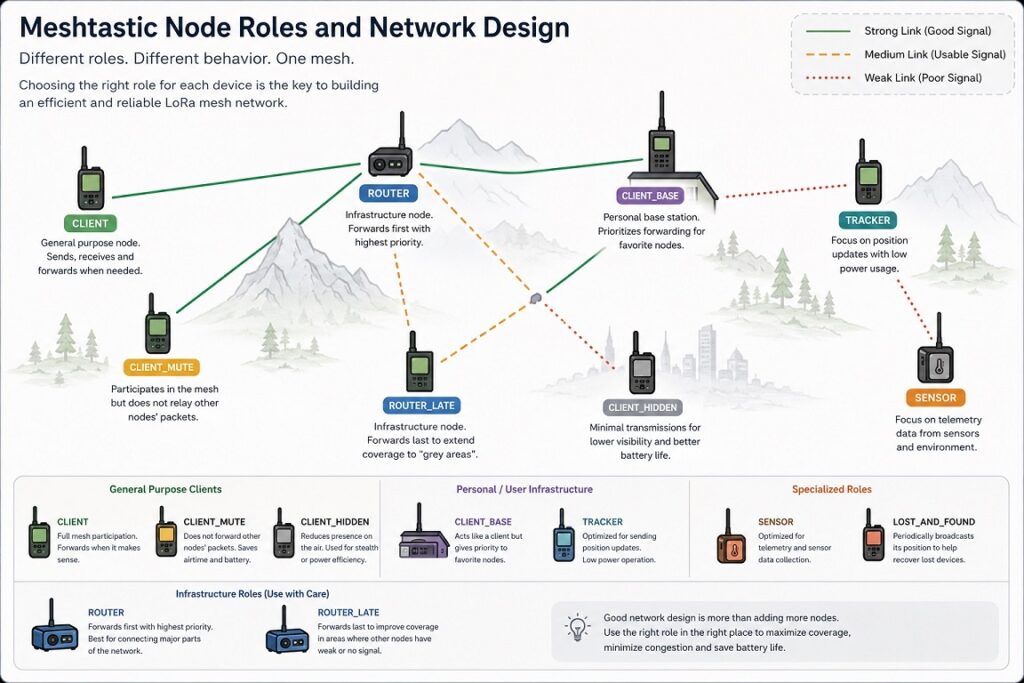
Choosing an infrastructure role simply because it sounds more powerful is rarely beneficial.
CLIENT
CLIENT is the standard operating mode and should be considered the default choice for most fixed and portable nodes.
A CLIENT device participates fully in the mesh. It exchanges messages, shares telemetry, discovers neighboring nodes, and retransmits packets when appropriate. Unlike infrastructure nodes, however, it only forwards traffic if another node has not already handled the retransmission.
This behavior significantly reduces duplicate traffic while maintaining excellent network connectivity.
Typical use cases include:
- personal handheld radios
- desktop gateway nodes
- fixed home installations
- mobile stations
- general-purpose community mesh nodes
Unless a network requires specialized infrastructure, CLIENT remains the recommended role.
CLIENT_MUTE
CLIENT_MUTE behaves almost identically to a standard client except for one critical difference.
It does not retransmit packets originating from other nodes.
The device still participates fully in the mesh as an endpoint. It can send messages, receive broadcasts, exchange telemetry, and maintain routing information, but it avoids generating additional network traffic.
This role is particularly valuable for portable battery-powered devices operating inside an already established mesh.
Examples include:
- handheld radios
- wearable trackers
- vehicle installations
- temporary field devices
When dozens of portable users operate within range of powerful rooftop stations, configuring every handheld as CLIENT_MUTE dramatically reduces unnecessary retransmissions.
CLIENT_HIDDEN
CLIENT_HIDDEN is designed for situations where minimizing radio activity is more important than maximizing visibility.
The node significantly limits background transmissions while remaining connected to the network. Reduced beaconing improves battery life and decreases the probability of detection by nearby receivers.
Although the device continues participating in the mesh, it intentionally reveals less information about itself than a normal client.
Typical deployments include:
- covert field operations
- battery-powered remote sensors
- long-duration portable equipment
- privacy-focused installations
This role should not be viewed as an anonymity feature but rather as a method for reducing airtime.
CLIENT_BASE
CLIENT_BASE serves as a personal relay station rather than public infrastructure.
Unlike a standard client, it gives transmission priority to packets exchanged with nodes listed as favorites. This makes it an excellent choice for users operating multiple devices.
A common deployment consists of:
- one rooftop node equipped with an external antenna
- one or more portable handheld devices
After adding each device to the other’s Favorites list, the rooftop CLIENT_BASE automatically prioritizes retransmission for those selected nodes while behaving like a normal CLIENT for everyone else.
This configuration increases coverage for a personal network without introducing unnecessary infrastructure behavior across the entire mesh.
Specialized Operational Roles
Several roles are optimized for highly specific applications rather than general messaging.
TRACKER
TRACKER prioritizes GPS position reporting over general communication.
These nodes spend much of their time conserving power and periodically wake to transmit updated location information.
Typical applications include:
- wildlife tracking
- asset monitoring
- hiking beacons
- vehicle tracking
Messaging capabilities remain available but are no longer the primary function.
LOST_AND_FOUND
The LOST_AND_FOUND role exists for recovering misplaced hardware.
Devices periodically broadcast their position on the default channel, allowing nearby users to locate them more easily.
Although relatively uncommon in permanent deployments, this role can be useful for expensive portable equipment that may be forgotten or accidentally dropped during field operations.
SENSOR
SENSOR is intended for telemetry-oriented installations.
Rather than prioritizing user communication, these devices periodically transmit environmental measurements collected from attached sensors.
Common examples include:
- weather stations
- environmental monitoring
- industrial telemetry
- agricultural sensing
- remote infrastructure monitoring
The firmware incorporates aggressive power management, making this role suitable for solar-powered or battery-operated deployments.
TAK
The TAK role optimizes communication with Android Team Awareness Kit (ATAK) and compatible tactical coordination systems.
Routine network broadcasts are minimized to reduce unnecessary traffic while maintaining efficient interoperability with ATAK plugins and mapping software.
This role is primarily intended for emergency management, public safety, and coordinated field operations.
TAK_TRACKER
TAK_TRACKER combines the behavior of TRACKER with automated Position Location Information (PLI) reporting required by ATAK deployments.
Its primary purpose is continuous position updates within tactical awareness systems rather than conventional text messaging.
Infrastructure Roles
Infrastructure roles deserve special consideration because they directly affect every node within radio range.
Unlike client roles, infrastructure devices modify retransmission priorities for the entire mesh. Poor placement or excessive deployment can easily create congestion instead of improving coverage.
The two most important infrastructure roles are ROUTER and ROUTER_LATE.
Although they appear similar, they behave very differently and should be deployed only after understanding how Meshtastic schedules retransmissions.
The next section examines these infrastructure roles in detail, explains why the obsolete REPEATER role should generally be avoided, and demonstrates how retransmission priorities influence the performance of large mesh networks.