How Developers Use Proxies to Test Geo-Targeted APIs
Programming APIGeographic location is no longer a simple presentation detail in modern software. An API may return a different price, currency, product catalog, payment method, feature set, or compliance decision depending on where the request appears to originate. For a development team working from a single office or data center, this creates an immediate testing problem: the application may behave correctly for the developers while failing for users in other countries.
A developer in Germany cannot reliably validate the experience of a user in Brazil by sending requests from a German IP address. A QA engineer in the United States cannot confirm that a location-restricted feature is unavailable in the United Kingdom without somehow reproducing the relevant geographic conditions.
This is where proxies become a practical part of the API testing stack. By routing requests through IP addresses associated with different countries, regions, networks, or connection types, developers can test how an API behaves under different geographic conditions without physically deploying test machines in every market.
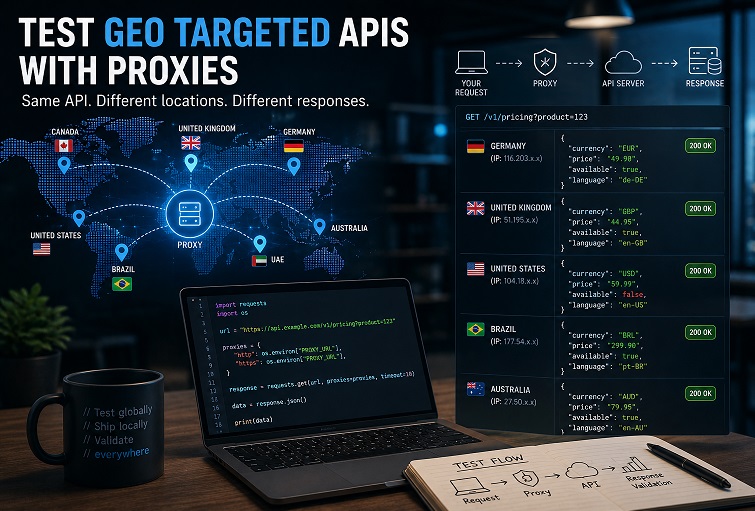
The important point is that proxies are not a substitute for a complete geolocation testing strategy. An IP address is only one signal among several that modern systems may use to determine location. However, when used correctly, proxies provide one of the simplest and most automatable ways to test location-dependent API behavior.
What Is a Geo-Targeted API?
A geo-targeted API is an API whose response or behavior changes according to the perceived location of the client.
The location may be determined from the request’s source IP address, HTTP headers, device or network information, account attributes, payment details, or a combination of these signals. In many systems, the IP address is the first and most important input, particularly when the user is not authenticated.
Examples include:
- An e-commerce API returning prices in EUR for a user in France and GBP for a user in the United Kingdom.
- A streaming service exposing different content catalogs in different countries.
- A hotel or travel platform applying regional pricing or availability rules.
- A fintech application hiding payment methods that are not available in a particular jurisdiction.
- A SaaS product enabling a feature only for customers in selected launch markets.
- A gaming service applying regional availability or regulatory restrictions.
- A content platform applying country-specific licensing rules.
- An API returning different tax calculations depending on the customer’s location.
From a user’s perspective, these differences may appear to be simple localization. From an engineering perspective, they are conditional branches in a distributed system that must be tested.
A location-aware API must answer questions such as:
- What happens when the request originates from a supported country?
- What happens when the country is unsupported?
- Which currency and language should be returned?
- Which products or features should be visible?
- Are regional restrictions applied correctly?
- Does the API behave consistently across different IP ranges within the same country?
- What happens when the IP-derived location conflicts with the user’s account or payment information?
If these questions are not tested explicitly, geographic logic can easily become a source of production bugs.
Why Geographic Testing Is Difficult
The simplest problem is that most development teams do not have a global testing environment.
A team working from one office naturally generates requests from a relatively narrow geographic area. Even if the application is designed for dozens of countries, most manual tests will originate from the same few IP ranges.
A developer can attempt to simulate another country by mocking the location service or changing an internal parameter. This is useful for unit testing business logic, but it does not necessarily reproduce the behavior of real upstream systems.
For example, the production request flow may look like this:
- The client sends a request.
- A CDN or reverse proxy receives it.
- The infrastructure extracts the source IP.
- A geolocation database maps the IP to a country.
- The application applies regional business rules.
- An external payment, pricing, or content service may apply its own location logic.
Mocking step four does not necessarily test the entire chain. A proxy allows the request to enter the system with a different network origin, making it possible to test a larger part of the real request path.
This is particularly valuable when the behavior depends on infrastructure outside the application’s direct control.
How a Proxy Helps Test Location-Based Behavior
A proxy acts as an intermediary between the client and the destination server.
Instead of sending a request directly:
Developer or test runner
        |
        v
    Target API
the request follows a different path:
Developer or test runner
        |
        v
      Proxy
        |
        v
    Target API
The target service generally sees the proxy’s public IP address as the network origin of the request. If the proxy is associated with an IP address in Germany, the target API may process the request as originating from Germany. A proxy located in Canada can produce a different geographic context.
This makes it possible to send essentially the same API request through multiple locations and compare the results.
For example:
GET /v1/products/123

Proxy: Germany
Expected currency: EUR

Proxy: United Kingdom
Expected currency: GBP

Proxy: United States
Expected currency: USD
The request itself may remain unchanged. The network origin changes, and the API response is evaluated against the expected behavior for each location.
This approach is attractive because it operates at the network layer. The application under test does not need to be modified simply to test another country. The same test code can often be executed repeatedly with different proxy configurations.
A Practical Geo-Testing Workflow
A reliable geo-testing process usually begins with a defined set of geographic scenarios rather than random IP switching.
1. Define the locations that matter
The test matrix should be based on actual product requirements.
A global application might need to test:
- The United States
- The United Kingdom
- Germany
- France
- Canada
- Australia
- Brazil
- The United Arab Emirates
- Selected countries with special regulatory requirements
The list should not simply contain every country the proxy provider supports. It should represent the geographic branches implemented in the application.
If the API has a rule such as:
Feature X:
- Enabled in Germany
- Enabled in France
- Disabled in the United States
then those three locations are the minimum required test cases.
2. Select appropriate proxy endpoints
The test runner chooses a proxy associated with each target location.
At this stage, several properties matter:
- Geographic accuracy
- Reliability
- Connection speed
- IP reputation
- Session persistence
- Rotation behavior
- Availability of the required country or region
A proxy located in the wrong country can produce a false test result. For geographic testing, correct location data is generally more important than simply having a large pool of IP addresses.
3. Send the same request from different locations
The test should keep as many variables constant as possible.
For example, the test may send:
GET /v1/pricing?product_id=123through several geographic endpoints.
The test then compares:
- Currency
- Price
- Product availability
- Language
- Regional feature flags
- Payment options
- Compliance-related responses
Keeping the request consistent makes it easier to identify whether the geographic condition is actually responsible for the observed difference.
4. Validate the response against explicit expectations
A successful test should not merely record that the API returned HTTP 200.
The response must be checked against the expected behavior for the target location.
For example:
Germany:
  currency = EUR
  payment_method = SEPA
  feature_x = enabled

United Kingdom:
  currency = GBP
  payment_method = UK-specific option
  feature_x = enabled

United States:
  currency = USD
  feature_x = disabled
This distinction is important. A technically successful HTTP request can still produce a business-level failure.
5. Automate the scenarios
Manual proxy switching is useful during initial investigation, but it does not provide long-term protection against regressions.
Once the expected behavior is established, the scenarios can be integrated into automated tests and executed during:
- CI/CD pipelines
- Scheduled regression runs
- Release validation
- Pre-production smoke tests
- Monitoring workflows
The objective is to make geographic behavior a repeatable test dimension rather than a manual debugging exercise.
What Developers Commonly Test
The exact scenarios depend on the product, but several categories appear repeatedly.
Currency and localization
The same product may have different:
- Currencies
- Number formats
- Date formats
- Languages
- Tax representations
A geo test can verify that the API returns the correct combination for a given location.
Regional availability
A service may be available in one market but not another. The API should return the correct availability state rather than exposing a feature that cannot actually be used.
Pricing
Some businesses use regional pricing models. Tests may need to verify:
- Currency conversion
- Country-specific pricing
- Tax inclusion
- Regional discounts
- Pricing tiers
Pricing tests are particularly sensitive because a small geolocation error can lead to incorrect charges or inconsistent customer experiences.
Payment methods
Payment providers often vary by country. An API may expose:
- Local bank transfer methods
- Country-specific wallets
- Card processing options
- Regional payment gateways
A location-based test should verify not only that the expected method is available, but also that unsupported options are not incorrectly exposed.
Compliance and content restrictions
Certain content or services may be restricted by jurisdiction. Geographic testing can help verify that the application consistently applies these rules.
These tests require particular care. A proxy should be used only as part of authorized testing of systems that the organization owns or has permission to assess.
Geographic feature flags
A feature may be gradually released to selected countries.
For example:
Feature rollout:
Germany: enabled
France: enabled
United Kingdom: enabled
United States: disabled
A multi-location test can ensure that the rollout configuration matches the intended release plan.
Choosing the Right Proxy Type
Different proxy types are useful for different testing objectives.
Datacenter proxies
Datacenter proxies are generally fast, predictable, and cost-effective.
They are often sufficient for testing basic business logic:
Does a request from a German IP return the German pricing configuration?
Their main limitation is that some services can identify datacenter IP ranges and treat them differently from residential users.
Residential proxies
Residential proxies use IP addresses associated with residential internet connections.
They are useful when the target service applies different rules to datacenter traffic or when the test needs to approximate the network identity of a typical household user.
The tradeoff is usually higher cost, more variable performance, and potentially less predictable availability.
Mobile proxies
Mobile proxies are associated with mobile networks and are useful for testing mobile-specific behavior.
They may be relevant when an application uses:
- Carrier information
- Mobile network characteristics
- Mobile IP ranges
- Region-specific mobile services
They are generally more expensive and less convenient for routine backend testing.
Rotating proxies
Rotating proxies change the source IP over time or between requests.
They can be useful for large-scale testing across many locations, but rotation can make debugging more difficult. If a test fails, the exact IP responsible for the result may matter.
For deterministic functional tests, a stable session or fixed proxy is often easier to reason about. Rotation is more useful when the objective is to test behavior across a broader range of IPs or to reduce dependence on a single address.
Proxy-Based Testing in CI/CD
The most valuable use of geo proxies is often not manual testing but automation.
A typical automated workflow looks like this:
Test matrix
    |
    v
Select target country
    |
    v
Configure proxy
    |
    v
Send API request
    |
    v
Validate response
    |
    v
Record result
A test configuration might conceptually look like:
[
  {
    "country": "DE",
    "expectedCurrency": "EUR"
  },
  {
    "country": "GB",
    "expectedCurrency": "GBP"
  },
  {
    "country": "US",
    "expectedCurrency": "USD"
  }
]
The same test logic can then be executed for each location.
This pattern works with virtually any programming language or HTTP client. The proxy configuration is commonly applied at the transport layer, while the assertions remain part of the normal test suite.
The exact implementation differs between libraries, but the principle is consistent:
- Select the geographic test case.
- Configure the corresponding proxy.
- Send the request.
- Verify the response.
- Fail the build if the result violates the geographic rules.
This approach is particularly useful for controlled feature rollouts. If a feature should be available only in selected countries, automated geographic tests can act as a guardrail against accidental exposure.
A Simple Example of a Geo-Regression Test
Suppose an API controls access to a feature called advanced_reports.
The intended rollout is:
| Country | Expected result |
|---|---|
| Germany | Enabled |
| France | Enabled |
| United Kingdom | Enabled |
| United States | Disabled |
| Canada | Disabled |
A regression test can execute the same request from each location and verify the result.
If a deployment accidentally changes the response for the United States from:
{
  "advanced_reports": false
}
to:
{
  "advanced_reports": true
}
the test should fail.
The value of this approach is not that it proves the entire geolocation system is correct. Rather, it continuously verifies the specific geographic assumptions that the application depends on.
Common Problems with Proxy-Based Geo Testing
A proxy changes the network origin of a request, but it does not automatically reproduce every aspect of a real user.
This is where many otherwise well-designed tests become misleading.
IP address is only one location signal
Modern systems may use several signals:
- IP geolocation
Accept-Language- Time zone
- Account country
- Billing address
- Payment instrument
- SIM or carrier information
- Device configuration
- GPS data
- Browser characteristics
If an application requires multiple signals to agree, changing only the IP address may not be enough.
For example, a request may originate from a French IP address while carrying an account registered in the United States. The application may intentionally prioritize the account location.
The correct solution is not to assume that the proxy is wrong. Instead, the test must identify which signals the product is actually designed to use.
Caching can hide geographic differences
Caching is a common source of confusing results.
An upstream system may cache a response using only the URL as the cache key:
/v1/pricing?product=123If the response is cached without considering geographic context, a request from one country may receive a response generated for another.
Depending on the system, geographic information may need to be included in the cache key or the cache variation rules.
Testers should also be careful with cache-busting techniques. Adding a random query parameter may help diagnose caching, but it can also change application behavior if the API treats query parameters differently.
Proxy IP databases are not perfect
Geolocation databases are constantly updated, but no IP-to-location mapping is perfect.
A proxy advertised as being in one country may be classified differently by the target service. This can happen because:
- Geolocation databases disagree.
- The IP was recently reassigned.
- The service uses its own proprietary database.
- The address belongs to a cloud or hosting provider.
- The IP is associated with a broader region rather than a specific city.
For critical tests, the actual geographic interpretation by the target service should be verified rather than assumed.
Time zones can create false conclusions
Some geographic behavior is actually a combination of location and time.
For example:
Feature enabled in Germany
Feature enabled only between 09:00 and 18:00 local time
A test that changes the IP but ignores the time zone may produce a result that appears incorrect.
Time-based logic should therefore be tested separately and documented explicitly.
Rotating IPs make failures harder to reproduce
If the IP changes on every request, a test failure may disappear on the next run.
This is useful for testing resilience across multiple IPs, but it is not ideal for deterministic regression testing.
When debugging a failure, record:
- The proxy country
- The actual exit IP
- The timestamp
- The request identifier
- The relevant headers
- The response
Without this information, reproducing the problem can be unnecessarily difficult.
Best Practices for Reliable Geo API Testing
A few operational practices make a substantial difference.
Keep the test matrix explicit
Do not rely on an undocumented list of countries hidden in a script.
Maintain a clear mapping between:
Geographic condition
        |
        v
Expected API behavior
This makes the test suite easier to review and update.
Log the geographic context
Every test result should ideally record the relevant context, including:
- Target country
- Proxy endpoint or identifier
- Actual exit IP where appropriate
- Timestamp
- API version or deployment
- Expected result
- Actual result
This information is invaluable when investigating a failure.
Separate deterministic tests from broad coverage tests
A fixed proxy is often better for regression tests.
A rotating proxy pool may be better for broader exploratory testing.
These are different objectives and should not necessarily use the same configuration.
Validate the proxy before testing the API
Before concluding that the application has a geographic bug, verify that the proxy is actually being interpreted as the intended location.
Otherwise, the test may be validating the proxy provider rather than the application.
Use HTTPS
Requests should be encrypted between the client, proxy infrastructure, and destination wherever supported.
This is particularly important when testing authenticated APIs or transmitting sensitive test data.
Avoid using production secrets in proxy tests
A proxy introduces another network component into the request path. Test environments should use appropriate credentials, test accounts, and restricted permissions.
Sensitive production credentials should not be used simply because a geographic test is convenient.
Test more than one IP when the risk justifies it
A single IP address is not always representative of an entire country.
For high-value geographic logic, testing multiple IPs within the same country can help identify:
- IP reputation issues
- Geolocation inconsistencies
- CDN behavior
- Provider-specific filtering
The number of IPs required depends on the risk and the expected variability of the system.
Proxies Compared with Other Testing Approaches
Proxies are not the only way to test geo-dependent behavior.
Mocking the geolocation service
This is excellent for unit and integration testing.
It is fast, deterministic, and inexpensive. However, it does not validate the full network path or the behavior of external systems.
Mocking should therefore be part of the test strategy, not the entire strategy.
Cloud infrastructure in multiple regions
Deploying test runners or virtual machines in different regions can provide realistic network origins.
This approach is useful for complex integration tests but may be expensive and operationally heavy when many locations are required.
Remote manual testing
A team can ask testers or colleagues in different countries to perform manual checks.
This can help with end-to-end user experience testing, but it is difficult to reproduce and automate consistently.
VPN-based testing
VPNs can be useful for manual testing and browser-based workflows. For automated API testing, however, they may be less flexible than programmable proxy infrastructure.
In practice, mature teams often combine these approaches:
- Mocks for fast unit tests
- Proxies for automated multi-country API testing
- Regional infrastructure for high-fidelity integration testing
- Manual testing for real-world end-user validation
Security and Compliance Considerations
Proxy-based testing must be performed responsibly.
A proxy should not be used to bypass access controls, evade contractual restrictions, or test systems without authorization. The purpose of the technique is to validate software behavior in environments that the testing team is authorized to assess.
Teams should also consider:
- Whether test data contains personal information
- Whether credentials are transmitted through third-party infrastructure
- Whether the proxy provider has appropriate security controls
- Whether the testing process complies with organizational policies
- Whether traffic volumes could be mistaken for abusive activity
For sensitive applications, the proxy provider and network architecture should be reviewed as part of the overall security model.
The Role of Proxies in a Modern Geo-Testing Strategy
A proxy is best understood as one component of a broader testing strategy.
It can answer a particularly important question:
How does the system behave when the request appears to originate from another geographic location?
That question matters for commerce, finance, streaming, travel, SaaS, advertising, gaming, and any other product that operates across multiple markets.
The most effective approach is to combine geographic proxy testing with:
- Unit tests for location-based business rules
- Integration tests for geolocation services
- Contract tests for external APIs
- End-to-end tests for critical user journeys
- Monitoring of regional production behavior
This layered approach avoids placing too much confidence in any single testing technique.
Conclusion
Geo-targeted APIs create a testing challenge because the same request can legitimately produce different results depending on where it originates. A development team working from one location cannot reliably validate every geographic branch through local testing alone.
Proxies provide a practical way to introduce geographic variation into automated API tests. By routing identical requests through different country-specific IP addresses, developers and QA engineers can verify regional pricing, currencies, availability, payment methods, content restrictions, feature flags, and other location-dependent behavior.
The most effective workflow is straightforward: define the geographic scenarios, select reliable endpoints, send consistent requests, compare the responses with explicit expectations, and automate the checks in the testing pipeline.
However, a proxy should not be treated as a perfect simulation of a real user. IP geolocation is only one signal, and production systems may also consider accounts, headers, device characteristics, time zones, network types, and other contextual data.
Used with those limitations in mind, proxy-based testing turns geographic behavior from something that is difficult to reproduce manually into a repeatable engineering process. Instead of asking whether an API works from one office, a team can systematically test how it behaves across the markets where the product actually operates.