If Aliens Made a Horror Movie About Humans
ScienceImagine an extraterrestrial civilization making a horror film about life on Earth.
The filmmakers have never seen a human before. They have no cultural assumptions about our bodies, no instinctive sense of what is normal, and no reason to consider our biology familiar. Their audience knows nothing about us either.
What would they see?
Probably not an ordinary-looking biped with two arms, two legs, and a face. They would see a remarkably strange organism that hides a rigid mineral framework inside soft tissue, continuously leaks water through millions of microscopic openings to prevent itself from overheating, grows a second set of teeth deep inside its jaw, and consumes neuroactive plant chemicals for recreation.
The monster in their film would not need to be invented.
It would simply be called Human.
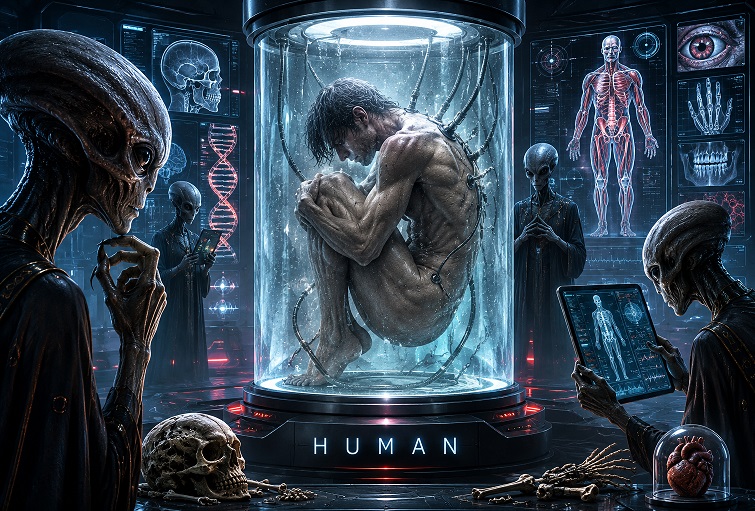
The creature with a skeleton on the inside
From a sufficiently alien perspective, the human body is already an anatomical oddity.
Humans are vertebrates, which means that the primary structural framework of the body is hidden inside it. Bones made largely from mineralized calcium phosphate support the organism from within, while muscles, organs, blood vessels, nerves, and connective tissues are arranged around that internal framework.
An extraterrestrial species evolved around an external shell might find this arrangement deeply unsettling. Why place the load-bearing structure where it cannot be seen or easily replaced? Why surround a hard skeleton with vulnerable soft tissue instead of putting the armor on the outside?
The human body has chosen a different engineering solution from that of insects, crustaceans, and many other animals. An internal skeleton can grow with the organism, provides attachment points for powerful muscles, and does not need to be periodically discarded during molting. It also allows the body to maintain a relatively flexible external surface.
But it comes with an obvious weakness. Damage the internal framework and the entire organism may lose its ability to move or support itself.
Humans have evolved an unusual answer to that problem: bone can repair itself. When a fracture occurs, the body initiates a complex biological repair process involving inflammation, specialized cells, temporary connective tissue, and the gradual formation and remodeling of new bone.
To an alien species without comparable regenerative mechanisms, a broken structural component that can slowly reconstruct itself might look less like ordinary biology and more like a supernatural ability.
The second set of teeth
Human development contains other features that would make an excellent scene in an extraterrestrial horror film.
During childhood, humans grow a temporary set of teeth. These are eventually lost and replaced by a larger permanent set. The developing adult teeth form inside the jaw before they erupt into the mouth.
From the outside, the process is familiar. From the perspective of an alien biologist, however, it is bizarre. The organism grows one set of cutting and grinding structures, discards them, and then produces a replacement set from within its own skeletal tissue.
The system is not perfect. Human teeth do not continuously regenerate throughout life, which is why damage to them can become a serious problem. Yet the underlying developmental process is remarkably complex: a temporary biological toolset is produced during early life, then replaced as the organism grows larger and its dietary requirements change.
A horror filmmaker would probably not waste the opportunity.
The camera would move beneath the jaw. Something hard would be growing there.
The predator that does not need to be fast
The most frightening thing about a human might not be strength, speed, claws, or teeth.
It might be persistence.
Many predators rely on short bursts of extreme performance. They accelerate, attack, and either capture their prey or fail. High-intensity movement consumes energy rapidly and generates substantial heat.
Humans evolved a different strategy in at least some hunting environments. Rather than relying exclusively on explosive speed, human hunters could pursue prey over long distances and extended periods. The objective was not necessarily to catch an animal immediately. It was to continue moving until the prey could no longer maintain its own pace.
This strategy is often associated with persistence hunting, in which a human follows an animal for long enough that heat stress and exhaustion begin to overwhelm it.
From a cinematic perspective, this is far more disturbing than a conventional chase.
The monster does not sprint toward its victim.
It simply keeps coming.
The prey runs. The human walks or jogs. The distance changes. The landscape changes. The temperature changes. Hours pass.
The human is still there.
The biological cooling system
This endurance is made possible by one of the strangest features of human physiology: sweating.
Humans possess millions of sweat glands distributed across the skin. When the body becomes too warm, water is released onto the skin. As that water evaporates, it carries heat away from the body.
It is an elegant cooling mechanism, but an alien observer might describe it differently.
The organism deliberately pumps water out of its own body through countless microscopic openings. It then allows the liquid to disappear into the surrounding atmosphere in order to keep its internal machinery operating.
Humans are unusually dependent on this process. Our ability to dissipate heat through sweating is one of the reasons prolonged physical activity in hot environments can be possible. It also explains one of the fundamental weaknesses of the system: the organism must constantly replace the water and electrolytes it loses.
The human body is therefore a machine that can sustain long periods of activity, provided it has access to sufficient water and can continue exchanging heat with its environment.
In the alien version of the film, this might be presented as a particularly disturbing discovery.
The creature is not merely running.
It is leaking.
The emergency chemical override
Human physiology also contains a temporary emergency mode.
When the brain detects a serious threat, the sympathetic nervous system activates the well-known fight-or-flight response. Hormones such as adrenaline help increase heart rate, redirect blood flow, mobilize energy stores, and prepare the body for rapid action.
This does not give humans unlimited strength, and popular stories often exaggerate what adrenaline can do. However, extreme stress can alter pain perception, motor behavior, attention, and the way the body recruits its available physical capacity.
The result can appear extraordinary when someone under severe stress performs an action that would normally seem impossible.
A person may continue moving despite injuries that would normally stop them. They may react with unusual speed or force. They may temporarily ignore signals that would ordinarily cause them to withdraw.
The important detail is that the body is not becoming stronger in a magical sense. It is changing the priorities of its control systems. Survival takes precedence over long-term damage.
From an alien perspective, this could look like a built-in emergency override.
The organism is injured.
The organism should stop.
Instead, its internal chemistry changes, pain becomes less dominant, energy is redirected, and the organism continues.
A creature that builds an external body
This is where humans become genuinely unusual.
Most animals are limited by the physical capabilities of their biological bodies. A bird can fly because it has wings. A fish can survive underwater because its body is adapted to that environment. A mammal cannot simply decide to enter outer space.
Humans solve this problem differently.
They build another body.
Clothing acts as an artificial layer of insulation and protection. Shoes protect the feet and improve traction. Glasses compensate for limitations in the visual system. Tools extend the reach and force of the limbs.
Then the external structures become more ambitious.
Humans construct vehicles, diving suits, aircraft, spacecraft, pressure vessels, and entire buildings. They place themselves inside these artificial environments and use them to survive conditions that would destroy their unprotected biological bodies.
A spacecraft is, in a very real sense, an artificial environment wrapped around a fragile organism.
The human body cannot breathe in space. It cannot withstand the vacuum. It cannot maintain a stable temperature without protection. It cannot obtain food or water from the surrounding environment.
So humans build a sealed shell of metal, glass, electronics, polymers, and composite materials.
Then they climb inside and continue their journey.
An alien observer might reasonably conclude that the human is not a single organism at all, but a biological core capable of constructing increasingly sophisticated external organs.
The human is not particularly powerful
Compared with many fictional monsters, humans are physically unimpressive.
We do not have claws capable of tearing through armor. We cannot fly under our own power. We are not especially fast over short distances. Our skin is relatively fragile, and our unprotected bodies are vulnerable to cold, heat, radiation, infection, and mechanical injury.
Yet humans compensate through a combination of endurance, adaptability, cooperation, and technology.
This distinction becomes especially interesting when humans are compared with the fictional xenomorph from the Alien universe.
The xenomorph is designed as a biological nightmare. It has a powerful external structure, remarkable physical abilities, aggressive behavior, rapid development, and a reproductive cycle that uses other organisms as hosts. Its body appears optimized for survival and predation.
The xenomorph is frightening because it represents biology pushed toward an extreme.
But the concept changes when the point of view changes.
An organism evolved with an external skeleton might find a human’s internal skeleton strange. A species that does not cool itself through evaporation might regard human sweating as an alarming physiological mechanism. A species without substantial tissue repair might consider bone regeneration extraordinary.
And a species that evolved without technology might regard human spacecraft as something even more disturbing than a biological adaptation.
Humans do not merely adapt to hostile environments.
They redesign the environment around themselves.
The human as a biological generalist
One of the most remarkable features of humans is that we are not specialized for a single extreme environment.
We are not the fastest land animals. We are not the strongest. We do not have the best night vision, the most powerful sense of smell, or the most effective natural armor.
Instead, humans are generalists with an unusual capacity for behavioral and technological adaptation.
Our bodies provide a basic platform. The brain modifies the strategy.
If the environment is cold, humans make insulation. If the environment is dark, they make artificial light. If the environment is underwater, they construct breathing equipment. If the environment is too high, too deep, too hot, too cold, or too distant, they build systems that compensate for the biological limitations of the body.
In this sense, human evolution did not stop at the skin.
Technology became an external layer of adaptation.
A coat performs a function that fur might perform in another species. A vehicle provides locomotion. A computer extends memory and calculation. A microscope extends vision. A spacecraft provides an artificial atmosphere.
The human organism is therefore unusual not only because of what its body can do, but because of what the organism can construct around itself.
The strangest habit: consuming plant neurotoxins for pleasure
The alien filmmakers would probably also be fascinated by human dietary behavior.
Humans regularly consume substances that alter the chemistry of their own nervous systems. Caffeine, nicotine, alcohol, and a wide range of other psychoactive compounds are consumed by humans for stimulation, relaxation, altered perception, social interaction, or pleasure.
Many of these substances are produced by plants as defensive chemicals.
From the plant’s perspective, these compounds may exist to discourage animals from eating it or to disrupt the physiology of potential predators. Humans, however, have learned to cultivate, process, trade, and deliberately consume many of them.
The result is a species that seeks out chemicals capable of changing its own brain function.
An extraterrestrial biologist might describe this as a form of voluntary neurochemical self-experimentation.
Humans find a molecule that changes the way their nervous system operates.
Then they build an industry around it.
Humans are not the only strange creatures on Earth
The thought experiment becomes even more interesting when we remember that almost every organism looks bizarre from the right perspective.
The octopus has distributed neural processing and three hearts. The mantis shrimp possesses visual capabilities far beyond those of humans. Tardigrades can survive conditions that would destroy most other animals. Certain fungi manipulate the behavior of insects. Plants communicate chemically and can respond to environmental threats.
There is no universal standard for what a normal organism should look like.
“Normal” simply means familiar.
Humans experience our own biology from the inside, so most of its features feel ordinary. We do not usually think of sweating as an extraordinary cooling system. We do not regard bones as internal mineral structures. We rarely consider the fact that we routinely construct artificial environments in order to survive.
Familiarity hides the strangeness.
Science fiction often reverses this process by presenting an organism with biology that violates our expectations. The xenomorph is frightening because it combines features that feel fundamentally wrong to human observers.
But the same mechanism works in reverse.
A sufficiently alien observer might look at a human and see an organism that hides its skeleton, grows replacement teeth, bleeds when damaged, repairs its own bones, pumps water through its skin, enters a chemically altered emergency state, consumes neuroactive plant compounds, and constructs a massive artificial shell whenever the environment becomes too hostile.
That description sounds less like an ordinary animal than a creature from a science-fiction horror film.
The real boundary between monster and normal organism
Perhaps the most interesting conclusion is that the distinction between a monster and a normal creature is not purely biological.
It is perceptual.
A xenomorph appears horrifying to humans because its anatomy and behavior are unfamiliar. Its body combines biological features that we associate with danger, disease, predation, and death.
But an alien civilization would have its own expectations about what life should look like. Those expectations might be completely different from ours.
To such a civilization, the human body could be the unsettling one.
A creature with a mineral skeleton hidden inside its body. A creature that cools itself by continuously evaporating water. A creature whose bones can repair themselves. A creature that responds to danger by flooding its nervous system with emergency chemicals. A creature that consumes substances capable of altering its own mind. A creature that encounters an environment it cannot survive and responds by constructing a new artificial body around itself.
The most disturbing part is that none of this requires an alien biology.
It is already happening on Earth.
The difference between a monster and an ordinary organism may therefore depend less on what the creature is capable of doing than on who is watching.
To humans, the alien is the nightmare.
To something that has never seen a human before, the nightmare might be the creature that hides its skeleton inside, sweats to stay alive, heals its own bones, poisons itself for pleasure, and builds a metal-and-glass shell whenever the universe becomes hostile.
The title of the film would simply be:
Human.