Humanoid Robots vs. Purpose-Built Automation: What Makes Sense for Manufacturing
Robotics RobotHumanoid robots have become one of the most visible trends in robotics. Demonstrations of machines walking, climbing stairs, manipulating objects, and performing increasingly complex movements have attracted significant attention from technology companies and manufacturers. The progress is substantial, but impressive demonstrations do not automatically translate into practical factory automation.
For manufacturing organizations, the more important question is not whether humanoid robots can reproduce aspects of human movement. It is whether they can perform specific industrial tasks with the reliability, safety, throughput, maintainability, and economic efficiency required on a production floor.
This distinction matters because manufacturing automation has never been primarily about creating machines that resemble people. Industrial robots have traditionally been optimized for particular operations, environments, payloads, and motion profiles. A six-axis robotic arm, an autonomous mobile robot, or a dedicated machine-vision system may look nothing like a human worker, yet can outperform a human in the task for which it was designed.
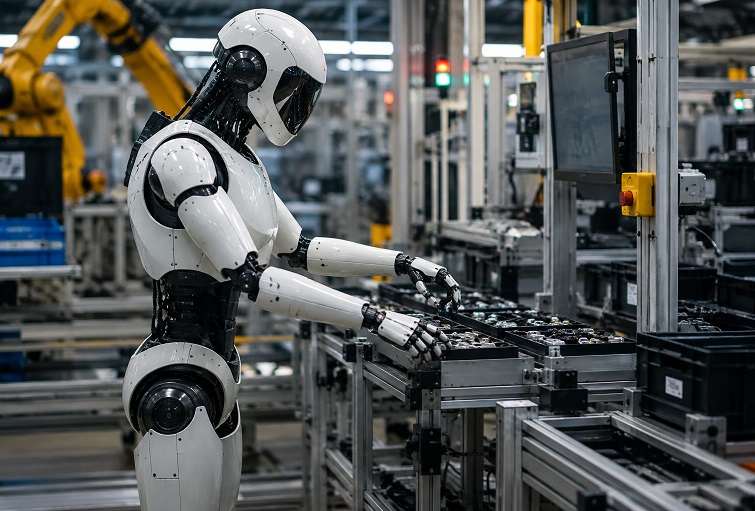
Humanoid robotics introduces a different proposition. Instead of adapting the factory around a machine, the objective is to create a machine capable of operating within environments originally designed for humans. That could eventually have enormous value, particularly in facilities where existing infrastructure is difficult or expensive to modify. However, achieving this economically and reliably remains a significant engineering challenge.
Demonstrations Are Not the Same as Industrial Deployment
One of the biggest misconceptions surrounding advanced robotics is the assumption that successful task completion in a demonstration indicates industrial readiness.
A laboratory robot can operate under carefully controlled conditions. Engineers can select the objects it encounters, optimize lighting, define the workspace, tune the software, and repeat an experiment until the desired result is obtained. A video may show the successful attempt without revealing how many failed attempts preceded it.
A production environment is fundamentally different.
An industrial robot may be expected to perform the same operation hundreds of thousands or millions of times per year. Components may arrive in slightly different orientations. Lighting conditions can change. Surfaces become contaminated. Tooling wears out. Materials vary within manufacturing tolerances. Operators enter the workspace. Sensors occasionally produce incorrect measurements. Communication networks experience interruptions.
Industrial automation therefore has to be evaluated statistically rather than by whether a machine can complete a task once.
Metrics such as mean time between failures, cycle-time consistency, availability, recovery time, maintenance requirements, and first-pass yield are often more important than the maximum capability demonstrated by a robot.
This is particularly relevant to humanoids because their mechanical architecture is considerably more complex than that of many conventional industrial robots.
Dexterous Manipulation Remains a Major Challenge
Human hands are extraordinarily versatile mechanical systems. They combine many degrees of freedom with tactile perception, visual feedback, fine motor control, and decades of learned motor behavior.
Replicating this capability in a robot is difficult.
A humanoid may have sophisticated cameras and force sensors, but manipulating an object reliably requires much more than recognizing its shape. The robot must estimate its position, determine an appropriate grasp, control contact forces, compensate for friction and compliance, and react when the object behaves differently than expected.
Consider a simple manufacturing operation such as picking a component from a container. A human can immediately compensate if the component is partially covered, slippery, rotated differently, or stuck to another part. A robotic system must have sensing and control algorithms capable of handling these variations.
Five-fingered robotic hands can provide a wide range of possible manipulation strategies, but additional degrees of freedom also increase the number of components, actuators, sensors, control parameters, and potential failure points.
For a manufacturing engineer, the question is therefore not whether a humanoid hand can manipulate an object. The relevant question is whether it can do so reliably enough to justify its cost and maintenance requirements.
Reliability Is More Important Than Versatility
Manufacturing systems are designed around predictable output.
A robot that can perform 50 different operations but requires frequent intervention may be less valuable than a specialized machine that performs one operation extremely reliably.
This is one of the strongest arguments for purpose-built automation.
A dedicated robotic cell can be engineered around a specific process. The robot, tooling, sensors, safety systems, and software can all be optimized for a known task. The resulting system may have limited flexibility, but its behavior is highly predictable.
Humanoids take the opposite approach. Their potential advantage comes from versatility. A single platform could theoretically move between tasks without requiring major changes to the production line. It could pick up components, operate tools, move materials, open doors, and interact with equipment designed for human workers.
That flexibility has significant potential value, particularly for low-volume manufacturing and facilities with frequent product changes. However, versatility only becomes economically attractive if the robot can maintain sufficient reliability across all of those tasks.
A general-purpose machine that requires constant supervision is not truly general purpose from an operational perspective.
Safety Creates Another Engineering Constraint
Safety is another area where humanoid robots face a difficult path to industrial adoption.
Traditional industrial robots generally operate within well-defined workspaces. Their movements, payloads, speeds, and trajectories can be analyzed during system design. Collaborative robots introduce additional safety considerations, but their operating envelopes are still relatively well understood.
Humanoids combine several characteristics that complicate safety engineering: substantial mass, dynamic movement, two-legged locomotion, articulated arms, and potentially high-speed changes in posture and direction.
A loss of balance is an obvious example. A stationary robotic arm does not normally fall over. A bipedal robot can.
The consequences of a failure also depend on the environment. A humanoid operating near workers, machinery, electrical equipment, or hazardous materials requires comprehensive risk analysis covering both normal operation and foreseeable failures.
This means that industrial deployment cannot depend solely on advances in AI perception or motion planning. Mechanical safety, redundant sensing, fault detection, emergency stopping, safe-state behavior, and certification requirements remain essential.
The Economics of Automation Matter
Technical feasibility is only one part of an automation decision.
Manufacturers typically evaluate an automation project using metrics such as:
- Capital expenditure
- Operating cost
- Labor savings
- Throughput improvement
- Product quality
- Scrap and rework reduction
- Equipment availability
- Maintenance requirements
- Integration cost
- Expected service life
- Return on investment
A humanoid robot may eventually offer a compelling advantage if it can be deployed without extensive modification of existing facilities. Human-oriented factories already contain doors, shelves, workbenches, carts, tools, and control interfaces. A machine capable of navigating and manipulating these systems could potentially enter an existing workflow without rebuilding the entire production environment.
This is one of the strongest arguments for humanoids.
However, the calculation changes if the robot requires specialized technicians, frequent software intervention, expensive replacement components, or significant downtime. A purpose-built automation system may require more initial engineering but deliver substantially lower operating costs over its lifetime.
Consequently, the right comparison is not humanoid versus conventional robot in abstract terms. It is total system cost versus production value for a particular application.
Where Purpose-Built Robots Still Have the Advantage
Purpose-built automation remains the dominant choice for many established manufacturing processes because it is optimized around specific requirements.
For example, a robotic arm mounted on a fixed base can be designed for high-speed pick-and-place operations, welding, dispensing, assembly, or machine tending. An autonomous mobile robot can be optimized for transporting materials between production zones. Automated guided vehicles can follow predefined routes with highly predictable behavior.
Machine vision can be integrated specifically for inspection, measurement, and quality control. Dedicated end effectors can be designed around individual components. Programmable logic controllers and industrial networks provide deterministic control over production equipment.
The result is an ecosystem in which each subsystem performs a defined function exceptionally well.
This architecture is particularly attractive for high-volume production because even a small improvement in cycle time or availability can produce significant financial benefits.
Humanoids become more interesting where this model breaks down, particularly when the number of tasks is large, production volumes are relatively low, and reconfiguring automation for every new product is economically impractical.
Humanoids May Be Most Valuable in Existing Human Workspaces
The strongest near-term business case for humanoids may therefore not be replacing conventional industrial robots.
It may be automating tasks that are currently difficult to automate because the surrounding environment was designed specifically for humans.
Warehouses and factories contain enormous numbers of existing workstations and processes based on human ergonomics. Rebuilding these facilities around specialized robots can require substantial investment.
A humanoid could potentially use the same physical infrastructure as a human operator. It could walk through aisles, reach shelves, manipulate containers, use hand tools, and interact with equipment.
This capability could be particularly valuable in applications such as material handling, machine tending, kitting, inspection, and repetitive assembly.
However, this advantage depends on the robot being capable of operating safely and reliably in unstructured environments. If a facility must still be redesigned extensively to accommodate the humanoid, much of its theoretical advantage disappears.
AI Is Important, but It Does Not Eliminate the Engineering Problem
Recent advances in machine learning, computer vision, reinforcement learning, and multimodal AI are changing what robots can perceive and how they can make decisions.
Foundation models can potentially allow robots to interpret natural-language instructions and generalize knowledge across tasks. Vision-language-action systems are also being developed to connect visual observations, language instructions, and physical actions.
These technologies could significantly improve robot adaptability.
Nevertheless, intelligence does not remove physical constraints.
A neural network can identify an object, but the robot still needs an actuator capable of generating sufficient force. A planning model can determine that a component needs to be moved, but the manipulator must actually grasp it. A perception system can recognize an obstacle, but the robot must be able to stop or change direction within the available space.
The final system therefore depends on the interaction between AI software, sensors, actuators, control algorithms, mechanical design, and safety architecture.
For industrial robotics, software intelligence and physical engineering cannot be treated as separate problems.
Deployment and Maintenance Are Part of the Product
Another important consideration is what happens after installation.
A robot that works during a pilot project but requires specialized engineers every time its environment changes is difficult to scale across hundreds of production sites.
Manufacturers need standardized deployment procedures, remote diagnostics, spare-parts availability, software update mechanisms, cybersecurity controls, training, and clear maintenance processes.
This is particularly important for global manufacturers operating factories in multiple countries. Automation platforms have to be replicated across sites while accounting for local regulations, workforce requirements, network infrastructure, and production processes.
Purpose-built robotics has an advantage here because the technology and operating conditions can be tightly standardized.
Humanoid platforms will need to demonstrate the same level of operational maturity before they can become a mainstream manufacturing technology.
A Hybrid Factory Is More Likely Than a Humanoid Factory
The debate is sometimes presented as a choice between humanoid robots and traditional automation. In practice, manufacturing is more likely to adopt a combination of technologies.
A factory could use fixed robotic arms for high-speed assembly, autonomous mobile robots for material transportation, machine vision for inspection, and humanoid robots for tasks that require flexible manipulation or interaction with existing human-oriented infrastructure.
Such a hybrid architecture allows manufacturers to use each technology where it provides the greatest economic value.
The same principle applies to AI. A robot does not need to be universally intelligent to provide value. It needs to be sufficiently capable for the specific operational problem it is solving.
How Manufacturers Should Evaluate Humanoid Robotics
Manufacturing companies considering humanoid robots should start with the process rather than the technology.
The first step is to identify operations where existing automation is difficult or expensive to implement. These may involve frequent product changes, complex manual handling, variable object positions, or workspaces that are impractical to redesign.
The next step is to establish measurable requirements. These should include cycle time, acceptable error rate, uptime, payload, reach, operating hours, safety constraints, maintenance intervals, and recovery procedures.
Pilot projects should then be evaluated over sustained operation rather than a small number of successful demonstrations.
A useful industrial trial should answer practical questions:
Can the robot maintain the required cycle time?
How often does human intervention become necessary?
How does performance change when components vary?
What happens after a failed grasp or unexpected obstacle?
How quickly can the system recover?
What level of technical expertise is required to maintain it?
What is the total cost per completed operation?
These measurements provide far more useful information than a demonstration of maximum capability.
The Real Question Is Not Whether Humanoids Will Win
Humanoid robotics is progressing rapidly, and it would be premature to dismiss its long-term industrial potential. Advances in actuators, batteries, sensors, embedded computing, machine learning, and robotic control are steadily addressing many of the limitations that have historically restricted mobile manipulation.
At the same time, manufacturers should resist the temptation to adopt a technology simply because it represents the latest stage of robotics development.
Factories are optimized around production economics, not technological novelty.
For highly repetitive and predictable operations, specialized automation is likely to remain difficult to beat. For flexible tasks in human-oriented environments, humanoids may eventually offer a compelling alternative. In between these extremes, hybrid solutions will probably become increasingly common.
The most important measure of progress will therefore not be how convincingly a humanoid can walk, dance, or complete a carefully selected demonstration. It will be whether the machine can operate for months on a production floor, perform its assigned tasks consistently, recover from failures, meet safety requirements, and generate a measurable economic return.
That is the point at which humanoid robotics stops being a demonstration technology and becomes manufacturing equipment.